
Hinged Dissection: 2 Cubes to Rhombic Dodecahedron
Loading the math board and drawing, please wait…
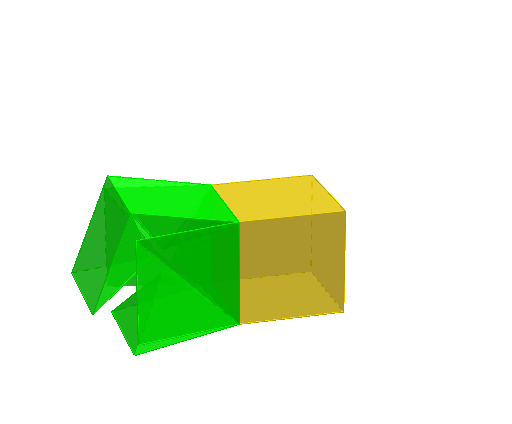
This example demonstrates how two cubes can be hinged to form a rhombic dodecahedron. Key mathematical concepts include solid geometry, spatial transformations, and geometric construction. The construction involves GeoGebra commands such as Intersect, Mirror, Cube, Pyramid, and Rotate, along with manipulating multiple faces and edges. Suitable for high school students or college freshmen learning spatial geometry and visualization skills.
GeoGebra Commands & Parameters
Intersect(yAxis, zAxis) → APoint(xAxis) → BMirror(B, A) → B'Point(Circle[B, Distance[A, B], Segment[A, B]]) → CCube(A, B, C) → a, D, faceCDHG, faceEFGH, edgeAD, edgeAB, edgeBC, edgeCD, edgeAE, edgeDH, edgeEH, edgeEF, E, edgeBF, edgeFG, edgeCG, edgeGH, F, G, H, faceABCD, faceADHE, faceABFE, faceBCGFPoint(Circle[A, Distance[B', A], Segment[B', A]]) → ICube(B', A, I) → b, J, faceIJNM_1, faceKLMN_1, edgeB'J_1, edgeAB'_1, edgeAI_1, edgeIJ_1, edgeB'K_1, edgeJN_1, edgeKN_1, edgeKL_1, K, edgeAL_1, edgeLM_1, edgeIM_1, edgeMN_1, L, M, N, faceAB'JI_1, faceB'JNK_1, faceAB'KL_1, faceAIML_1Midpoint(J, L) → OPyramid(J, N, M, I, O) → c, faceIJNM, edgeJO_1, edgeNO_1, edgeMO_1, edgeIO_1, faceJNO_1, faceMNO_1, faceIMO_1, faceIJO_1, edgeJN_2, edgeMN_2, edgeIM_2, edgeIJ_2Pyramid(I, J, B', A, O) → d, faceAB'JI, edgeIO_2, edgeJO_2, edgeB'O_1, edgeAO_1, faceIJO, faceB'JO_1, faceAB'O_1, faceAIO_1, edgeIJ, edgeB'J_2, edgeAB'_2, edgeAI_2Pyramid(I, A, L, M, O) → e, faceAIML, edgeIO, edgeAO_2, edgeLO_1, edgeMO_2, faceAIO, faceALO_1, faceLMO_1, faceIMO, edgeAI, edgeAL_2, edgeLM_2, edgeIMPyramid(J, N, K, B', O) → f, faceB'JNK, edgeJO, edgeNO_2, edgeKO_1, edgeB'O_2, faceJNO, faceKNO_1, faceB'KO_1, faceB'JO, edgeJN, edgeKN_2, edgeB'K_2, edgeB'JPyramid(B', A, L, K, O) → g, faceAB'KL, edgeB'O, edgeAO, edgeLO_2, edgeKO_2, faceAB'O, faceALO, faceKLO_1, faceB'KO, edgeAB', edgeAL, edgeKL_2, edgeB'KPyramid(N, M, L, K, O) → h, faceKLMN, edgeNO, edgeMO, edgeLO, edgeKO, faceMNO, faceLMO, faceKLO, faceKNO, edgeMN, edgeLM, edgeKL, edgeKNRotate(h, ((-n) * π), Segment[H, E]) → h'Rotate(N, ((-n) * π), Segment[H, E]) → N'Rotate(K, ((-n) * π), Segment[H, E]) → K'Rotate(f, ((-n) * π), Segment[H, E]) → f'Rotate(f', ((-n) * π), Segment[N', K']) → f''Rotate(d, ((-n) * π), Segment[A, D]) → d'Rotate(c, (n * π), Segment[H, D]) → c'Rotate(g, (n * π), Segment[A, E]) → g'
AI Drawing Prompt Reference
Draw the process of transforming two cubes into a rhombic dodecahedron by hinging them. Start by creating two cubes, then use mirroring and rotating to transform their edges and faces, ultimately forming the rhombic dodecahedron. Ensure the spatial geometric relationships are correct.
The prompt above was compiled from the original drawing commands and is for reference only.