
Hidden Symmetry in an Atom
Loading the math board and drawing, please wait…
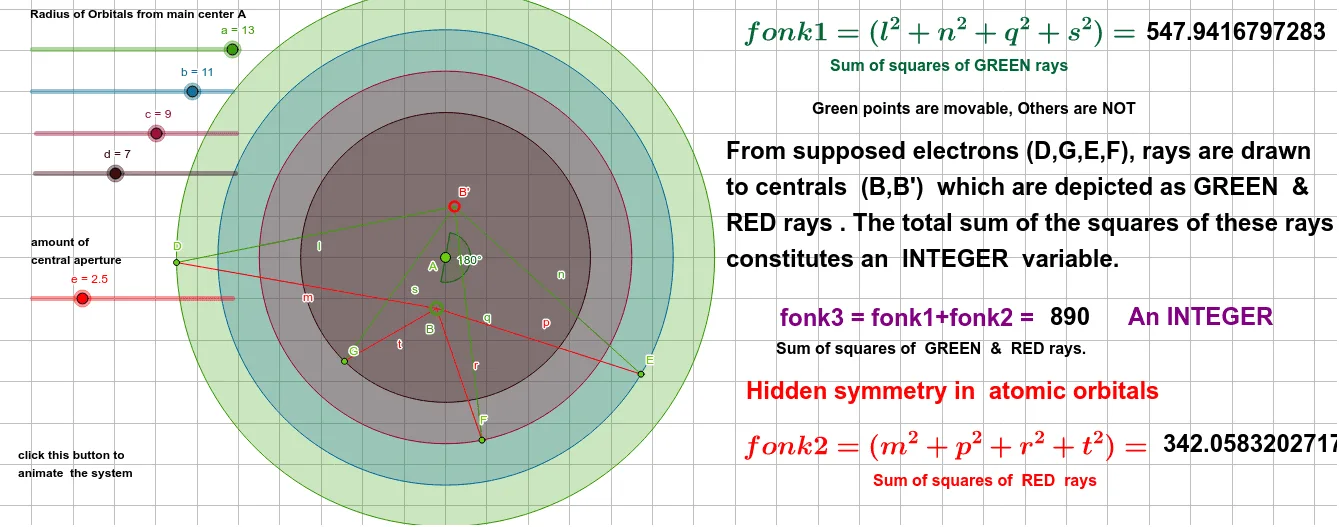
This example demonstrates the hidden symmetry phenomenon in atomic structures. It involves core mathematical concepts such as geometric distribution, geometric mean, symmetry, geometric transformations, and random experiments. The construction utilizes GeoGebra commands/objects like Circle, Point, Segment, Rotate, and Angle. Suitable for high school students and mathematics enthusiasts studying symmetry and geometric transformations.
GeoGebra Commands & Parameters
Circle(A, a) → fCircle(A, b) → gCircle(A, c) → hCircle(A, d) → kPoint(Circle[A, e]) → BSegment(A, B) → iPoint(Circle[A, e]) → CSegment(A, C) → jRotate(B, 180°, A) → B'Angle(B, A, B') → αPoint(f) → DPoint(g) → EPoint(h) → FPoint(k) → GSegment(D, B') → lSegment(D, B) → mSegment(E, B') → nSegment(E, B) → pSegment(F, B') → qSegment(F, B) → rSegment(G, B') → sSegment(G, B) → t
AI Drawing Prompt Reference
Draw a center point and create four circles of different sizes around it. Take points on each circle and connect the center to these points with line segments. Rotate one point by 180 degrees and measure the angle of rotation. From the rotated and original points, draw line segments to points on the circumferences of the other three circles, forming a symmetrical geometric pattern that reveals hidden symmetry.
The prompt above was compiled from the original drawing commands and is for reference only.