
Henry Perigal's Dynamic Proof of Pythagoras' Theorem
Loading the math board and drawing, please wait…
In collections
GCSE Higher Ch5 Angles & Trigonometry
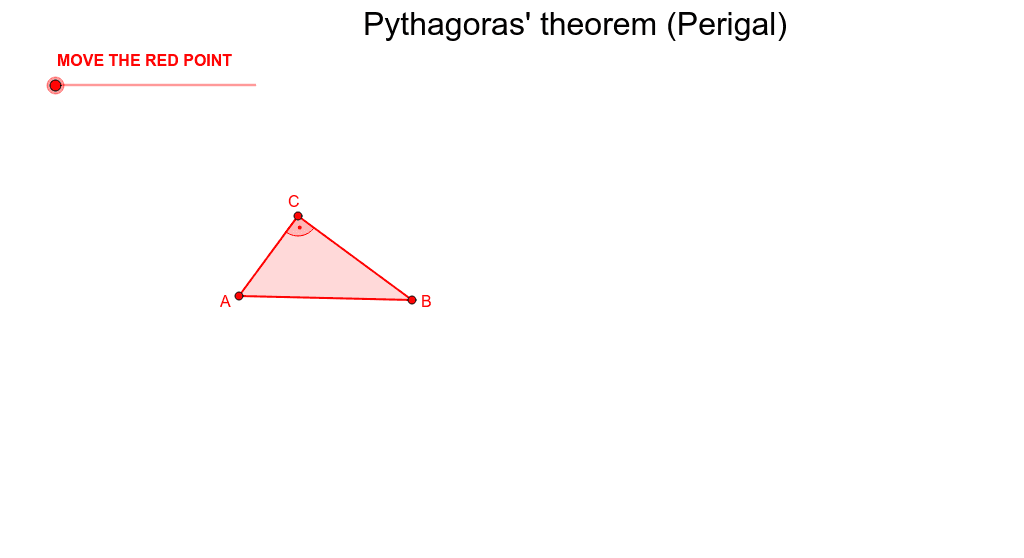
This example demonstrates a dynamic proof of Pythagoras' theorem created by Henry Perigal, visually splitting and reassembling shapes to illustrate the theorem. Key mathematical concepts include Pythagorean theorem, geometric proof, and shape transformation. GeoGebra commands and objects used in construction are Polygon, Semicircle, Point, OrthogonalLine, Segment, Angle, Line, Intersect, Vector, and Translate. Suitable for high school mathematics education to enhance understanding and application of the Pythagorean theorem.
GeoGebra Commands & Parameters
Polygon(B, A, 4) → mnohoúhelník4, l, m, n, p, H, ISemicircle(A, B) → cPoint(c) → CPolygon(A, B, C) → mnohoúhelník1, c_1, a_1, bOrthogonalLine(C, c_1) → d_1Segment(A, B) → aAngle(A, C, B) → αPolygon(C, B, 4) → mnohoúhelník2, d, e, f, g, D, EPolygon(A, C, 4) → mnohoúhelník3, h, i, j, k, F, GLine(D, E) → qLine(G, F) → rSegment(E, B) → sSegment(D, C) → tIntersect(s, t) → JLine(J, n) → b_1OrthogonalLine(J, b_1) → e_1Intersect(f, e_1) → KIntersect(b_1, e) → LIntersect(b_1, g) → MIntersect(e_1, a_1) → NSegment(K, N) → f_1Segment(M, L) → g_1Polygon(C, N, J, M) → mnohoúhelník5, c_2, n_1, j_1, m_1Polygon(K, J, L, D) → mnohoúhelník6, k_1, j_2, l_1, d_2Polygon(K, E, M, J) → mnohoúhelník7, k_2, e_2, m_2, j_3Polygon(B, N, J, L) → mnohoúhelník8, b_2, n_2, j_4, l_2Segment(F, A) → h_1Segment(G, C) → i_1Intersect(h_1, i_1) → OSegment(I, A) → p_1Segment(H, B) → q_1Intersect(p_1, q_1) → PVector(O, P) → uTranslate(mnohoúhelník3, u) → mnohoúhelník3'Translate(mnohoúhelník3, Vector[(u * (o - 1.2))]) → mnohoúhelník3'_1Vector(J, B) → vTranslate(C, v) → C'Translate(N, v) → N'Translate(J, v) → J'Translate(M, v) → M'Polygon(C', N', J', M') → mnohoúhelník5', c', n', j', m'Translate(C, Vector[(v * (o - 0.2))]) → C'_1Translate(N, Vector[(v * (o - 0.2))]) → N'_1Translate(J, Vector[(v * (o - 0.2))]) → J'_1Translate(M, Vector[(v * (o - 0.2))]) → M'_1Polygon(C'_1, N'_1, J'_1, M'_1) → mnohoúhelník5'_1, c'_1, n'_1, j'_1, m'_1Vector(J, H) → wTranslate(K, Vector[(w * (o - 0.2))]) → K'Translate(J, Vector[(w * (o - 0.2))]) → J'_2Translate(L, Vector[(w * (o - 0.2))]) → L'Translate(D, Vector[(w * (o - 0.2))]) → D'Polygon(K', J'_2, L', D') → mnohoúhelník6', k', j'_2, l', d'Translate(K, w) → K'_1Translate(J, w) → J'_3Translate(L, w) → L'_1Translate(D, w) → D'_1Polygon(K'_1, J'_3, L'_1, D'_1) → mnohoúhelník6'_1, k'_1, j'_3, l'_1, d'_1Vector(J, I) → zTranslate(K, z) → K'_2Translate(E, z) → E'Translate(M, z) → M'_2Translate(J, z) → J'_4Polygon(K'_2, E', M'_2, J'_4) → mnohoúhelník7', k'_2, e', m'_2, j'_4Translate(K, Vector[(z * (o - 0.2))]) → K'_3Translate(E, Vector[(z * (o - 0.2))]) → E'_1Translate(M, Vector[(z * (o - 0.2))]) → M'_3Translate(J, Vector[(z * (o - 0.2))]) → J'_5Polygon(K'_3, E'_1, M'_3, J'_5) → mnohoúhelník7'_1, k'_3, e'_1, m'_3, j'_5Vector(J, A) → u_1Translate(B, u_1) → B'Translate(N, u_1) → N'_2Translate(J, u_1) → J'_6Translate(L, u_1) → L'_2Polygon(B', N'_2, J'_6, L'_2) → mnohoúhelník8', b', n'_2, j'_6, l'_2Translate(B, Vector[(u_1 * (o - 0.2))]) → B'_1Translate(N, Vector[(u_1 * (o - 0.2))]) → N'_3Translate(J, Vector[(u_1 * (o - 0.2))]) → J'_7Translate(L, Vector[(u_1 * (o - 0.2))]) → L'_3Polygon(B'_1, N'_3, J'_7, L'_3) → mnohoúhelník8'_1, b'_1, n'_3, j'_7, l'_3
AI Drawing Prompt Reference
Draw a dynamic proof of the Pythagorean theorem created by Henry Perigal, visually splitting and reassembling shapes to illustrate the theorem. The diagram includes a quadrilateral and two semicircles, with triangles and other geometric shapes derived from them. Draw the quadrilateral and semicircles first, then add perpendicular lines, edges, and angles, and find their intersections. Finally, show how the shapes can be reassembled by translating and rotating them to prove the Pythagorean theorem.
The prompt above was compiled from the original drawing commands and is for reference only.