
Dynamic Proof of the Law of Sines for Acute Angle
Loading the math board and drawing, please wait…
In collections
Grade 12 Calculus & Vectors MCV4U1
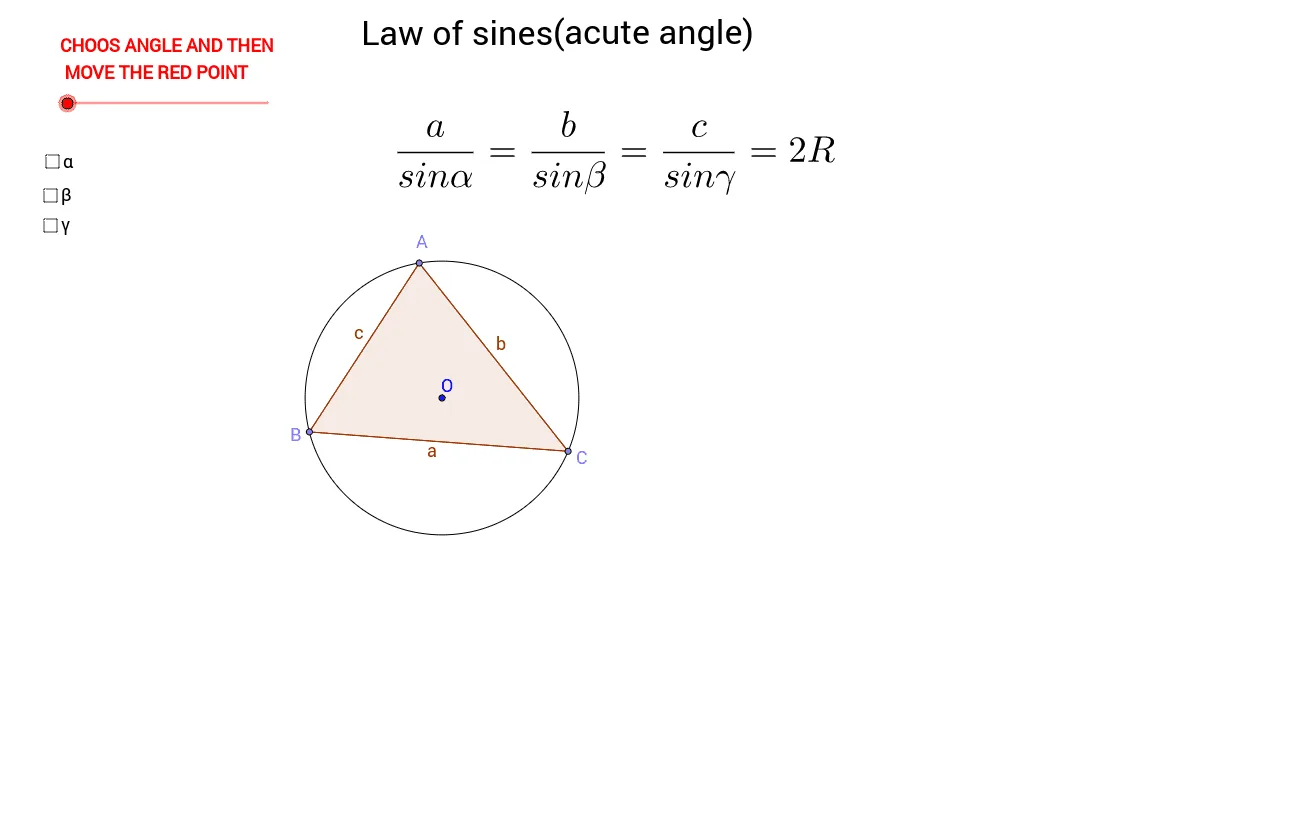
This example dynamically demonstrates the law of sines for acute angles. It involves the concept of trigonometry, specifically sine. Using GeoGebra commands such as Circle, Point, Polygon, and operations like rotation and intersection, a triangle is constructed to visually prove the law of sines. Suitable for high school mathematics education and learning.
GeoGebra Commands & Parameters
Circle(O, P) → cPoint(c) → APoint(c) → BPoint(c) → CPolygon(A, B, C) → mnohoúhelník1, e, c_1, dAngle(B, A, C) → α_1Angle(A, C, O) → βIf(a < 1, a, 1) → alfaLine(C, A) → bRotate(b, alfa * β, C) → b'Intersect(c, b') → D, EAngle(C, E, B) → γAngle(B, E, C) → α_2Polygon(B, C, E) → mnohoúhelník2, e_1, b_1, c_2Angle(C, B, E) → αIf(a < 1, 0, If[a < 2, a - 1, 1]) → betaRotate(B, (beta * 90)°, F) → B'Rotate(C, (beta * 90)°, F) → C'Rotate(E, (beta * 90)°, F) → E'Polygon(B', C', E') → mnohoúhelník2', e', b'_1, c'Angle(C', B', E') → δAngle(B', E', C') → εAngle(C, B, A) → ζAngle(A, C, B) → ηLine(A, B) → iAngle(B, A, O) → θRotate(i, alfa * θ, A) → i'Intersect(c, i') → G, HPolygon(C, A, H) → mnohoúhelník3, h_1, c_3, a_1Angle(C, H, A) → ιAngle(A, C, H) → κRotate(C, -((beta * 35)°), I) → C'_1Rotate(A, -((beta * 35)°), I) → A'Rotate(H, -((beta * 35)°), I) → H'Polygon(C'_1, A', H') → mnohoúhelník3', h', c'_1, a'Angle(C'_1, H', A') → λAngle(A', C'_1, H') → μLine(B, C) → jAngle(C, B, O) → νRotate(j, alfa * ν, B) → j'Intersect(c, j') → J, KPolygon(A, B, K) → mnohoúhelník4, k, a_2, b_2Angle(B, A, K) → ξAngle(A, K, B) → οRotate(A, -((beta * 147)°), L) → A'_1Rotate(B, -((beta * 147)°), L) → B'_1Rotate(K, -((beta * 147)°), L) → K'Polygon(A'_1, B'_1, K') → mnohoúhelník4', k', a'_1, b'_2Angle(B'_1, A'_1, K') → ρAngle(A'_1, K', B'_1) → σ
AI Drawing Prompt Reference
Draw a dynamic illustration of the Law of Sines for acute angles. Start by drawing a circle and marking three points on it to form a triangle, labeling the angles. Then, use rotation and intersection to visually demonstrate the Law of Sines, showing the relationship between angles and side lengths. Include elements like triangles, rotated lines, and intersection points to highlight the geometric proof.
The prompt above was compiled from the original drawing commands and is for reference only.