
Dynamic Proof of Euler's Formula for Polyhedra
Loading the math board and drawing, please wait…
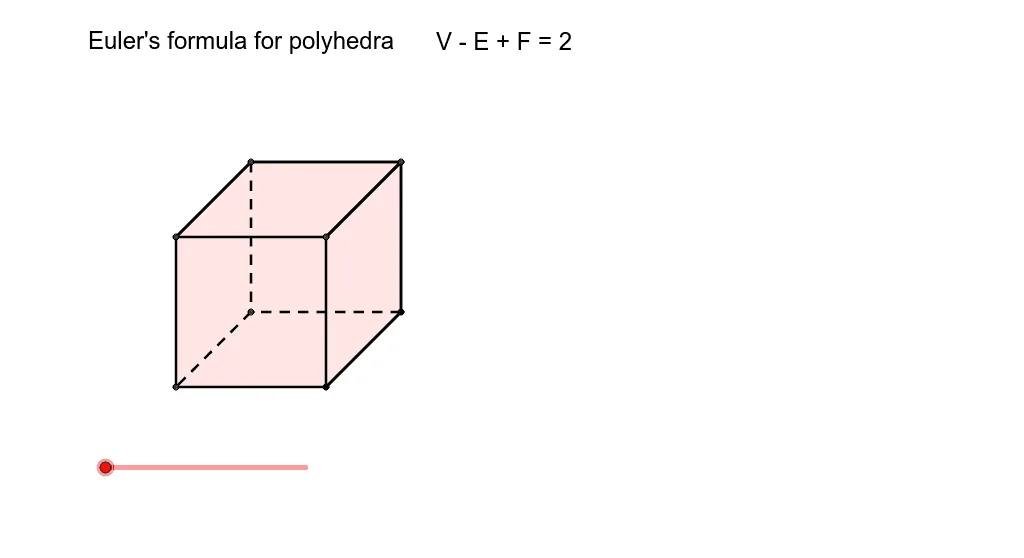
This example dynamically demonstrates the topological proof of Euler's formula for polyhedra, involving core concepts like vertices(V), edges(E), faces(F), and the formula V-E+F=2. It uses GeoGebra commands such as Intersect, Polygon, Segment, Vector, Translate, Circle, and Rotate to construct polyhedral models. Suitable for high school students and math enthusiasts studying topology and geometric proofs.
GeoGebra Commands & Parameters
Intersect(xAxis, yAxis) → APoint(xAxis) → BPolygon(A, B, 4) → mnohoúhelník1, a, b, c, d, C, DSegment(A, C) → eSegment(B, D) → fIntersect(f, e) → EVector(A, E) → uTranslate(B, u) → B'Translate(C, u) → C'Translate(D, u) → D'Segment(D, D') → gSegment(D', C') → hSegment(C', B') → iSegment(B', B) → jSegment(C, C') → kSegment(D', E) → lSegment(B', E) → mSegment(E, A) → nPolygon(D, C, C', D') → mnohoúhelník2, d_1, c_1, c', d'Polygon(B, B', C', C) → mnohoúhelník3, b_1, b', c'_1, c_2Intersect(c, d_1) → FIntersect(l, c) → GIntersect(m, b) → HSegment(E, H) → sSegment(E, G) → pSegment(A, E) → qCircle(C, A) → rRotate(A, 90*°, C) → A'Rotate(A', 90*°, C) → A''Rotate(A'', 90*°, C) → A'''Vector(D, A''') → vVector(C, A'') → wVector(B, A') → tTranslate(D, Vector[((o - 0.1) * v)]) → D'_1Translate(C, Vector[((o - 0.1) * w)]) → C'_1Translate(B, Vector[((o - 0.1) * t)]) → B'_1Segment(D'_1, D') → a_1Segment(C', C'_1) → e_1Segment(D'_1, A) → f_1Segment(D'_1, C'_1) → g_1Segment(B', B'_1) → h_1Segment(A, B'_1) → i_1Segment(C'_1, B'_1) → j_1Segment(A''', A) → k_1Segment(A''', A'') → l_1Segment(A, A') → m_1Segment(A'', A') → n_1Segment(A''', D') → p_1Segment(C', A'') → q_1Segment(A', B') → r_1Polygon(D'_1, C'_1, C', D') → mnohoúhelník4, d'_1, c'_2, c'_3, d'_2Polygon(C'_1, B'_1, B', C') → mnohoúhelník5, c'_4, b'_1, b'_2, c'_5Intersect(g_1, l) → ISegment(E, I) → s_1Segment(D', E) → t_1Segment(E, B') → a_2Intersect(m, j_1) → JSegment(E, J) → b_2Segment(A''', E) → d_2Segment(E, C') → e_2Segment(D', A'') → f_2Segment(C', A') → g_2Segment(B', A) → h_2Translate(A'', Vector[((3.2 - o) * w)]) → A'''_1Translate(A'', Vector[(-w)]) → A'''_2Translate(A', Vector[((3.2 - o) * t)]) → A''_1Translate(A', Vector[(-t)]) → A''_2Translate(A''', Vector[((3.2 - o) * v)]) → KTranslate(A''', Vector[(-v)]) → LSegment(K, A) → i_2Segment(A, A''_1) → j_2Segment(K, A'''_1) → k_2Segment(A'''_1, A''_1) → l_2Segment(K, D') → m_2Segment(C', A'''_1) → n_2Segment(B', A''_1) → p_2Segment(L, A) → q_2Segment(A, A''_2) → r_2Segment(A'''_2, A''_2) → s_2Segment(L, A'''_2) → t_2Segment(L, D') → a_3Segment(A'''_2, C') → b_3Segment(A''_2, B') → c_3Intersect(k_2, t_1) → MSegment(M, E) → d_3Segment(D', M) → e_3Segment(D', E) → f_3Intersect(a_2, l_2) → NSegment(E, N) → h_3Segment(E, B') → i_3Segment(E, B') → g_3Polygon(D', K, A'''_1, C') → mnohoúhelník6, d'_3, k_3, a'''_1, c'_6Polygon(A'''_1, A''_1, B', C') → mnohoúhelník7, a'''_2, a''_1, b'_3, c'_7Polygon(L, A'''_2, C', D') → mnohoúhelník8, l_3, a'''_3, c'_8, d'_4Polygon(A'''_2, A''_2, B', C') → mnohoúhelník9, a'''_4, a''_2, b'_4, c'_9Polygon(A, A''_2, A'''_2, L) → mnohoúhelník10, a_4, a''_3, a'''_5, l_4
AI Drawing Prompt Reference
Draw a dynamic topological proof of Euler's formula for polyhedra. Start with a quadrilateral base and draw its diagonals intersecting at the center. From the center, create vectors to each base vertex and translate the base vertices along these vectors to form a corresponding upper quadrilateral, connecting corresponding vertices to form a prism. Inside the prism, connect the center to each translated vertex and base vertex to form internal triangular faces. Then, using one base vertex as a center, rotate to generate three auxiliary points, and use these to define three translation vectors. Translate each base vertex along its corresponding vector to create offset vertices. Connect these offset vertices to the original vertices and auxiliary points, forming multiple triangles and quadrilaterals that illustrate the topological relationships among faces, edges, and vertices, ultimately demonstrating Euler's formula V-E+F=2.
The prompt above was compiled from the original drawing commands and is for reference only.