
Half-Life Demonstration
Loading the math board and drawing, please wait…
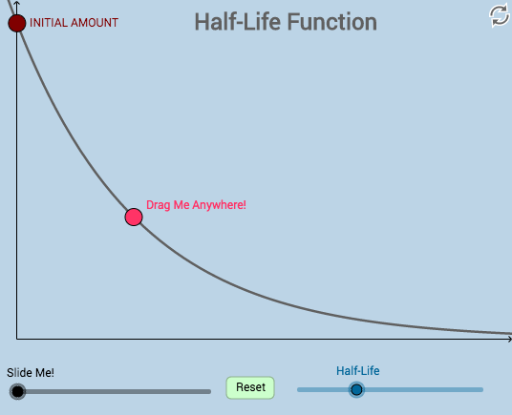
This example illustrates the concept of half-life in radioactive substances, demonstrating that it is independent of the initial amount. Key mathematical concepts include exponential decay, independence, and mathematical modeling. It utilizes commands like Textfield, Intersect, Segment, Midpoint, Dilate, Rotate, Integral, Ray, Point, Vector, and Translate in GeoGebra for construction. Suitable for high school students and teachers to understand radioactive decay and calculus applications.
GeoGebra Commands & Parameters
Textfield(a_0) → InputBox1Textfield(k) → InputBox2Intersect(A, b, (315.1, 600)) → DIntersect(A, c, (630.2, 300)) → EIntersect(A, d, (945.3000000000001, 150)) → FIntersect(A, e, (1260.4000000000003, 74.99999999999994)) → GTextfield(f) → InputBox3Intersect(b, h) → HSegment(H, D) → iIntersect(c, j) → IIntersect(d, l) → JSegment(I, E) → mSegment(J, F) → nSegment(D, I) → pSegment(E, J) → qIntersect(h, s) → KIntersect(r, t) → LSegment(K, C) → f_1Segment(C, L) → g_1Midpoint(M, Initial) → NDilate(M, If[0 < o ≤ 1, 1 - o, 0], N) → M'Rotate(M, If[1 < o ≤ 2, ((o - 1) * π), π], N) → M'_1Rotate(M', If[1 < o ≤ 2, ((o - 1) * π), π], N) → M''Dilate(N, If[2 < o ≤ 3, 3 - o, 0], D) → N'Segment(N, N') → j_1Dilate(Initial, If[0 < o ≤ 1, 1 - o, 0], N) → B'Segment(Initial, B') → h_1Rotate(Initial, If[1 < o ≤ 2, ((-(o - 1)) * π), (-π)], N) → B'_1Rotate(B', If[1 < o ≤ 2, ((-(o - 1)) * π), (-π)], N) → B''Segment(B'_1, B'') → i_1Rotate(N', If[6 < o ≤ 7, ((-(o - 6)) * π), (-π)], D) → N''Integral(A, 0, Infinity) → o_1Ray((0, 0), (1, 0)) → g_2Textfield(u_1) → InputBox4Textfield(val) → InputBox5Point(A) → RIntersect(k_1, y = 0) → SMidpoint(R, S) → UIntersect(A, l_1, (747.0739488341455, 231.98826691092705)) → WDilate(R, If[3 < o ≤ 4, 4 - o, 0], U) → R'Segment(R, R') → m_1Dilate(U, If[4 < o ≤ 5, 5 - o, 0], S) → U'Segment(U, U') → n_1Rotate(R, If[5 < o ≤ 6, ((-(o - 5)) * π), (-π)], U) → R'_1Rotate(R', If[5 < o ≤ 6, ((-(o - 5)) * π), (-π)], U) → R''Segment(R'_1, R'') → p_1Dilate(U, If[6 < o ≤ 7, 7 - o, 0], W) → U'_1Segment(U, U'_1) → t_1Dilate(N, If[7 < o ≤ 8, 8 - o, 0], U) → N'_1Vector(N, N'_1) → uTranslate(N, u) → N'_2Translate(N', u) → N''_1Segment(N'_2, N''_1) → a_1
AI Drawing Prompt Reference
Create a visualization demonstrating the concept of half-life in radioactive substances, showing independence from initial amount. Include input fields for initial quantity and decay rate, along with intersecting points, segments, and midpoints to form an exponential decay curve. Use integral and vector tools for mathematical modeling, suitable for high school students to understand radioactive decay and calculus applications.
The prompt above was compiled from the original drawing commands and is for reference only.