
Grass Blade Problem
Loading the math board and drawing, please wait…
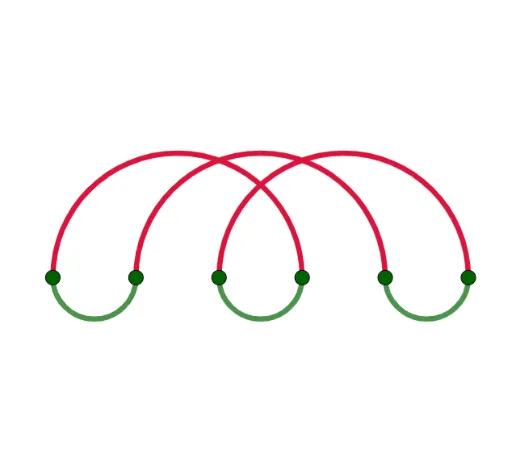
This example demonstrates the grass blade problem, involving concepts such as binomial distribution, combinatorics, and hypergeometric distribution. Using GeoGebra commands like Shuffle, Sequence, and Semicircle, it constructs random experiments and statistical characteristics of random variables. Suitable for high school or university statistics courses.
GeoGebra Commands & Parameters
Shuffle(tips) → l1Sequence(IndexOf[l1(w), tips], w, 1, 6) → l2Semicircle(A2, A1) → cSemicircle(B2, B1) → dSemicircle(C2, C1) → eSequence(Semicircle[tips(l4(w)), tips(l4(w + 1))], w, 1, 5, 2) → l3Sequence(l4(w + 1) ≟ l4(w) + 1 ∧ (l4(w) ≟ 1 ∨ l4(w) ≟ 3 ∨ l4(w) ≟ 5), w, 1, 5, 2) → l5Sum(l5) → aDotPlot(data, false, 0.1) → l6CountIf(x ≟ 0, data) → fCountIf(x ≟ 1, data) → gCountIf(x ≟ 3, data) → hTableText({"Big Circle", "Medium and small", "All small"}, {f, g, h}, "c|h") → text1
AI Drawing Prompt Reference
Draw a grass field with 6 randomly distributed tips, each tip represented by a semicircle. Construct 5 semicircles with diameters increasing first and then decreasing. Mark 0, 1, or 3 points on each tip, count the number of points on each tip, and create a dot plot to show the count of tips with different numbers of points.
The prompt above was compiled from the original drawing commands and is for reference only.