
Graphing Transformations of Sine and Cosine Functions
Loading the math board and drawing, please wait…
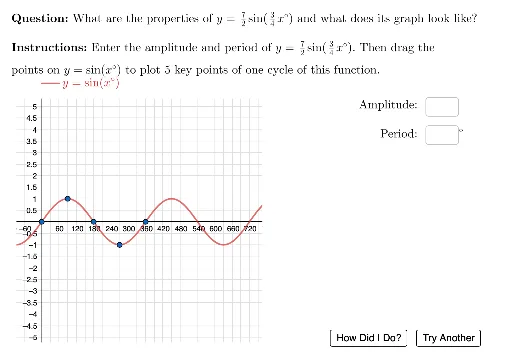
This example demonstrates the transformations of sine and cosine functions, involving key mathematical concepts such as sine and cosine functions and their transformations. Using GeoGebra commands like Sequence, If, Point, etc., you can dynamically adjust the phase, amplitude, and period of the functions to observe changes in their graphs. Suitable for high school mathematics education and learning.
GeoGebra Commands & Parameters
Sequence(Sequence[(i, j), i, -45, 735, 15], j, -5, 5, 0.5) → gridSpaceIf(isSinFunc, sin(x°), cos(x°)) → parentFuncPoint(Union[gridSpace, {Element[homeBase, 5]}]) → B6Point(Union[gridSpace, {Element[homeBase, 4]}]) → B5Point(Union[gridSpace, {Element[homeBase, 3]}]) → B4Point(Union[gridSpace, {Element[homeBase, 2]}]) → B3Point(Union[gridSpace, {Element[homeBase, 1]}]) → B2Shuffle(F2:F13) → aValsElement(aVals, 1) → aValShuffle(D2:D8) → bValsElement(bVals, 1) → bValUnicodeToLetter(10003) → cmarkUnicodeToLetter(10007) → xmarkLaTeX(FractionText[abs(bVal)]) → fmtAbsBvalNumToFracNoPhantom(1 / abs(bVal)) → currentStretchFactorLaTeX(If[isSinFunc, "y=\sin(x°)", "y=\cos(x°)"]) → lblParentNumToFrac(bVal) → latexBvalPolygon({(left, bottom), (left, top), (right, top), (right, bottom)}) → viewboxPoint(Union[gridSpace, homeBase]) → activePtLaTeX((((("\text{\(y=" * NumToFrac[aVal]) * If[isSinFunc, "\sin(", "\cos("]) * NumToFrac[bVal]) * "x°)\)}")) → lblFxSequence(startXPos + (i * quarterPeriod), i, 0, 4) → correctXvalsLaTeX(If[bVal > 0, "", "\text{Since \(b \lt 0\), there is a reflection\\in the \(y\)-axis.}"]) → fbHReflectionLaTeX((((("\text{There is a horizontal stretch by a factor \\of \(" * currentStretchFactor) * "\), and the graph has the same \\\(y\)-intercept as \(") * lblParent) * "\).}")) → fbHStretchIf(showFeedback, E21:E22, {"", ""}) → questionMarksLaTeX((((((("\text{Since \(b =" * latexBval) * "\), the period is \\\(\dfrac{360}{\mid b \mid} °=\dfrac{360}{") * fmtAbsBval) * "}°=") * abs(periodValue)) * "^\circ\).}")) → fbPeriodLaTeX((("\text{The base function is \(" * lblParent) * "\)}.")) → fbBaseTextfield(C22) → B22If(D22 ≟ periodValue, correct, incorrect) → E22If(isSinFunc, (aVal * sin(((bVal * x))°)), (aVal * cos(((bVal * x))°))) → translatedFuncZip((A, translatedFunc(A)), A, correctXvals) → correctPtsTextfield(C21) → B21If(amplitudeCorrect, correct, incorrect) → E21LaTeX((((("\text{The amplitude is \(\left\vert a \right\vert = \left\vert " * NumToFracNoPhantom[aVal]) * "\right\vert = ") * NumToFracNoPhantom[abs(aVal)]) * "\)}")) → fbAmplitudeLaTeX(If[aVal > 0, "", "\text{Since \(a<0\), there is a reflection\\in the \(x\)-axis.}"]) → fbVReflectionLaTeX(If[isCorrect, "\text{The points you graphed are correct.}", "\text{You did not graph a correct set of points.}"]) → fbCorrectLaTeX(If[bVal < 0, "\text{Note that this reflection has no effect for a\\cosine function, since the cosine function\\is symmetric about the \(y-\)axis.}", ""]) → fbCosReflectionLaTeX(If[aVal < 0 ∧ bVal < 0, "\text{Note that for a sine function, the reflections \\in the \(x\)-axis and the \(y-\)axis cancel\\each other out.}", If[aVal < 0 ∨ bVal < 0, (("\text{For a sine function, this reflection has the\\same effect as a reflection in the \(" * If[aVal < 0, "y", "x"]) * "\)-axis.}"), ""]]) → fbSinReflectionLaTeX((((("\text{\textbf{Question: }" * MainInstruc) * "\\\textbf{Instructions: }") * SpecInstruc) * "}")) → allInstrucLaTeX(((((((((((fbAmplitude * "\\") * fbPeriod) * "\\") * fbBase) * "\\") * fbVReflection) * "\\") * fbHReflection) * "\\") * If[isSinFunc, fbSinReflection, fbCosReflection])) → fbAllSegment(Element[legendPoints, 1], Element[legendPoints, 1] + (60, 0)) → legendParentSegment(Element[legendPoints, 2], Element[legendPoints, 2] + (60, 0)) → legendTransformedTableText({questionLbls, questionSpacers, questionMarks}, "vr") → tblInput