
Graph Transformation for k·f(x): Piecewise and Tangent-Style Insight
Loading the math board and drawing, please wait…
In collections
geometriadinamica.es
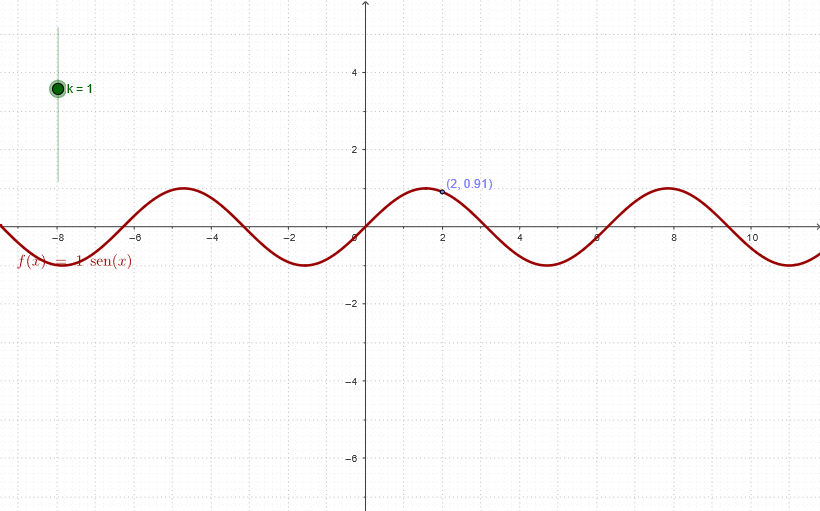
This GeoGebra example demonstrates how multiplying a function f(x) by a constant k transforms the graph into k·f(x), highlighting the correspondence between the original and transformed curves on the same coordinate plane. It emphasizes key ideas in function transformation—specifically vertical scaling (stretching or compressing in the y-direction)—and uses piecewise-function structure to reflect rule changes across intervals. The original topic tags also indicate a tangent/tangency viewpoint tied to trigonometric thinking, providing geometric intuition for local behavior such as slope or tangent-like constructions. Construction-wise, the model relies on GeoGebra geometry tools such as Point and Segment to build essential objects: the parameter k, the function f, characteristic points (A, B, C), and additional control/anchor points (e, a), together with points T1, T3, T4 that capture the alignment of notable features before and after transformation. The resulting setup is well suited for secondary school instruction on function graphs and transformations, and for introductory pre-calculus / early calculus lessons where students learn to interpret piecewise graphs via visual reasoning.
GeoGebra Commands & Parameters
Point(f) → ASegment(C, A) → eSegment(A, B) → a
AI Drawing Prompt Reference
Draw a coordinate plane with the graph of a piecewise function y=f(x) and its vertically scaled version y=k·f(x), where k is a variable parameter. The original function has different rules over intervals and shows tangent-like local behavior near certain points. Mark three key points on the original curve and their corresponding images on the scaled curve, then connect each pair with a vertical segment to show the scaling effect. Add two extra control points to adjust the piecewise intervals or the scaling factor. The overall figure highlights how the transformed curve stretches or compresses in the y-direction relative to the original, with visual emphasis on slope or tangent direction changes, suitable for teaching function transformations.
The prompt above was compiled from the original drawing commands and is for reference only.