
Graph a Non-Vertical Line Given Its Slope-Intercept Form
Loading the math board and drawing, please wait…
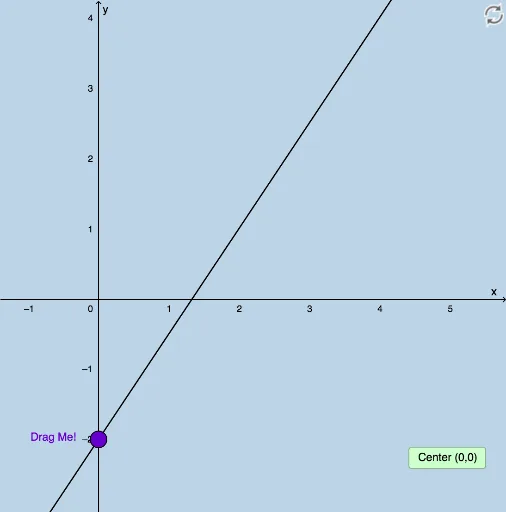
This example demonstrates how to graph a non-vertical line given its slope-intercept form. Key mathematical concepts include linear equations, slope, and y-intercept. Using GeoGebra commands such as Vector, Translate, and Dilate, the transformation process of the line is dynamically illustrated. Suitable for students at middle school level and above to learn about linear equations and geometric transformations.
GeoGebra Commands & Parameters
Vector((0, 0), (1, 0)) → uTranslate(A, u) → A'Dilate(A, If[0 < o ≤ 1, 1 - o, 0], A') → A'_1Dilate(A'_1, If[1 < o ≤ 2, 2 - o, 0], B) → HDilate((0, 0), If[-1 < o ≤ 0, (-o), 0], A) → D_1Translate(G, u) → G'Translate(B, u) → B'Translate(C, u) → C'Translate(D, u) → D'Polygon(A, A', B) → poly1, b, a_1, a'Polygon(B, B', C) → poly2, c, b_1, b'Polygon(C, C', D) → poly3, d, c_1, c'Polygon(D, D', E) → poly4, e, d_1, d'Dilate(B, If[0 < o ≤ 1, 1 - o, 0], B') → B'_1Dilate(C, If[0 < o ≤ 1, 1 - o, 0], C') → C'_1Dilate(D, If[0 < o ≤ 1, 1 - o, 0], D') → D'_1Segment(A, A'_1) → pSegment(B, B'_1) → qSegment(C, C'_1) → rSegment(D, D'_1) → sDilate(A'_1, If[2 < o ≤ 3, 3 - o, 0], B'_1) → IVector(A'_1, I) → vTranslate(A'_1, v) → JTranslate(H, v) → H'Dilate(B'_1, If[3 < o ≤ 4, 4 - o, 0], C'_1) → KVector(B'_1, K) → wTranslate(J, w) → J'Translate(H', w) → H''Dilate(C'_1, If[4 < o ≤ 5, 5 - o, 0], D'_1) → MVector(C'_1, M) → u_1Translate(J', u_1) → J''Translate(H'', u_1) → H'''Translate(L, u) → L'Translate(F, u) → F'Line(A, B) → f_1IntegralBetween(f, g, 0, 1) → e_1Translate(O, u) → O'IntegralBetween(f, g_1, 1, 2) → h_1IntegralBetween(f, h, 2, 3) → i_1Dilate(O, If[0 < p_1 ≤ 1, 1 - p_1, 0], O') → O'_1Dilate(L, If[0 < p_1 ≤ 1, 1 - p_1, 0], L') → L'_1Dilate(G, If[0 < p_1 ≤ 1, 1 - p_1, 0], G') → G'_1Segment(G, G'_1) → k_1Segment(O, O'_1) → l_1Segment(L, L'_1) → m_1Dilate(G'_1, If[1 < p_1 ≤ 2, 2 - p_1, 0], O) → PSegment(G'_1, P) → q_1Midpoint(O'_1, L) → QMidpoint(L'_1, F) → RDilate(G'_1, If[2 < p_1 ≤ 3, 3 - p_1, 0], O'_1) → SVector(G'_1, S) → v_1Translate(G'_1, v_1) → TTranslate(P, v_1) → P'Segment(T, P') → j_1Dilate(G'_1, If[3 < p_1 ≤ 4, 4 - p_1, 0], Q) → UVector(G'_1, U) → w_1Translate(G'_1, w_1) → VTranslate(P, w_1) → P'_1Segment(V, P'_1) → n_1Segment(O'_1, L) → r_1Dilate(O'_1, If[4 < p_1 ≤ 5, 5 - p_1, 0], L'_1) → WVector(O'_1, W) → s_1Translate(O'_1, s_1) → ZTranslate(L, s_1) → L'_2Segment(Z, L'_2) → t_1Dilate(O'_1, If[5 < p_1 ≤ 6, 6 - p_1, 0], R) → A_1Vector(O'_1, A_1) → u_2Translate(O'_1, u_2) → B_1Translate(L, u_2) → L'_3Segment(B_1, L'_3) → f_2Segment(C_1, A) → g_2Slope(f_1) → a_2Textfield(m) → InputBox1Distance(C_1, A) → distanceC1ADistance(A'_1, H) → c_2Vector(E_1, D_1) → v_2Vector(A'_1, H) → tDistance(E_1, D_1) → distanceE1D1Vector(J, H') → w_2Vector(J', H'') → c_2Vector(J'', H''') → d_2Distance(J, C) → distanceJCDistance(J', D) → distanceJ'DDistance(J'', E) → distanceJ''E