
Golden Rhombus
Loading the math board and drawing, please wait…
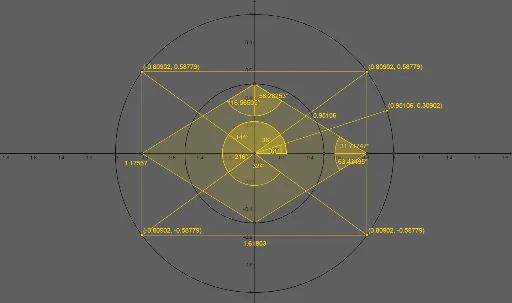
This example demonstrates the construction of a golden rhombus, highlighting its relationship with the golden ratio. It involves core mathematical concepts such as rhombus, vectors, rotation, symmetry, etc. The construction uses GeoGebra commands like points, orthogonal lines, intersections, circles, rotations, angles, reflections, polygons, midpoints, and segments. Suitable for high school mathematics teaching, focusing on geometric constructions and transformations.
GeoGebra Commands & Parameters
TableText({{A1, B1, C1, D1, E1, F1, G1, H1, I1, J1, K1, L1, M1, N1, O1}, {A2, B2, C2, D2, E2, F2, G2, H2, I2, J2, K2, L2, M2, N2, O2}, {A3, B3, C3, D3, E3, F3, G3, H3, I3, J3, K3, L3, M3, N3, O3}, {A4, B4, C4, D4, E4, F4, G4, H4, I4, J4, K4, L4, M4, N4, O4}, {A5, B5, C5, D5, E5, F5, G5, H5, I5, J5, K5, L5, M5, N5, O5}, {A6, B6, C6, D6, E6, F6, G6, H6, I6, J6, K6, L6, M6, N6, O6}, {A7, B7, C7, D7, E7, F7, G7, H7, I7, J7, K7, L7, M7, N7, O7}, {A8, B8, C8, D8, E8, F8, G8, H8, I8, J8, K8, L8, M8, N8, O8}, {A9, B9, C9, D9, E9, F9, G9, H9, I9, J9, K9, L9, M9, N9, O9}, {A10, B10, C10, D10, E10, F10, G10, H10, I10, J10, K10, L10, M10, N10, O10}, {A11, B11, C11, D11, E11, F11, G11, H11, I11, J11, K11, L11, M11, N11, O11}, {A12, B12, C12, D12, E12, F12, G12, H12, I12, J12, K12, L12, M12, N12, O12}, {A13, B13, C13, D13, E13, F13, G13, H13, I13, J13, K13, L13, M13, N13, O13}, {A14, B14, C14, D14, E14, F14, G14, H14, I14, J14, K14, L14, M14, N14, O14}}, "|_lllllllllllllll") → text1Point(xAxis) → COrthogonalLine(C, xAxis) → iPoint(xAxis) → EOrthogonalLine(E, xAxis) → kOrthogonalLine(G, xAxis) → lIntersect(xAxis, yAxis) → APoint(xAxis) → BCircle(A, B) → ePoint(xAxis) → DCircle(A, D) → fRotate(B, 36°, A) → B'_1Angle(B, A, B'_1) → βOrthogonalLine(B'_1, xAxis) → gIntersect(g, xAxis) → FMirror(F, A) → F'Rotate(B, 144°, A) → B'_2Angle(B, A, B'_2) → αRotate(B, 216°, A) → B'_3Angle(B, A, B'_3) → γRotate(B, 324°, A) → B'_4Angle(B, A, B'_4) → δIntersect(f, yAxis, 2) → HIntersect(f, yAxis, 1) → KPolygon(F', H, F, K) → q1, f', h, f_1, k_1Angle(A, H, F) → εAngle(H, F, A) → ζMidpoint(H, F) → LSegment(B'_2, B'_1) → jPointIn(q1) → Pointq1_1Perimeter(q1) → perimeterq1PointIn(q1) → Pointq1Segment(B'_1, B'_4) → mSegment(B'_4, B'_3) → nSegment(B'_3, B'_2) → pAngle(H, F, K) → ηAngle(F', H, F) → θSegment(A, B'_1) → qSegment(A, B'_2) → rSegment(A, B'_3) → sSegment(A, B'_4) → tCircle(H, F) → c_1OrthogonalLine(H, yAxis) → g_1Intersect(c_1, g_1, 1) → MOrthogonalLine(M, xAxis) → h_1Intersect(e, h_1, 2) → NAngle(B, A, N) → ιSegment(A, N) → i_1Midpoint(H, F) → OMidpoint(F', K) → PMidpoint(K, F) → QMidpoint(F', H) → RSegment(R, P) → j_1Segment(P, O) → l_1