
Pascal's Triangle and Metatron's Cube
Loading the math board and drawing, please wait…
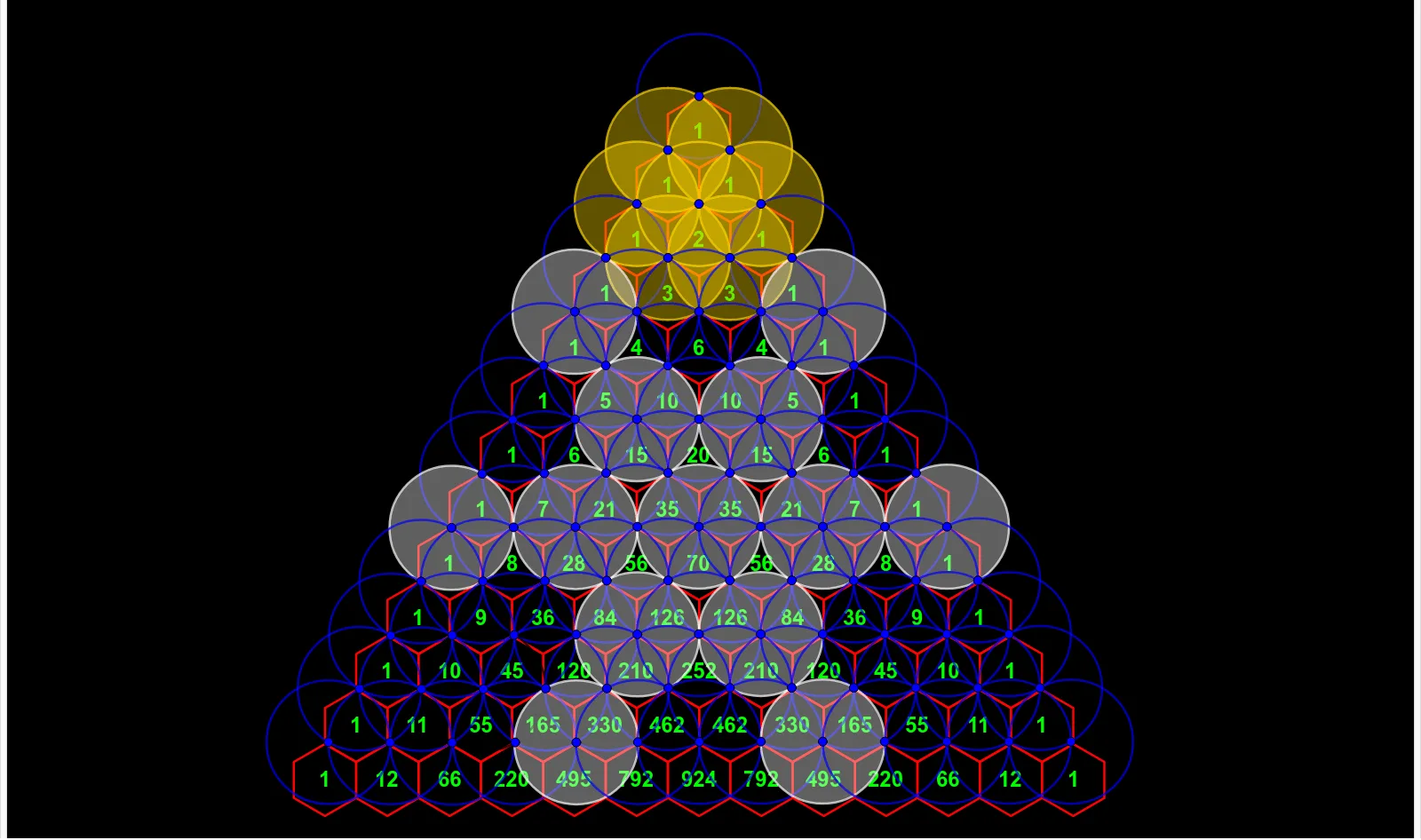
This example demonstrates the geometric connection and visual correspondence between Pascal's Triangle and Metatron's Cube. It involves core mathematical concepts such as binomial distribution, integers, polygon construction, vector operations, and geometric transformations. The construction utilizes GeoGebra commands and objects like Intersect, Point, Polygon, Vector, Sequence, Element, Translate, Circle, Mirror, and Midpoint. It is suitable for high school students and above, mathematics enthusiasts, geometers, or as an educational case study combining probability statistics with geometry.
GeoGebra Commands & Parameters
Intersect(xAxis, yAxis) → APoint(yAxis) → BPolygon(B, A, 6) → poly1, f, F, g, h, i, j, k, C, D, EVector(F, A) → uVector(A, D) → vSequence(Sequence[nCr[P, Q], Q, 0, P], P, 0, rows) → pasclistElement(Element[pasclist, 3], 2) → aSequence(Sequence[Polygon[A + (P * u) + (Q * v) + (0, 1), A + (P * u) + (Q * v), 6], Q, 0, P], P, 0, rows) → sierpSequence(Sequence[Text[Element[Element[pasclist, P + 1], Q + 1], A + (P * u) + (Q * v) + (1; 30°) + (0, adjusty) + ((adjustx * (1, 0)) * ceil(log(10, 0.01 + Element[Element[pasclist, P + 1], Q + 1])))], Q, 0, P], P, 0, rows) → L_1Sequence(Sequence[If[Mod[Element[Element[pasclist, P + 1], Q + 1], n] ≟ 0, Polygon[A + (P * u) + (Q * v) + B, A + (P * u) + (Q * v), 6]], Q, 0, P], P, 0, rows) → sierp2Translate(sierp, (0, -1)) → sierp'Point(u) → GPoint(v) → HPoint(v) → ICircle(G, H) → pMirror(G, H) → G'Mirror(G, I) → G'_1Circle(H, G') → qCircle(I, G'_1) → rCircle(G', H) → sCircle(G'_1, I) → tMirror(H, G') → H'Mirror(I, G'_1) → I'Midpoint(G', G'_1) → JCircle(J, H) → c_1Circle(H', G') → d_1Circle(I', G'_1) → e_1Intersect(s, c_1, 2) → KIntersect(t, c_1, 1) → LCircle(K, J) → f_1Circle(L, J) → g_1Mirror(G', H') → G''Mirror(G'_1, I') → MMirror(H', G'') → H''Mirror(I', M) → I''Circle(G'', H') → h_1Circle(M, I') → k_1Intersect(d_1, f_1, 2) → NIntersect(e_1, g_1, 1) → OCircle(N, K) → p_1Circle(O, L) → q_1Intersect(f_1, g_1, 2) → PCircle(P, L) → r_1Intersect(h_1, p_1, 2) → QIntersect(p_1, r_1, 2) → RIntersect(q_1, r_1, 2) → SIntersect(k_1, q_1, 1) → TCircle(H'', Q) → s_1Circle(Q, R) → t_1Circle(R, S) → c_2Circle(S, T) → d_2Circle(T, I'') → e_2Circle(I'', T) → f_2Intersect(s_1, t_1) → U, V, ,Intersect(t_1, c_2, 2) → WIntersect(c_2, d_2, 2) → ZIntersect(d_2, e_2, 2) → A_1Intersect(e_2, f_2, 2) → B_1Circle(V, Q) → g_2Circle(W, R) → h_2Circle(Z, S) → k_2Circle(A_1, T) → p_2Circle(B_1, I'') → q_2Intersect(s_1, g_2, 2) → C_1Intersect(f_2, q_2, 1) → D_1Intersect(p_2, q_2, 2) → E_1Intersect(k_2, p_2, 2) → F_1Intersect(h_2, k_2, 2) → G_1Intersect(g_2, h_2, 2) → H_1Circle(C_1, V) → r_2Circle(D_1, B_1) → s_2Circle(H_1, V) → t_2Circle(G_1, Z) → c_3Circle(F_1, A_1) → d_3Circle(E_1, B_1) → e_3Intersect(g_2, r_2, 1) → I_1Intersect(q_2, s_2, 2) → J_1Circle(I_1, V) → f_3Circle(J_1, B_1) → g_3Intersect(r_2, f_3, 2) → K_1Intersect(s_2, g_3, 2) → M_1Circle(K_1, I_1) → h_3Circle(M_1, J_1) → k_3Intersect(f_3, h_3, 1) → N_1Intersect(t_2, f_3, 2) → O_1Intersect(t_2, c_3, 2) → P_1Intersect(c_3, d_3, 2) → Q_1Intersect(d_3, e_3, 2) → R_1Intersect(e_3, g_3, 2) → S_1Intersect(g_3, k_3, 2) → T_1Circle(N_1, I_1) → p_3Circle(O_1, H_1) → q_3Circle(P_1, G_1) → r_3Circle(Q_1, F_1) → s_3Circle(R_1, E_1) → t_3Circle(S_1, J_1) → c_4Circle(T_1, J_1) → d_4Intersect(h_3, p_3, 2) → U_1Intersect(k_3, d_4, 2) → V_1Circle(U_1, K_1) → e_4Circle(V_1, M_1) → f_4Intersect(p_3, e_4, 1) → W_1Intersect(p_3, q_3, 2) → Z_1Intersect(q_3, r_3, 2) → A_2Intersect(r_3, s_3, 2) → B_2Intersect(s_3, t_3, 2) → C_2Intersect(t_3, c_4, 2) → D_2Intersect(c_4, d_4, 2) → E_2Intersect(d_4, f_4, 2) → F_2Circle(W_1, N_1) → g_4Circle(Z_1, O_1) → h_4Circle(A_2, P_1) → k_4Circle(B_2, Q_1) → p_4Circle(C_2, R_1) → q_4Circle(D_2, S_1) → r_4Circle(E_2, T_1) → s_4Circle(F_2, T_1) → t_4Intersect(e_4, f_4) → G_2, , ,Mirror(Z_1, W_1) → H_2Mirror(E_2, F_2) → I_2Circle(H_2, W_1) → c_5Circle(I_2, F_2) → d_5Mirror(U_1, H_2) → J_2Mirror(N_1, W_1) → L_2Mirror(O_1, Z_1) → M_2Mirror(P_1, A_2) → Q_2Mirror(Q_1, B_2) → S_2Mirror(R_1, C_2) → U_2Mirror(S_1, D_2) → W_2Mirror(R_1, D_2) → A_3Mirror(S_1, E_2) → C_3Mirror(T_1, F_2) → E_3Mirror(V_1, I_2) → G_3Circle(J_2, H_2) → e_5Circle(L_2, W_1) → f_5Circle(M_2, Z_1) → g_5Circle(Q_2, A_2) → h_5Circle(S_2, B_2) → k_5Circle(U_2, C_2) → p_5Circle(W_2, D_2) → q_5Circle(A_3, E_2) → r_5Circle(C_3, F_2) → s_5Circle(E_3, I_2) → t_5Circle(G_3, I_2) → c_6Intersect(e_5, f_5, 2) → K_2Circle(K_2, J_2) → d_6Intersect(e_5, d_6, 2) → N_2Circle(N_2, J_2) → e_6Intersect(f_5, g_5, 2) → O_2Circle(O_2, M_2) → f_6Intersect(g_5, h_5, 2) → P_2Circle(P_2, Q_2) → g_6Intersect(h_5, k_5, 2) → R_2Circle(R_2, S_2) → h_6Intersect(k_5, p_5, 2) → T_2Circle(T_2, U_2) → k_6Intersect(p_5, q_5, 2) → V_2Circle(V_2, W_2) → p_6Intersect(q_5, r_5, 2) → Z_2Circle(Z_2, A_3) → q_6Intersect(r_5, s_5, 2) → B_3Circle(B_3, C_3) → r_6Intersect(s_5, t_5, 2) → D_3Circle(D_3, E_3) → s_6Intersect(t_5, c_6, 2) → F_3Circle(F_3, G_3) → t_6Intersect(c_6, t_6, 1) → H_3Circle(H_3, G_3) → c_7Intersect(d_6, e_6, 2) → I_3Circle(I_3, N_2) → d_7Intersect(e_6, d_7, 2) → J_3Circle(J_3, N_2) → e_7Intersect(d_6, f_6, 2) → K_3Circle(K_3, O_2) → f_7Intersect(f_6, g_6, 2) → L_3Circle(L_3, P_2) → g_7Intersect(g_6, h_6, 2) → M_3Circle(M_3, R_2) → h_7Intersect(h_6, k_6, 2) → N_3Circle(N_3, T_2) → k_7Intersect(k_6, p_6, 2) → O_3Circle(O_3, T_2) → p_7Intersect(p_6, q_6, 2) → P_3Circle(P_3, Z_2) → q_7Intersect(q_6, r_6, 2) → Q_3Circle(Q_3, B_3) → r_7Intersect(r_6, s_6, 2) → R_3Circle(R_3, B_3) → s_7Intersect(s_6, t_6, 2) → S_3Circle(S_3, D_3) → t_7Intersect(t_6, c_7, 2) → T_3Circle(T_3, H_3) → c_8Intersect(c_7, c_8, 1) → U_3Circle(U_3, H_3) → d_8
AI Drawing Prompt Reference
Draw the geometric connection between Pascal's Triangle and Metatron's Cube. Start by creating a hexagon, then use vectors and sequences to generate a Sierpinski triangle. Place text based on the values of Pascal's Triangle on the Sierpinski triangle. Finally, construct the geometric shapes of Metatron's Cube, including multiple circles and their intersections, forming a complex geometric pattern.
The prompt above was compiled from the original drawing commands and is for reference only.