
GoGeometry Action 3
Loading the math board and drawing, please wait…
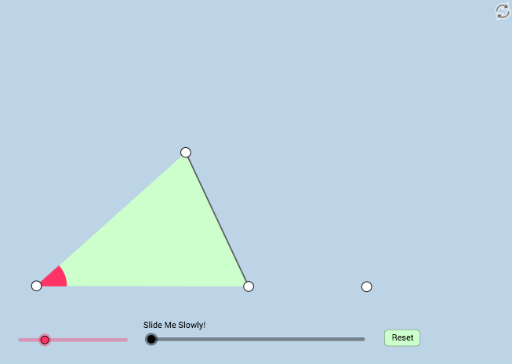
This is a dynamic and modifiable geometric problem example posted by Antonino Gutierrez on Twitter. It demonstrates a tangent line problem in triangles. Using GeoGebra commands such as Ray, Rotate, Angle, Point, etc., one can dynamically explore and understand the properties of geometric figures. Suitable for high school mathematics education and learning.
GeoGebra Commands & Parameters
Ray(A, B) → fRotate(B, (a * π / 180), A) → B'Angle(B, A, B') → αRay(A, B') → gPoint(g) → CPoint(f) → DSegment(C, D) → hSegment(A, D) → iSegment(A, C) → jCircle(C, 4) → cCircle(D, 4) → dIntersect(c, g, 2) → EIntersect(d, f, 2) → FRay(D, F) → kRay(C, E) → lMin({i, j}) → bCircle(C, (0.15 * b)) → eCircle(D, (0.15 * b)) → pAngle(F, D, C) → βAngle(D, C, E) → γRotate(F, β / 2, D) → F'Angle(F, D, F') → δRotate(D, γ / 2, C) → D'Angle(D, C, D') → εRay(C, D') → mRay(D, F') → nIntersect(e, m, 1) → GIntersect(e, h, 1) → HIntersect(p, h, 1) → ICircleSector(C, H, G) → qCircleSector(D, F, F') → rIntersect(m, n) → JOrthogonalLine(J, k) → sOrthogonalLine(J, l) → tIntersect(s, k) → KIntersect(t, l) → LCircle(J, K) → c_1Segment(L, K) → f_1Midpoint(f_1) → MOrthogonalLine(M, f_1) → g_1Intersect(c_1, g_1, 2) → NSegment(N, C) → h_1Segment(N, D) → i_1Intersect(f_1, h_1) → OSegment(L, O) → j_1Circle(O, j_1) → d_1Intersect(d_1, f_1, 2) → PPolygon(A, D, C) → poly1, c_2, a_1, d_2Angle(J, K, D) → ζAngle(C, L, J) → ηIntersect(f_1, i_1) → QDilate(A, If[0 < o ≤ 1, 1 - o, 0], D) → A'Dilate(A, If[0 < o ≤ 1, 1 - o, 0], C) → A'_1Segment(A, A') → k_1Segment(A, A'_1) → l_1Dilate(C, If[1 < o ≤ 2, 2 - o, 0], J) → C'Dilate(D, If[1 < o ≤ 2, 2 - o, 0], J) → D'_1Segment(C, C') → m_1Segment(D, D'_1) → n_1Rotate(r, If[2.5 < o ≤ 3.5, ((o - 2.5) * δ), δ], D) → r'Rotate(q, If[3.5 < o ≤ 4.5, ((o - 3.5) * ε), ε], C) → q'Dilate(J, If[5 < o ≤ 6, 6 - o, 0], L) → J'Dilate(J, If[5 < o ≤ 6, 6 - o, 0], K) → J'_1Segment(J, J'_1) → p_1Segment(J, J') → q_1Angle(L, J, K) → θRotate(L, If[6 < o ≤ 7, ((o - 6) * θ), θ], J) → L'CircleArc(J, L, L') → e_1Rotate(K, If[7 < o ≤ 8, ((o - 7) * ((2 * π) - θ) / 2), ((2 * π) - θ) / 2], J) → K'CircleArc(J, K, K') → r_1Rotate(N, If[8 < o ≤ 9, ((o - 8) * ((2 * π) - θ) / 2), ((2 * π) - θ) / 2], J) → N'CircleArc(J, N, N') → s_1Rotate(r_1, If[10 < o ≤ 11, ((o - 10) * ((2 * π) - θ) / 2), ((2 * π) - θ) / 2], J) → t_1Dilate(N, If[11 < o ≤ 12, 12 - o, 0], D) → N'_1Dilate(N, If[11 < o ≤ 12, 12 - o, 0], C) → N'_2Segment(N, N'_1) → b_1Segment(N, N'_2) → f_2Dilate(L, If[12 < o ≤ 13, 13 - o, 0], O) → L'_1Dilate(O, If[13 < o ≤ 14, 14 - o, 0], P) → O'Segment(L, L'_1) → g_2Segment(O, O') → h_2Dilate(P, If[14 < o ≤ 15, 15 - o, 0], Q) → P'Segment(P, P') → i_2Dilate(Q, If[15 < o ≤ 16, 16 - o, 0], K) → Q'Segment(Q, Q') → j_2Rotate(L, If[17 < o ≤ 18, ((o - 17) * π), π], O) → L'_2Rotate(L'_1, If[17 < o ≤ 18, ((o - 17) * π), π], O) → RSegment(L'_2, R) → k_2Rotate(Q, If[18 < o ≤ 19, ((o - 18) * π), π], Q) → Q'_1Rotate(Q', If[18 < o ≤ 19, ((o - 18) * π), π], Q) → Q''Segment(Q'_1, Q'') → l_2Min(c_2, d_2) → wCircle(A, (0.15 * w)) → e_2Segment(A, C) → m_2Intersect(e_2, m_2) → S,Segment(A, D) → n_2Intersect(e_2, n_2) → T,CircleSector(A, T, S) → p_2