
GIANT OWL Logo: Creative Drawing with Vectors and Geometric Transformations
Loading the math board and drawing, please wait…
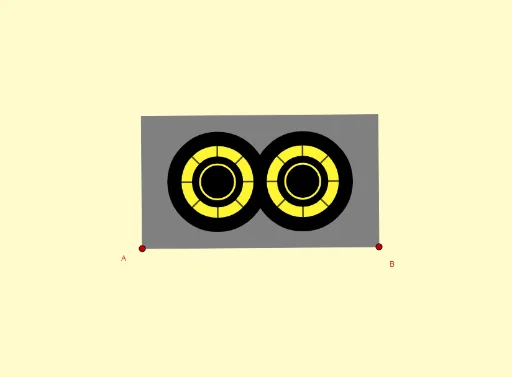
This GeoGebra example constructs a logo named 'GIANT OWL', demonstrating how to use vectors, angles, circles, reflections, fractions, stochastic processes, roots, and statistical characteristics for artistic geometric composition. The core mathematical concepts include 2D vector operations, angle bisectors, line symmetry (reflection), combinations of circles and polygons, as well as the introduction of random processes and statistical features. The construction uses numerous GeoGebra commands: LineBisector, Vector, OrthogonalVector, Midpoint, OrthogonalLine, Line, Intersect, Polygon, Circle, Mirror, AngularBisector, Segment, and Rotate, creating many points, lines, circles, polygons, texts, and images. It is suitable for middle school and above to learn vectors, geometric transformations, and dynamic drawing, and can also be used for mathematical art creation or logo design teaching demonstrations.
GeoGebra Commands & Parameters
LineBisector(A, B) → mVector(A, B) → uOrthogonalVector(u) → vMidpoint(A_1, A) → JOrthogonalLine(B, u, xOyPlane) → gLine(A, B) → sOrthogonalLine(A, s) → bOrthogonalLine(A_1, b) → rIntersect(g, r) → COrthogonalLine(J, m) → iPolygon(A_1, C, B, A) → q1, a_1, c, b_1, a_2Intersect(g, i) → F_3Intersect(m, i) → DCircle(E, G) → dMirror(d, m) → d'Intersect(d', i) → H, ICircle(E, I) → eCircle(E, K) → fCircle(E, L) → hCircle(E, M) → kOrthogonalLine(E, i) → jAngularBisector(j, i) → l, nSegment(I, K) → pRotate(I, 45°, E) → I'Rotate(K, 45°, E) → K'Segment(I', K') → p'Rotate(I', 45°, E) → I''Rotate(K', 45°, E) → K''Segment(I'', K'') → p''Rotate(I'', 45°, E) → I'''Rotate(K'', 45°, E) → K'''Segment(I''', K''') → p'''Rotate(I''', 45°, E) → NRotate(K''', 45°, E) → OSegment(N, O) → qRotate(N, 45°, E) → N'Rotate(O, 45°, E) → O'Segment(N', O') → q'Rotate(N', 45°, E) → N''Rotate(O', 45°, E) → O''Segment(N'', O'') → q''Rotate(N'', 45°, E) → N'''Rotate(O'', 45°, E) → O'''Segment(N''', O''') → q'''Mirror(e, m) → e'Mirror(f, m) → f'Mirror(h, m) → h'Mirror(k, m) → k'Mirror(I, m) → I'_1Mirror(K, m) → K'_1Segment(I'_1, K'_1) → p'_1Mirror(I', m) → I''_1Mirror(K', m) → K''_1Segment(I''_1, K''_1) → p''_1Mirror(I'', m) → I'''_1Mirror(K'', m) → K'''_1Segment(I'''_1, K'''_1) → p'''_1Mirror(I''', m) → PMirror(K''', m) → QSegment(P, Q) → tMirror(N, m) → N'_1Mirror(O, m) → O'_1Segment(N'_1, O'_1) → q'_1Mirror(N', m) → N''_1Mirror(O', m) → O''_1Segment(N''_1, O''_1) → q''_1Mirror(N'', m) → N'''_1Mirror(O'', m) → O'''_1Segment(N'''_1, O'''_1) → q'''_1Mirror(N''', m) → RMirror(O''', m) → SSegment(R, S) → a