
Geometric Investigation of Trigonometric Identities
Loading the math board and drawing, please wait…
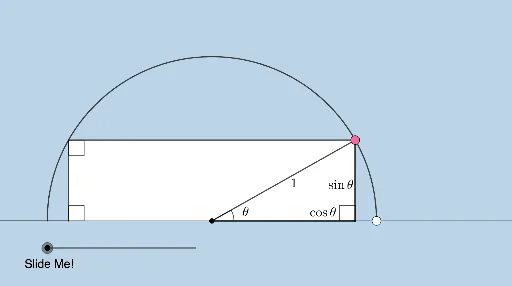
This interactive example provides a visual exploration of trigonometric identities through geometric construction. It demonstrates the fundamental relationships between sine, cosine, and ratios using a dynamic geometric model. The construction is built using a variety of GeoGebra tools, including Intersect, Semicircle, Rotate, OrthogonalLine, and Dilate, incorporating elements such as vectors, circle sectors, and polygons to map out the trigonometric properties. This resource is ideal for high school students and educators seeking to bridge the gap between algebraic trigonometric formulas and their spatial geometric representations.
GeoGebra Commands & Parameters
Intersect(xAxis, yAxis) → APoint(Ray[(0, 0), (1, 0)]) → BSemicircle(A, B) → cMidpoint(A, B) → CRotate(B, π / 2, C) → B'Center(c) → DCircleArc(C, B, B') → dPoint(d) → EOrthogonalLine(E, xAxis) → fOrthogonalLine(E, f) → gIntersect(c, g, 2) → FOrthogonalLine(F, g) → hIntersect(h, xAxis) → GIntersect(f, xAxis) → HPolygon(G, H, E, F) → q1, g_1, h_1, e, f_1Angle(E, H, C) → αAngle(H, G, F) → βAngle(G, F, E) → γAngle(B, C, E) → δDilate(D, If[0 < a ≤ 1, 1 - a, 0], E) → D'Segment(E, H) → jSegment(G, F) → lRotate(E, δ, D) → E'Segment(C, H) → kSegment(C, E) → iCircle(C, (0.4 * Distance[D, H])) → pIntersect(p, i, 1) → IIntersect(p, k, 1) → JDilate(D, If[1 < a ≤ 2, 2 - a, 0], E') → D'_1Segment(C, D'_1) → mOrthogonalLine(E', xAxis) → nIntersect(n, xAxis) → KSegment(F, E) → qRotate(J, If[0 < a ≤ 1, (a * δ), δ], D) → J'CircleSector(C, J, J') → rRotate(r, If[2 < a ≤ 3, ((a - 2) * δ), δ], D) → r'Angle(E, C, E') → εDilate(E', If[4 < a ≤ 5, 5 - a, 0], K) → E''Segment(E', E'') → sAngle(E', K, C) → ζSegment(C, A) → tDilate(C, If[6 < a ≤ 7, 7 - a, 0], E') → C'Vector(C, C') → uTranslate(C, u) → C'_1Translate(E, u) → E'_1Segment(C'_1, E'_1) → i'Rotate(C'_1, If[6 < a ≤ 7, ((a - 6) * δ), (-δ)], C'_1) → LRotate(E'_1, If[6 < a ≤ 7, ((-(a - 6)) * δ), (-δ)], C'_1) → MSegment(L, M) → i''OrthogonalLine(M, xAxis) → bIntersect(b, xAxis) → NRay(G, A) → j_1Line(M, m) → k_1Dilate(M, If[8 < a ≤ 9, 9 - a, 0], N) → M'Angle(E', M, N) → ηAngle(M, N, K) → θ_1Dilate(K, If[7 < a ≤ 8, 8 - a, 0], N) → K'Vector(K, K') → vTranslate(E', v) → E''_1Translate(E'', v) → E'''Segment(E''_1, E''') → s'Line(F, E) → l_1Circle(H, Distance[C, A]) → c_1Intersect(c_1, l_1, 2) → OLine(H, N) → i_1Dilate(E, If[9 < a ≤ 10, 10 - a, 0], O) → E'_2Vector(E, E'_2) → wTranslate(F, w) → F'Polygon(G, F', E'_2, H) → q2, g_2, f', e'_2, h_2Line(G, F') → m_1OrthogonalLine(O, m_1) → n_1Intersect(m_1, n_1) → PDilate(F', If[11 < a ≤ 12, 12 - a, 0], P) → F''Vector(F', F'') → u_1Translate(G, u_1) → G'Polygon(G', F'', O, H) → q3, g', f'', o, h_3Dilate(H, If[13 < a ≤ 14, 14 - a, 0], K) → H'Vector(H, H') → v_1Translate(G', v_1) → G''Translate(F'', v_1) → F'''Translate(O, v_1) → O'Translate(H, v_1) → H'_1Polygon(G'', F''', O', H'_1) → q3', g'', f''', o', h'_1Line(F'', G') → p_1Line(O, H) → q_1Line(F, E) → r_1Angle(N, H, O) → θRotate(G'', If[14 < a ≤ 15, ((-(a - 14)) * θ), (-θ)], K) → G'''Rotate(F''', If[14 < a ≤ 15, ((-(a - 14)) * θ), (-θ)], K) → QRotate(O', If[14 < a ≤ 15, ((-(a - 14)) * θ), (-θ)], K) → O''Rotate(H'_1, If[14 < a ≤ 15, ((-(a - 14)) * θ), (-θ)], K) → RPolygon(G''', Q, O'', R) → q3'', g''', q_2, o'', r_2Angle(B, E'', O') → κRotate(G'', If[14 < a ≤ 15, ((-(a - 14)) * κ), (-κ)], H') → G'''_1Rotate(F''', If[14 < a ≤ 15, ((-(a - 14)) * κ), (-κ)], H') → SRotate(O', If[14 < a ≤ 15, ((-(a - 14)) * κ), (-κ)], H') → O''_1Rotate(H'_1, If[14 < a ≤ 15, ((-(a - 14)) * κ), (-κ)], H') → TPolygon(G'''_1, S, O''_1, T) → q3''_1, g'''_1, s_1, o''_1, t_1