
Geometric Illustration of an Exponent Law
Loading the math board and drawing, please wait…
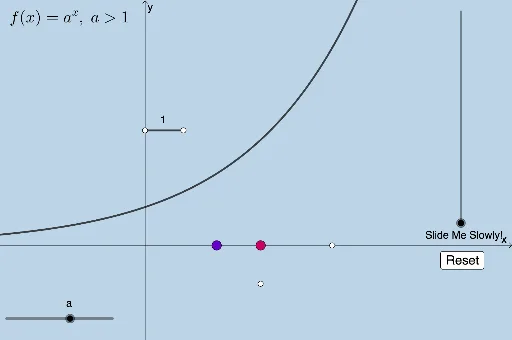
This example geometrically illustrates a popular exponent law, visually demonstrating the geometric meaning of exponent operations. Core math concepts include exponent rules, geometric transformations, similarity ratios, and figure scaling. Construction highlights involve commands/objects like Segment, Dilate, Intersect, Vector, Translate, Polygon, Rotate, Circle, Line, OrthogonalLine, Point, and Angle in GeoGebra. Suitable for high school mathematics education to help students understand abstract exponent laws and enhance spatial reasoning.
GeoGebra Commands & Parameters
Segment(E, F) → gDilate(A, If[0 < d ≤ 1, 1 - d, 0], (b, 0)) → A'Dilate(B, If[0 < d ≤ 1, 1 - d, 0], (b, 0)) → B'Segment(A, A') → hIntersect(f, i, (1.8642830646268114, 1.8725094674603222)) → KIntersect(f, j, (3.01, 2.753248348510107)) → LDilate(J, If[1 < d ≤ 2, 2 - d, 0], K) → J'Segment(J, J') → kDilate(M, If[2 < d ≤ 3, 3 - d, 0], C) → M'Segment(M, M') → lDilate(C, If[3 < d ≤ 4, 4 - d, 0], I) → C'Segment(C, C') → mDilate(I, If[4 < d ≤ 5, 5 - d, 0], L) → I'Segment(I, I') → nDilate(M, If[5 < d ≤ 6, 6 - d, 0], (b, -2)) → M'_1Vector(M, M'_1) → uTranslate(M, u) → M'_2Translate(M', u) → M''Segment(M'_2, M'') → l'Dilate(A, If[5 < d ≤ 6, 6 - d, 0], (0, -2)) → A'_1Vector(A, A'_1) → vTranslate(A, v) → A'_2Translate(A', v) → A''Segment(A'_2, A'') → h'Dilate(M'', If[6 < d ≤ 7, 7 - d, 0], G) → M'''Segment(M'', M''') → pIntersect(f, q, (4.874283064626811, 5.155483598854672)) → DDilate(G, If[7 < d ≤ 8, 8 - d, 0], D) → G'Segment(G, G') → rDilate(E, If[9 < d ≤ 10, 10 - d, 0], D) → E'Vector(E, E') → wTranslate(E, w) → E'_1Translate(F, w) → F'Segment(E'_1, F') → g'Dilate(D, If[10 < d ≤ 11, 11 - d, 0], F') → D'Vector(D, D') → sTranslate(G, s) → G'_1Translate(G', s) → G''Segment(G'_1, G'') → r'Dilate(D, If[11 < d ≤ 12, 12 - d, 0], G) → D'_1Vector(D, D'_1) → tTranslate(E'_1, t) → NTranslate(F', t) → F''Segment(N, F'') → g''Polygon(G, G'_1, F', D) → q1, g_1, g'_1, f', d_1Dilate(K, If[13 < d ≤ 14, 14 - d, 0], L) → K'Vector(K, K') → u_1Translate(J, u_1) → J'_1Dilate(K, If[12 < d ≤ 13, 13 - d, 0], L) → K'_1Vector(K, K'_1) → v_1Translate(J, v_1) → J'_2Translate(J', v_1) → J''Segment(J'_2, J'') → k'Rotate(J'_2, If[12 < d ≤ 13, ((-(d - 12)) * π / 2), ((-π)) / 2], K'_1) → PRotate(J'', If[12 < d ≤ 13, ((-(d - 12)) * π / 2), ((-π)) / 2], K'_1) → J'''Segment(P, J''') → k''Dilate(L, If[13 < d ≤ 14, 14 - d, 0], P) → L'Vector(L, L') → w_1Translate(I, w_1) → I'_1Translate(I', w_1) → I''Segment(I'_1, I'') → n'Dilate(P, If[14 < d ≤ 15, 15 - d, 0], I'_1) → P'Vector(P, P') → a_1Translate(P, a_1) → P'_1Translate(J''', a_1) → QSegment(P'_1, Q) → k'''Polygon(I'_1, I, L, P) → q2, i'_1, i_1, l_1, p_1Circle(I'_1, r) → c_1Intersect(c_1, f_1, 1) → RDilate(P, If[16.5 < d ≤ 17.5, 17.5 - d, 0], R) → P'_2Vector(P, P'_2) → b_1Translate(L, b_1) → L'_1Polygon(I'_1, I, L'_1, P'_2) → q3, i'_2, i_2, l'_1, p'_2Segment(I'_1, P'_2) → h_1Segment(I, L'_1) → j_1Segment(L'_1, P'_2) → k_1Line(L'_1, I) → m_1OrthogonalLine(P'_2, m_1) → n_1Intersect(m_1, n_1) → SDilate(L'_1, If[19.5 < d ≤ 20.5, 20.5 - d, 0], S) → TVector(L'_1, T) → e_1Translate(I, e_1) → I'_2Polygon(I'_1, I'_2, T, P'_2) → q4, i'_3, i'_4, t_1, p'_1Segment(T, I'_2) → q_1Segment(T, P'_2) → r_1Segment(I'_2, I'_1) → s_1Line(T, g) → f_2Point(f_2) → ZAngle(P'_2, T, Z) → αDilate(E, If[21 < d ≤ 22, 22 - d, 0], T) → E'_2Vector(E, E'_2) → u_2Translate(E, u_2) → E'_3Translate(F, u_2) → F'_1Segment(E'_3, F'_1) → g'_2Rotate(E'_3, If[21 < d ≤ 22, ((-(d - 21)) * α), (-α)], E'_3) → URotate(F'_1, If[21 < d ≤ 22, ((-(d - 21)) * α), (-α)], E'_3) → VSegment(U, V) → g_2Dilate(T, If[23 < d ≤ 24, 24 - d, 0], F') → T'Vector(T, T') → v_2Translate(I'_1, v_2) → WTranslate(I'_2, v_2) → A_1Translate(T, v_2) → T'_1Translate(P'_2, v_2) → B_1Polygon(W, A_1, T'_1, B_1) → q4', w_2, a_2, t'_1, b_2Rotate(W, If[23 < d ≤ 24, ((-(d - 23)) * (π - α)), (-(π - α))], T'_1) → W'Rotate(A_1, If[23 < d ≤ 24, ((-(d - 23)) * (π - α)), (-(π - α))], T'_1) → C_1Rotate(T'_1, If[23 < d ≤ 24, ((-(d - 23)) * (π - α)), (-(π - α))], T'_1) → D_1Rotate(B_1, If[23 < d ≤ 24, ((-(d - 23)) * (π - α)), (-(π - α))], T'_1) → E_1Polygon(W', C_1, D_1, E_1) → q4'', w', c_2, d_2, e_2
AI Drawing Prompt Reference
Draw a geometric illustration showing the meaning of exponent operations. Start with a base line, create a series of similar figures of different sizes through multiple scaling and transformations, and connect key points with line segments to form a complex structure that visually represents the result of exponent operations, emphasizing similarity ratios and geometric transformations.
The prompt above was compiled from the original drawing commands and is for reference only.