
Geometric Explanation of Complex Number Multiplication
Loading the math board and drawing, please wait…
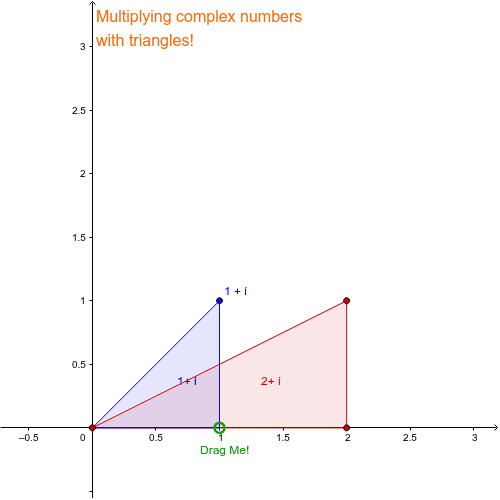
This example demonstrates the geometric interpretation of multiplying complex numbers, visually showing how multiplication affects the position and magnitude of complex numbers in the plane. Key math concepts include the geometric representation of complex numbers, vector rotation and scaling, and the relationship between modulus and argument. It uses GeoGebra commands like Intersect, Polygon, and CurveCartesian to construct the rotation and scaling effects in complex multiplication. Suitable for high school students or math enthusiasts studying the geometric applications of complex numbers, helping to understand the essence of complex multiplication.
GeoGebra Commands & Parameters
Intersect(xAxis, yAxis) → APolygon(A, B, C) → poly1, c, a, bCurveCartesian(((Length[1 + ί] * Length[D]) * cos(t)), ((Length[D] * Length[1 + ί]) * sin(t)), t, 0, 6.28319) → dCurveCartesian((Length[D] * cos(t)), (Length[D] * sin(t)), t, 0, 6.28319) → fPolygon(A, D, E) → poly2, e, a_1, d_1
AI Drawing Prompt Reference
Draw a geometric representation of complex number multiplication on the complex plane. Start by plotting the intersection of the x and y axes, then draw a triangle centered at the origin to represent a complex number. Next, use parametric equations to plot a curve showing the rotation and scaling effect of multiplication. Also, draw a reference circle for scaling and connect the intersection point with the origin to form another triangle, visually demonstrating how multiplication affects the position and magnitude of complex numbers.
The prompt above was compiled from the original drawing commands and is for reference only.