
Geometric practice for complex-number arithmetic
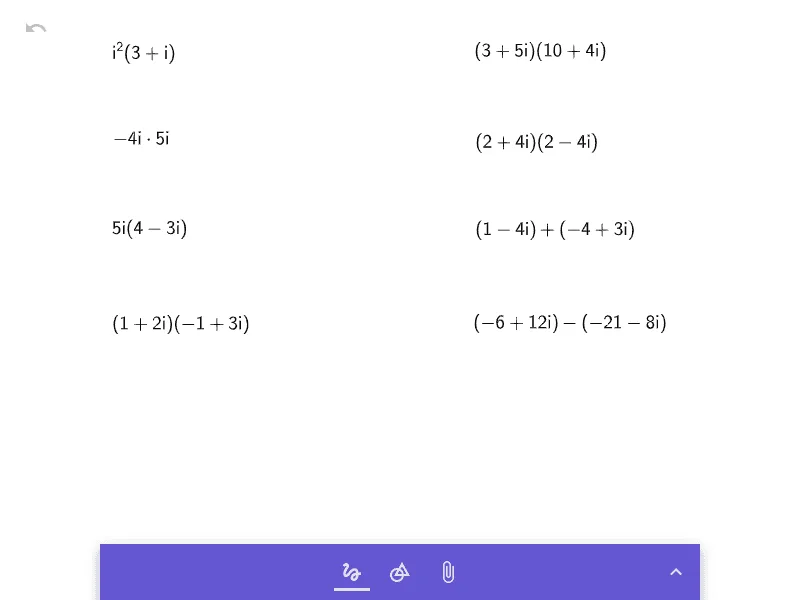
Loading the math board and drawing, please wait…
This GeoGebra example demonstrates how complex-number arithmetic (such as addition/subtraction and multiplication) translates into clear geometric behavior on the complex plane—for instance, showing that multiplication corresponds to a rotation together with a scaling determined by the modulus and argument. The key mathematics includes representing complex numbers as points (real/imaginary parts as coordinates), performing complex arithmetic, and interpreting multiplication geometrically via vector viewpoint, where angles and lengths change in a predictable way. Construction-wise, it uses the provided objects a, b, c, d, e, f, g, h as intermediate representations of complex quantities and their corresponding geometric entities (points/vectors). By combining these objects through GeoGebra’s arithmetic operations and mapping between algebraic results and geometric locations, the example produces new points/vectors that reveal the effect of each operation visually. Suitable for late secondary school through pre-university learners and for anyone practicing the algebra-to-geometry connection in complex numbers.
GeoGebra Commands & Parameters
Formula aFormula bFormula cFormula dFormula eFormula fFormula gFormula h
AI Drawing Prompt Reference
Draw points on the complex plane to represent complex numbers, showing the geometric meaning of addition, subtraction, multiplication, and division, especially the rotation and scaling effect of multiplication. Use multiple points for complex numbers, vector operations for addition and subtraction, and show multiplication as rotation with modulus change, forming a clear geometric relationship to understand the visual representation of complex operations.
The prompt above was compiled from the original drawing commands and is for reference only.