
Visualizing the N-th Root of a Complex Number via cis Form
Loading the math board and drawing, please wait…
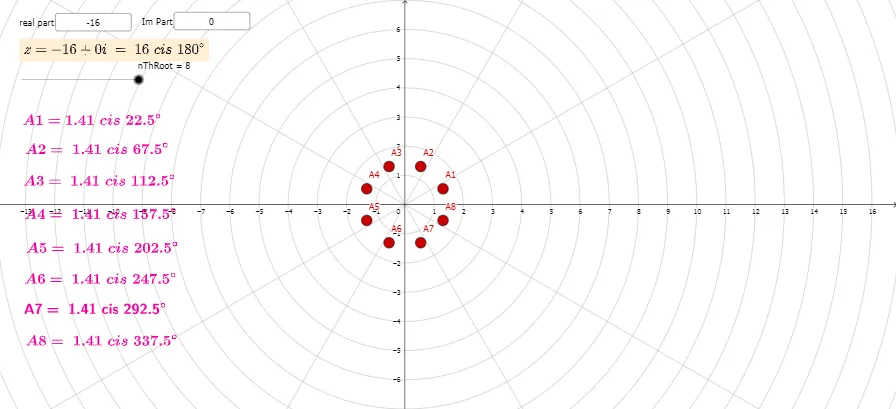
This example demonstrates how to compute and visualize the n-th roots of a complex number z=a+bi on the complex plane using polar form. It focuses on the key ideas of complex numbers: modulus and argument, the multi-valued nature of roots, and expressing results with the cis (cos+ i sin) representation. The construction uses GeoGebra input and text/formatting commands to calculate parameters and display them clearly. From the provided construction summary: Textfield/InputBox objects gather parameters n and the real/imaginary parts (a, b); an If statement governs conditional root handling (e.g., branch selection or validity checks); intermediate complex quantities (z1), root magnitude (rRoot, r_{z1}), and angle (argm, angAdd, argR) are computed; FormulaText is used to render equations such as z= a+bi and each root candidate like A1= rRoot cis(angle). The resulting points A1…A8 illustrate multiple roots/branches. Suitable for high school to early university students learning complex analysis concepts visually, and for graphing/parameter exploration in mathematics classes.
GeoGebra Commands & Parameters
Textfield(a) → InputBox1Textfield(b) → InputBox2If(arg(z1) < 0, arg(z1) + 360°, arg(z1)) → argm
AI Drawing Prompt Reference
Draw a complex plane visualization showing the n-th roots of a complex number z=a+bi. Use input boxes to set the real part a, imaginary part b, and the root order n. Compute the modulus and argument of z, normalizing the argument to the range 0 to 360 degrees. Then generate n root points, each expressed as modulus times cis(angle), with angles equally spaced. Mark these roots as points on the plane and display each root's polar form like r cis(θ). Also show the original complex number z in algebraic form as text. The figure should clearly illustrate the symmetric distribution of multiple roots around the origin, suitable for teaching complex analysis.
The prompt above was compiled from the original drawing commands and is for reference only.