
Geometric Demonstration of Equation A
Loading the math board and drawing, please wait…
In collections
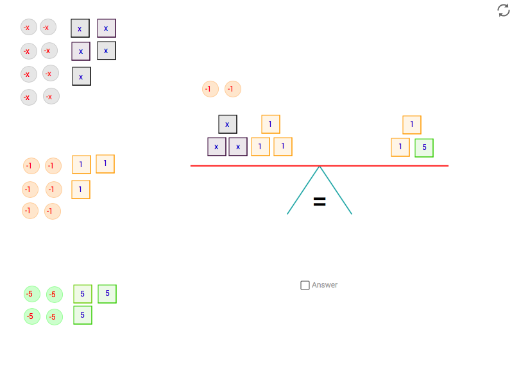
Solving equations by balancing
This example dynamically demonstrates the geometric relationship between a cube and its circumscribed circle. Core math concepts include volume, cube, circumscribed circle, real numbers, difference, and slope. The construction utilizes GeoGebra commands and objects such as angle, polygon, point, segment, circle, line, intersect, rotate, PointIn, If, and Textfield. Suitable for high school and above students to understand the application of solid geometry and analytical geometry.
GeoGebra Commands & Parameters
Angle(angle_c, angle_b, angle_a) → anglemeasurePolygon(C_1, C_2, 4) → x_c, c_1, c_2, c_3, c_4, C_3, C_4Polygon(A_1, A_2, 4) → x_a, a_1, a_2, a_4, a_3, A_3, A_4Polygon(P_1, P_2, 4) → x_P, p_1, p_2, p_4, p_3, P_3, P_4Point(xAxis) → foot1Segment(fulcrum, foot1) → leg_bPoint(xAxis) → foot2Segment(fulcrum, foot2) → leg_aCircle(fulcrum, 4) → circleLine(fulcrum, xAxis) → parallelIntersect(circle, parallel, 2) → balance1Intersect(circle, parallel, 1) → balance2Segment(balance1, balance2) → balanceSegment(angle_a, angle_b) → anglesegment_aSegment(angle_b, angle_c) → anglesegment_bRotate(balance1, tip, fulcrum) → balance1'Rotate(balance2, tip, fulcrum) → balance2'Segment(balance1', balance2') → balance'PointIn(x_c) → APointIn(x_P) → CPointIn(x_a) → PIf(equal > tipequal, ">", If[equal < tipequal, "<", "="]) → signCircle(O, 0.25) → oCircle(D, 0.25) → dPolygon(Q_1, Q_2, 4) → x_Q, q_3, q_1, q_2, q_4, Q_3, Q_4PointIn(x_Q) → QPolygon(F_1, F_2, 4) → x_F, f_2, f_1, f_3, f_4, F_3, F_4Polygon(E_1, E_2, 4) → x_E, e_2, e_1, e_3, e_4, E_4, E_3PointIn(x_F) → EPointIn(x_E) → FPolygon(H_1, H_2, 4) → x_H, h_2, h_1, h_3, h_4, H_3, H_4Polygon(G_1, G_2, 4) → x_G, g_2, g_1, g_3, g_4, G_3, G_4PointIn(x_H) → HPointIn(x_G) → GPolygon(J_1, J_2, 4) → x_J, j_2, j_1, j_3, j_4, J_3, J_4Polygon(I_1, I_2, 4) → x_I, i_2, i_1, i_3, i_4, I_3, I_4PointIn(x_J) → IPointIn(x_I) → JCircle(K, 0.25) → kCircle(L, 0.25) → lCircle(S, 0.25) → sCircle(U, 0.25) → uCircle(R, 0.25) → rCircle(T, 0.25) → tCircle(W, 0.25) → wCircle(V, 0.25) → vCircle(Y, 0.25) → y_1Circle(X, 0.25) → x_1Circle(Z2, 0.25) → z2Circle(Z, 0.25) → zPolygon(M_1, M_2, 4) → x_M, m_2, m_1, m_3, m_4, P_7, P_8PointIn(x_M) → MPolygon(C'_1, C'_2, 4) → x_{C'}, c'_2, c'_1, c'_3, c'_4, Q_7, Q_8PointIn(x_{C'}) → C'Polygon(A'_1, A'_2, 4) → x_{A'}, a'_2, a'_1, a'_3, a'_4, P_{11}, P_{12}PointIn(x_{A'}) → A'Polygon(D'_1, D'_2, 4) → x_{D'}, d'_2, d'_1, d'_3, d'_4, Q_{12}, Q_{13}PointIn(x_{D'}) → D'Polygon(B'_1, B'_2, 4) → x_{B'}, b'_2, b'_1, b'_3, b'_4, P_{15}, P_{16}PointIn(x_{B'}) → B'Polygon(E'_1, E'_2, 4) → x_{E'}, e'_2, e'_1, e'_3, e'_4, Q_{17}, Q_{18}PointIn(x_{E'}) → E'Circle(N, 0.25) → nCircle(B, 0.25) → bCircle(J2, 0.25) → j'Circle(L2, 0.25) → l'Circle(K2, 0.25) → k'Circle(M2, 0.25) → m'Polygon(I'_2, I'_1, 4) → x_2, i'_2, i'_1, i'_3, i'_4, P_6, P_{10}PointIn(x_2) → I'Polygon(G'_2, G'_1, 4) → x_3, g'_2, g'_1, g'_3, g'_4, Q_6, Q_{10}PointIn(x_3) → G'Polygon(F'_2, F'_1, 4) → x_4, f'_2, f'_1, f'_3, f'_4, P_5, P_9PointIn(x_4) → F'Polygon(H'_2, H'_1, 4) → x_5, h'_2, h'_1, h'_3, h'_4, Q_5, Q_9PointIn(x_5) → H'Textfield(unknown) → answer