
Modifiable Solid: Isosceles Triangle Cross Sections Parallel to yAxis
Loading the math board and drawing, please wait…
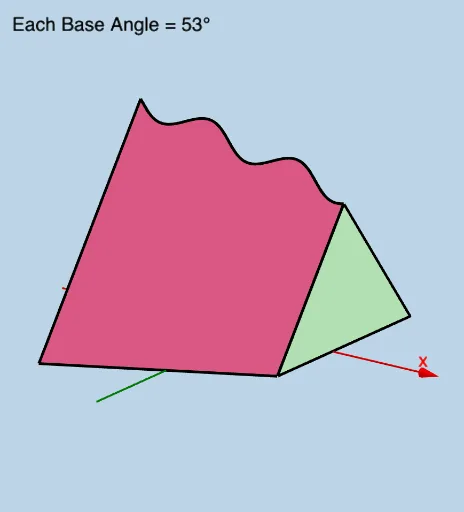
This example demonstrates a modifiable solid where cross-sections parallel to the yAxis are isosceles triangles with adjustable base angles. Core math concepts include solid geometry, coordinate geometry, and calculus concepts like cross-section analysis. Construction utilizes GeoGebra commands such as Intersect, Segment, Midpoint, Line, Rotate, Ray, Sphere, Polygon, Textfield, Angle, CurveCartesian, and Surface. Suitable for high school and above students to explore complex geometric solids and their cross-sectional properties.
GeoGebra Commands & Parameters
Intersect(lower, h, (-8, -14)) → CIntersect(upper, h, (-8, 10.145500033808613)) → BSegment(C, B) → qIntersect(upper, q, (-8, 10.145500033808613)) → GMidpoint(C, G) → TLine(T, T + (1, 0, 0)) → l_1Rotate(C, (-α), G, l_1) → C'Ray(G, C') → f_2Rotate(G, α, C, l_1) → G'Ray(C, G') → e_1Intersect(f_2, e_1) → B_1Segment(H, I) → s_1Midpoint(s_1) → ELine(E, E + (1, 0, 0)) → r_1Rotate(I, (-α), H, r_1) → I'Ray(H, I') → b_1Rotate(H, α, I, r_1) → H'Ray(I, H') → a_1Intersect(b_1, a_1) → A_1Segment(J, K) → q_1Midpoint(q_1) → FLine(F, F + (1, 0, 0)) → cRotate(K, (-α), J, c) → K'Ray(J, K') → p_1Rotate(J, α, K, c) → J'Ray(K, J') → m_1Intersect(m_1, p_1) → ZLine(B, D) → iSphere(B, d) → ePolygon(C, G, B_1) → q1, f_1, g_1, n_1Segment(C, B) → pPolygon(K, J, Z) → q2, l, m, nPolygon(H, I, A_1) → q3, r, s, tTextfield(upper) → InputBox1Textfield(lower) → InputBox2Textfield(a) → InputBox3Textfield(b) → InputBox4Segment(C, G) → k_1Segment(K, Z) → fSegment(J, Z) → gSegment(A_1, I) → c_1Segment(A_1, H) → d_1Segment(C, B_1) → i_1Segment(B_1, G) → j_1Angle(G, C, B_1) → βAngle(B_1, G, C) → γCurveCartesian(t, lower(t) + (0.5 * (upper(t) - lower(t))), ((0.5 * (upper(t) - lower(t))) * tan(α)), t, a, b) → jSurface(u, ((0.5 * (upper(u) - lower(u))) * v) + lower(u), (((0.5 * (upper(u) - lower(u))) * tan(α)) * v), u, a, b, v, 0, 1) → kSurface(u, ((0.5 * (upper(u) - lower(u))) * v) + (0.5 * (lower(u) + upper(u))), (((-0.5 * (upper(u) - lower(u))) * tan(α)) * v) + ((0.5 * (upper(u) - lower(u))) * tan(α)), u, a, b, v, 0, 1) → o