
Geometric Demo of ASA Triangle Congruence
Loading the math board and drawing, please wait…
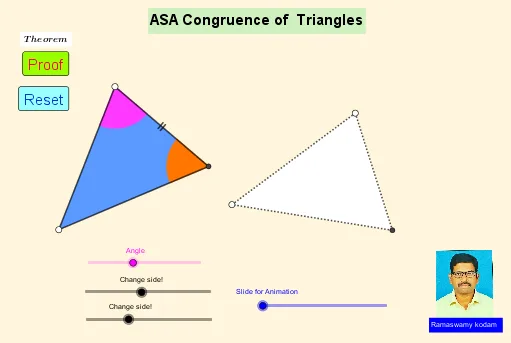
This example constructs two triangles to demonstrate the ASA congruence criterion: if two angles and the included side of one triangle are respectively equal to those of another, then the triangles are congruent. It focuses on triangle congruence reasoning (ASA), corresponding angles, included side, and how geometric constraints can determine a unique match. The construction uses GeoGebra elements and commands reflected in the provided construction summary: Circle and Point to define circles and key points; Intersect to obtain intersection points that fix the geometry; Segment plus Line/Polygon to form triangle edges and boundaries; Angle to measure and label the given equal angles; Rotate, Translate, and Dilate together with Vector to align one triangle with the other for congruence verification; and CircleSector/angle-related structures to visualize the angle region tied to the included side. Suitable for middle/high school geometry instruction and practice, especially for students learning how ASA leads to a rigid correspondence between triangles.
GeoGebra Commands & Parameters
Circle(A, a) → cCircle(B, a) → dCircle(A, b) → eCircle(B, b) → fPoint(c) → DPoint(d) → ESegment(A, D) → gSegment(B, E) → hRotate(D, α, A) → D'Angle(D, A, D') → βRotate(E, α, B) → E'Angle(E, B, E') → γSegment(A, D') → iSegment(B, E') → jIntersect(e, i) → C,Intersect(f, j) → F,Segment(A, C) → kSegment(C, D) → lSegment(B, F) → mSegment(F, E) → nSegment(A, B) → pCircle(A, ((a + b) * 0.15)) → qIntersect(q, g) → G,Intersect(i, k) → HIntersect(q, k) → I,CircleSector(A, G, I) → rLine(A, h) → sAngle(s, g) → δDilate(A, If[2 < o ≤ 3, 3 - o, 0], B) → A'_1Vector(A, A'_1) → vTranslate(r, v) → r'Translate(A, v) → A'_2Translate(C, v) → C'Segment(A'_2, C') → k'Line(A, m) → tAngle(t, k) → εRotate(r', If[3 < o ≤ 4, ((-(o - 3)) * ε), (-ε)], B) → r''Rotate(A'_2, If[3 < o ≤ 4, ((-(o - 3)) * ε), (-ε)], B) → KRotate(C', If[3 < o ≤ 4, ((-(o - 3)) * ε), (-ε)], B) → C''Segment(K, C'') → k''Dilate(A, If[4 < o ≤ 5, 5 - o, 0], B) → A'_3Polygon(A, D, C) → t1, c_1, a_1, d_1Polygon(B, E, F) → t2, f_1, b_1, e_1Vector(A, A'_3) → wTranslate(A, w) → A'_4Translate(D, w) → D'_3Translate(C, w) → C'_1Polygon(A'_4, D'_3, C'_1) → t1', c'_1, a'_4, d'_3Rotate(A'_4, If[5 < o ≤ 6, ((-(o - 5)) * δ), (-δ)], B) → LRotate(D'_3, If[5 < o ≤ 6, ((-(o - 5)) * δ), (-δ)], B) → MRotate(C'_1, If[5 < o ≤ 6, ((-(o - 5)) * δ), (-δ)], B) → NPolygon(L, M, N) → t1'', n_1, l_1, m_1Circle(C, ((a + b) * 0.15)) → g_1Intersect(l, a_1) → QIntersect(l, a_1) → RIntersect(l, a_1) → SIntersect(g_1, l) → T,Intersect(g_1, k) → U,CircleSector(C, U, T) → h_1Dilate(C, If[0 < o ≤ 1, 1 - o, 0], F) → C'_2Vector(C, C'_2) → uTranslate(h_1, u) → k_1Rotate(k_1, If[1 < o ≤ 2, ((-(o - 1)) * δ), (-δ)], F) → p_1
AI Drawing Prompt Reference
Draw two triangles ABC and DEF, where angle A equals angle D, angle B equals angle E, and side AB equals side DE. First, draw circles centered at A and B to determine points D and E. Then, draw line segments AD and BE. Next, rotate points D and E so that angle ADB equals angle BEC. Draw line segments AD' and BE', and find their intersections with the circles to get points C and F. Finally, draw triangles ABC and DEF, and use translation and rotation to align triangle DEF with triangle ABC to verify their congruence.
The prompt above was compiled from the original drawing commands and is for reference only.