
Geometric Construction Practice: Angle Construction with Tangent/Symmetry Aids
Loading the math board and drawing, please wait…
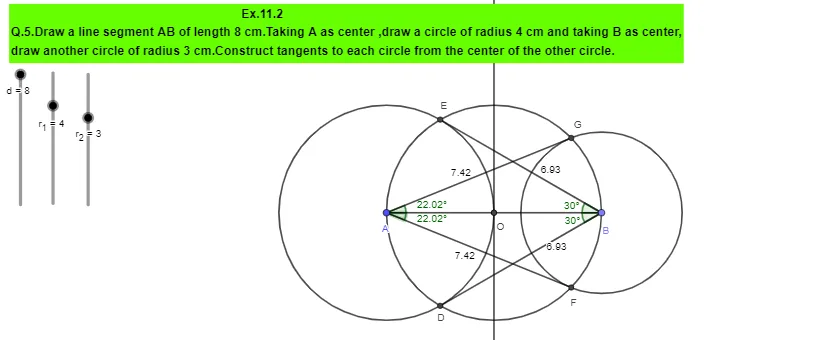
This GeoGebra example demonstrates a guided geometry-construction workflow that turns given points and angle data into the required key entities—such as tangent-related lines, symmetric/angle-equality constraints, and intersection-defined construction points. The main mathematical ideas include angle construction and verification (Angle), building and using circles to localize geometry (Circle), computing critical locations via intersections (Intersect), and employing angle bisectors to enforce equal-angle or symmetry conditions (LineBisector). The construction steps are reflected in the GeoGebra command summary: Point to place the involved points (e.g., A, B, O, C and auxiliary vertices), Segment to form the geometric skeleton, Circle to generate the working circles with radii (r1, r2), LineBisector to create the bisector lines that act as constraints, Intersect to determine intersection points used for later steps, and Angle to measure/label angles (α, β, γ, δ) that drive the solution. It is well-suited for secondary-school students and as a classroom demonstration for geometric construction reasoning, especially for learners practicing “construct from constraints → generate auxiliaries → intersect to determine targets” in a systematic way.
GeoGebra Commands & Parameters
Point(Circle[A, d]) → BSegment(A, B) → fCircle(A, r_{1}) → cCircle(B, r_2) → eLineBisector(f) → gIntersect(c, g) → O, CCircle(O, A) → hIntersect(h, c) → D, E, ,Intersect(e, h) → F, G, ,Segment(E, B) → iSegment(B, D) → jSegment(A, G) → kSegment(A, F) → lAngle(B, A, G) → αAngle(F, A, B) → βAngle(E, B, O) → γAngle(O, B, D) → δ
AI Drawing Prompt Reference
Draw a planar geometric construction starting with two given points A and B. Create a line through A and B, then construct an auxiliary angle-bisector type line associated with that segment. Draw two circles: one centered at A with a specified radius r1 and one centered at B with a specified radius r2. Find intersections between the A-circle and the auxiliary bisector to obtain points O and C. Construct a new circle centered at O with radius OA, then intersect this O-circle with the A-circle to get points D and E, and intersect it with the B-circle to get points F and G. Finally, draw segments EB, BD, AG, and AF, and mark four angles determined by these segments: ∠BAG, ∠FAB, ∠EBO, and ∠OBD.
The prompt above was compiled from the original drawing commands and is for reference only.