
Geometric Construction of the nth Roots of Unity on the Complex Plane
Loading the math board and drawing, please wait…
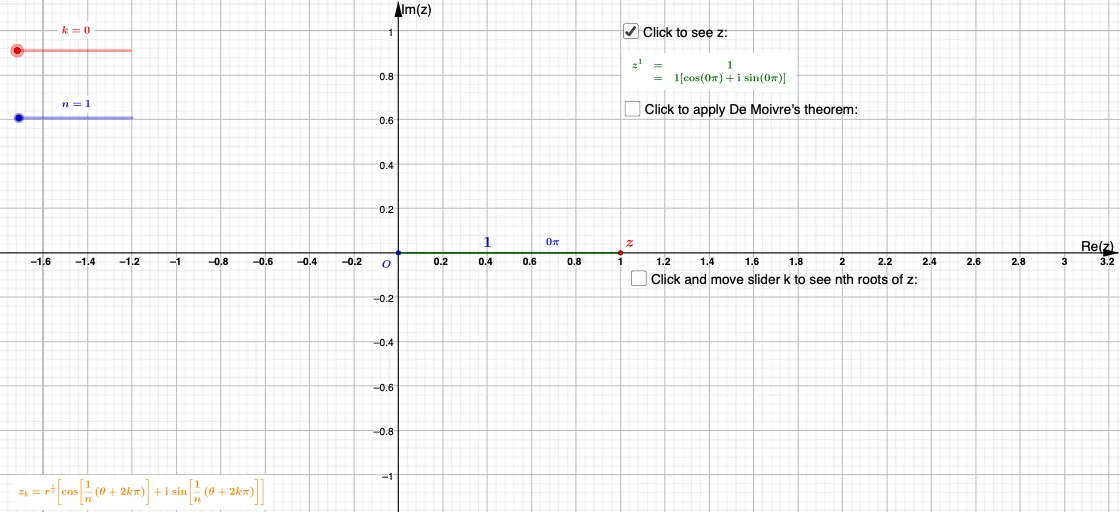
This GeoGebra example demonstrates the nth roots of unity as equally spaced points on the unit circle in the complex plane, illustrating how complex multiplication corresponds to rotation and how the roots form the vertices of a regular n-gon. Core mathematical concepts include complex numbers, roots of unity, trigonometric and polar representations, angle bisection, and regular polygon geometry. The construction employs GeoGebra commands such as Point, Intersect, Rotate, Angle, Ray, Segment, FractionText, AngularBisector, Midpoint, and SurdText, together with objects n, k, a, O, A, A′, α, z_k and related text labels to generate and annotate the roots. It is suitable for high school complex number electives, undergraduate complex analysis courses, and classroom demonstrations exploring the geometric and algebraic properties of roots of unity.
GeoGebra Commands & Parameters
Point(xAxis) → AIntersect(xAxis, yAxis) → ORotate(A, a, O) → A'Angle(A, O, A') → αRay(O, A') → fPoint(Circle[O, r]) → BSegment(O, B) → gSegment(O, C) → hFractionText(c) → text1AngularBisector(A, O, A') → iPoint(i) → DFractionText(e) → text6Midpoint(O, C) → ESurdText(a_1) → text17SurdText(b_1) → text18SurdText(a_2) → text22SurdText(b_2) → text23SurdText(z_3) → text_3SurdText(z_2) → text_2SurdText(z_1) → text_1SurdText(z_4) → text_4SurdText(z_5) → text_5Segment(O, z_1) → qSegment(O, z_2) → sSegment(O, z_3) → tSegment(O, z_4) → f_1Segment(O, z_5) → g_1
AI Drawing Prompt Reference
Draw the complex plane with a circle centered at the origin, representing the unit circle. Start by placing a base point on the real axis, then rotate it around the origin by a parameter angle to obtain the second direction point; measure the angle between the two directions and construct its angle bisector. Use rays from the origin through the constructed directions to locate several equally spaced points on the circle (the vertices of a regular n-gon). Connect the origin to each selected circle point with segments, showing the corresponding radii. Add nearby text labels for the key angles and the symbols associated with the nth roots.
The prompt above was compiled from the original drawing commands and is for reference only.