
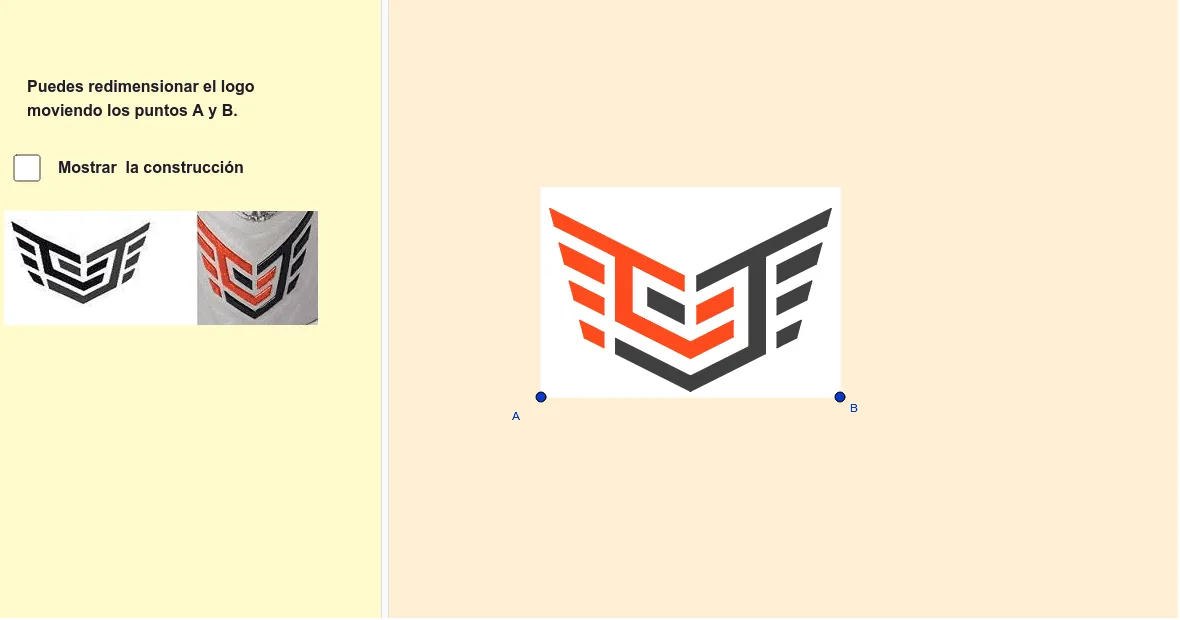
Geometric Construction of the KALVIN JONSHON Logo
Loading the math board and drawing, please wait…
① This example demonstrates how to construct a planar logo named 'KALVIN JONSHON' using GeoGebra's geometric tools, combining lines, circles, polygons, vectors, and quadratic functions. ② Core mathematical concepts include two-dimensional vectors, angles, circles, quadrilaterals, quadratic functions, rotation, piecewise functions, area, and plane figures, showcasing the integration of geometry and algebra in graphic design. ③ Construction highlights: from the summary, commands such as LineBisector, Line, OrthogonalLine, Vector, OrthogonalVector, Intersect, Mirror, and Polygon are used, along with numerous objects like e_2, e_1, B, A, m, s, b, u, v, F, f, A_1, l, I, f', D, i, E, G, H, k, K, t, r, j, g, C, plus text objects and auxiliary points, to precisely build the logo's outline and internal structure. ④ Suitable for high school or early college mathematics and geometry drawing courses, as well as teaching the mathematical principles behind graphic design, helping students understand the practical application of geometric transformations, vector operations, and function graphs in creative work.
GeoGebra Commands & Parameters
LineBisector(A, B) → mLine(A, B) → sOrthogonalLine(A, s) → bVector(A, B) → uOrthogonalVector(u) → vOrthogonalLine(F, b) → fLineBisector(A_1, A) → lIntersect(m, l) → IMirror(f, l) → f'OrthogonalLine(D, s) → iIntersect(i, f') → EOrthogonalLine(H, i) → kOrthogonalLine(G, b) → tOrthogonalLine(A_1, b) → rOrthogonalLine(K, l) → jOrthogonalLine(B, u, xOyPlane) → gIntersect(g, r) → CMirror(f, l) → f'_1Mirror(F, l) → F'Polygon(A_1, C, B, A) → c4, a_1, c_3, b_2, a_2Intersect(m, f') → JIntersect(m, k) → MLineBisector(A, B) → nMirror(i, n) → i'Intersect(n, f) → OLine(R, k) → hLine(S, h) → pLine(T, h) → qLine(L, q) → aLine(U, a) → cIntersect(j, c) → NOrthogonalLine(P, r) → dLine(Q, d) → eLine(V, e) → f_1Line(W, f_1) → g_1Line(O, N) → h_1Line(E, h_1) → i_1Line(E, N) → j_1Line(G, i_1) → k_1Line(H, i_1) → l_1Line(R, i_1) → m_1Line(S, i_1) → n_1Line(T, n_1) → p_1Line(L, i_1) → q_1Line(U, i_1) → r_1Intersect(j_1, k_1) → ZIntersect(j_1, l_1) → B_1Intersect(j_1, m_1) → C_1Intersect(j_1, n_1) → D_1Intersect(j_1, p_1) → E_1Intersect(j_1, q_1) → F_1Intersect(j_1, r_1) → G_1Intersect(n, n_1) → L_1Intersect(n, p_1) → M_1Intersect(n, q_1) → N_1Intersect(n, r_1) → O_1Line(P_1, n) → s_1Intersect(s_1, i_1) → H_1Intersect(s_1, k_1) → I_1Intersect(s_1, l_1) → J_1Intersect(s_1, m_1) → K_1Polygon(E, H_1, I_1, Z) → c1, e_3, t_1, b_1, z_1Intersect(d, l_1) → Q_1Intersect(d, m_1) → R_1Intersect(d, n_1) → S_1Intersect(d, p_1) → T_1Intersect(d, q_1) → U_1Intersect(d, r_1) → V_1Polygon(Q_1, R_1, C_1, B_1) → c2, c_1, d_1, f_2, g_2Polygon(S_1, D_1, E_1, T_1) → c3, h_2, i_2, j_2, k_2Polygon(V_1, U_1, F_1, G_1) → c5, v_1, u_1, l_2, m_2Intersect(e, r_1) → W_1Intersect(e, q_1) → Z_1Polygon(Z_1, N_1, O_1, W_1) → c6, n_2, p_2, o_1, w_1Intersect(g_1, l_1) → A_2Intersect(g_1, m_1) → B_2Polygon(A_2, J_1, K_1, B_2) → c7, q_2, r_2, s_2, t_2Intersect(k_1, e) → C_2Intersect(f_1, k_1) → D_2Intersect(p_1, e) → E_2Intersect(n_1, f_1) → F_2Polygon(E_2, M_1, L_1, F_2, D_2, C_2) → polígono1, c_2, d_2, f_3, g_3, h_3, i_3Mirror(E, n) → E'Mirror(H_1, n) → G_2Mirror(I_1, n) → H_2Mirror(Z, n) → Z'Polygon(E', G_2, H_2, Z') → c1', e', j_3, k_3, z'Mirror(Q_1, n) → I_2Mirror(R_1, n) → J_2Mirror(C_1, n) → K_2Mirror(B_1, n) → L_2Polygon(I_2, J_2, K_2, L_2) → c2', l_3, m_3, n_3, p_3Mirror(S_1, n) → M_2Mirror(D_1, n) → N_2Mirror(E_1, n) → O_2Mirror(T_1, n) → P_2Polygon(M_2, N_2, O_2, P_2) → c3', q_3, r_3, o_2, s_3Mirror(V_1, n) → Q_2Mirror(U_1, n) → R_2Mirror(F_1, n) → S_2Mirror(G_1, n) → T_2Polygon(Q_2, R_2, S_2, T_2) → c5', t_3, b_3, d_3, f_4Mirror(Z_1, n) → U_2Mirror(N_1, n) → V_2Mirror(O_1, n) → W_2Mirror(W_1, n) → Z_2Polygon(U_2, V_2, W_2, Z_2) → c6', u_2, v_2, w_2, z_2Mirror(A_2, n) → A_3Mirror(J_1, n) → B_3Mirror(K_1, n) → C_3Mirror(B_2, n) → D_3Polygon(A_3, B_3, C_3, D_3) → c7', g_4, h_4, i_4, j_4Mirror(E_2, n) → E_3Mirror(M_1, n) → F_3Mirror(L_1, n) → G_3Mirror(F_2, n) → H_3Mirror(D_2, n) → I_3Mirror(C_2, n) → J_3OrthogonalLine(A_3, f'_1) → k_4Mirror(p_1, n) → l_4Mirror(n_1, n) → m_4Intersect(k_4, m_4) → K_3Intersect(k_4, l_4) → L_3Polygon(G_3, K_3, L_3, F_3) → c8, n_4, p_4, q_4, r_4OrthogonalLine(I_3, k) → s_4Mirror(q_1, n) → t_4Intersect(s_4, t_4) → M_3Polygon(I_3, J_3, U_2, M_3) → c9, a_4, b_4, c_4, d_4