
Geometric Construction of Scalar Multiplication of Vectors
Loading the math board and drawing, please wait…
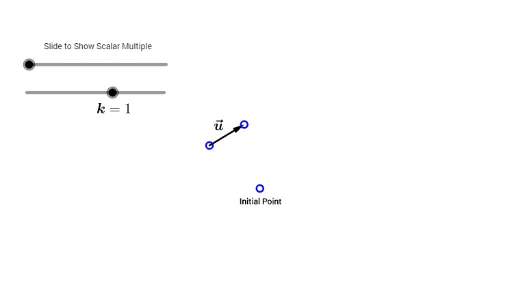
This example demonstrates, through an interactive geometry construction, how scalar multiplication k·u stretches, shrinks, or reverses a vector while keeping the relation along the same direction line. The key concepts are vector scalar multiplication, the geometric meaning of direction and magnitude changes, and related visual connections to angles/trigonometry and circle-based properties (e.g., tangent or circumcircle intuitions) that can be explored alongside the vector construction. In GeoGebra, the construction uses Vector to define the involved vectors, Translate to reproduce the vector shift corresponding to scalar scaling effects, Segment to display the measurable vector connections, Point to create and track construction points, and Midpoint to introduce midpoint-based geometric structure that supports proportional reasoning. The objects include the main parameters/vectors (k, A, B, u) and many derived points (e.g., A_1, B_1 and primed/subscripted points) used to form the vector endpoints and intermediate geometric relationships. Suitable for middle and high school students and for classroom demonstrations or self-guided inquiry on vector operations and geometric transformations.
GeoGebra Commands & Parameters
Vector(A, B) → uTranslate(C, u) → C'Translate(C', u) → C''Translate(C'', u) → C'''Translate(C''', u) → C''''Segment(C, C') → aSegment(C', C'') → bSegment(C'', C''') → cSegment(C''', C'''') → dSegment(A, C) → a'Segment(A, C') → b'Segment(A, C'') → c'Segment(A, C''') → d'Point(a', n) → A_1Point(b', n - 1) → B_1Translate(A_1, u) → DVector(A_1, D) → a_1Translate(B_1, u) → EVector(B_1, E) → b_1Translate(C, Fin) → EndCSegment(C, EndC) → CEndCPoint(CEndC, ((n - abs(k)) * 2 / abs(k))) → AlmEndVector(C, AlmEnd) → EndTranslate(C, Vector[(-u)]) → C'_1Translate(C'_1, Vector[(-u)]) → C''_1Translate(C''_1, Vector[(-u)]) → C'''_1Translate(C'''_1, Vector[(-u)]) → C''''_1Segment(C, C'_1) → eSegment(C'_1, C''_1) → fSegment(C''_1, C'''_1) → gSegment(C'''_1, C''''_1) → hSegment(A, C'_1) → e'Segment(A, C''_1) → f'Segment(A, C'''_1) → g'Segment(A, C''''_1) → h'Point(c', n - 2) → C_1Point(d', n - 3) → D_1Translate(C_1, u) → FVector(C_1, F) → c_1Translate(D_1, u) → GVector(D_1, G) → d_1Point(e', n - 1) → E_1Translate(E_1, Vector[(-u)]) → HVector(E_1, H) → e_1Translate(A_1, Vector[(-u)]) → IVector(A_1, I) → a_1'Point(f', n - 2) → F_1Point(g', n - 3) → G_1Translate(F_1, Vector[(-u)]) → JVector(F_1, J) → f_1Translate(G_1, Vector[(-u)]) → KVector(G_1, K) → g_1Translate(A, Vector[(-u)]) → A'Vector(A, A') → vMidpoint(C, AlmEnd) → Mid
AI Drawing Prompt Reference
Draw a geometric construction illustrating scalar multiplication of vectors. Start with a vector u from point A to point B. From point C, translate along u four times to create four equally spaced points, connecting consecutive points with segments to form a straight line of equal parts. From A, draw segments to each of these points. On each such segment, place points at proportional positions and translate them along u to create new small vectors. Simultaneously, translate from C in the opposite direction of u four times to create equally spaced points on the reverse side, connecting them with segments. Finally, on the segment from C to the endpoint, place a point at a position determined by the scalar k, and draw a vector from C to that point, representing the scaled vector. The whole figure shows stretching, shrinking, and reversal of vectors.
The prompt above was compiled from the original drawing commands and is for reference only.