
Difference-based Trigonometric Construction with Tangent Geometry
Loading the math board and drawing, please wait…
In collections
geometriadinamica.es
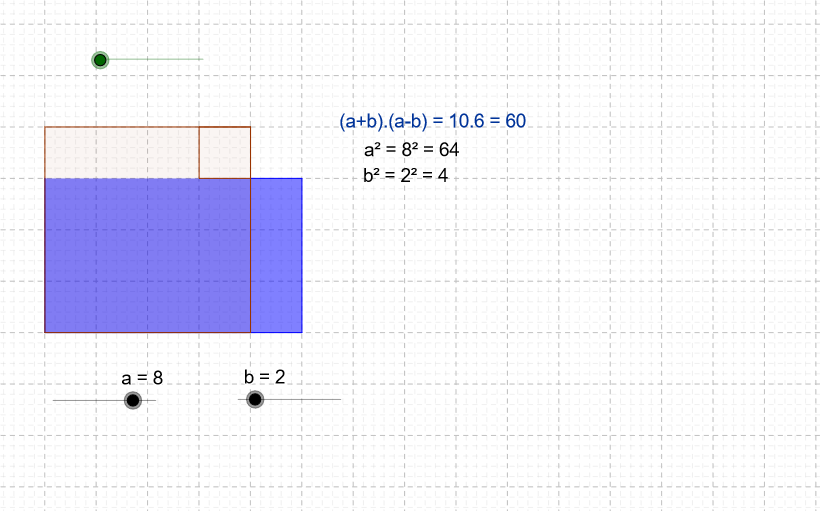
This example uses a “sum by difference” (Suma por diferencia) geometric relationship to connect difference-structured quantities with tangent geometry, illustrating how direction information can be realized as constructed tangent-related points and segments in a unified diagram. It centers on trigonometry (tangent), the geometric meaning of tangents, and vector-based direction handling, supported by standard construction transforms. In GeoGebra, the construction relies on Rotate, Vector, Polygon, Translate, and Mirror, together with many transformed (primed/double-primed) objects to show correspondences after each transformation. Key named points (e.g., A, B, C, D, F, G, I, P and intermediate points like H, E) and tangent/related objects (e.g., T1, T2, T3, T, plus quantities such as h_1, b_1, c_1, i_1) are arranged so the reader can visually track how the “difference-driven” setup affects the tangent geometry. Suitable for high school to early university learners for building geometric intuition about trigonometric tangents and for learning constructive visualization techniques.
GeoGebra Commands & Parameters
Rotate(H, (j * 90°), A) → H'Vector(H', E) → wPolygon(A, B, H, E) → P, c, d, e, fPolygon(H, B, C, I) → T, h_1, b_1, c_1, i_1Rotate(B, (j * 90°), A) → B'Rotate(C, (j * 90°), A) → C'Rotate(I, (j * 90°), A) → I'Translate(H', v) → H''Translate(B', v) → B''Translate(C', v) → C''Translate(I', v) → I''Polygon(H'', B'', C'', I'') → T'', h'', b'', c'', i''Polygon(D, F, B, A) → Q, d_1, f_1, b_2, a_1Mirror(G, F) → JMirror(I, f_1) → KPolygon(F, J, K, H) → R, f_2, j_1, k, hPolygon(JJ, GG, II, KK) → S, jj, gg, ii, kk
AI Drawing Prompt Reference
Draw a trigonometric construction based on differences, including points A, B, C, D, F, G, I, and H, and their corresponding points H', B', C', I', H'', B'', C'', and I''. Use polygons P, T, Q, R, and S to illustrate how direction information is realized through constructed tangent-related points and segments. Employ transformations like rotation, vector, polygon, translation, and reflection to build the figure step by step, ultimately showing how the difference-driven setup affects the tangent geometry.
The prompt above was compiled from the original drawing commands and is for reference only.