
Geometric Construction of Vector Addition
Loading the math board and drawing, please wait…
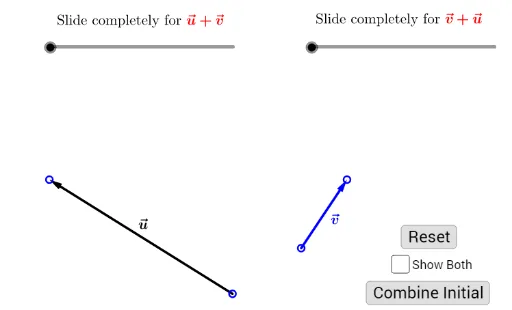
This example demonstrates vector addition using a clear geometric construction and uses the idea to define basic vectors. It focuses on vector concepts such as magnitude and direction, translating vectors to a convenient position, and computing sums by the head-to-tail (tip-to-tail) method. The construction uses GeoGebra commands including Vector, Segment, and Point to create vectors and key points; Translate to move vectors and obtain equivalent vectors positioned for addition (e.g., producing objects like TransUV/TransVU and corresponding translated endpoints such as C′, D′, A′, B′); and If for conditional logic to manage steps. Interactive elements (buttons and text via Show/Show_1/Show_2) help visualize the incremental process. Suitable for middle school through introductory university courses, especially for lessons on vectors and linear/translation-based relationships.
GeoGebra Commands & Parameters
Vector(A, B) → u'Vector(C, D) → v'Segment(B, C) → bPoint(b, 1 - t_1) → EVector(C, E) → TransUVTranslate(C, TransUV) → C'Translate(D, TransUV) → D'Segment(A, D) → aPoint(a, t_2) → FVector(A, F) → TransVUTranslate(A, TransVU) → A'Translate(B, TransVU) → B'Vector(C', D') → vSegment(D', A) → cPoint(c, 2 - t_1) → GVector(A, G) → UVSegment(B', C) → dPoint(d, 2 - t_2) → HVector(C, H) → VUVector(F, B') → uIf(Show ≟ true, t_1, 0) → Show_1If(Show ≟ true, t_2, 0) → Show_2
AI Drawing Prompt Reference
Draw a geometric construction of vector addition. Start with two free vectors, each from a start point to an end point, and connect the end of the first vector to the start of the second with a segment. Place a moving point on this segment, and from the second vector's start point draw a translation vector to that moving point. Translate both endpoints of the second vector by this translation vector to obtain a new pair of endpoints, forming a translated copy of the second vector. Similarly, place another moving point on a different connecting segment, and translate the endpoints of the first vector accordingly. Finally, draw the sum vector from the start of the first vector to the translated end of the second vector, and show the positions of the moving points on the auxiliary segments to illustrate the head-to-tail addition.
The prompt above was compiled from the original drawing commands and is for reference only.