
Geometric Construction for the Sum of the Fourth Powers of Diagonals
Loading the math board and drawing, please wait…
In collections
Besondere Punkte/Special Points
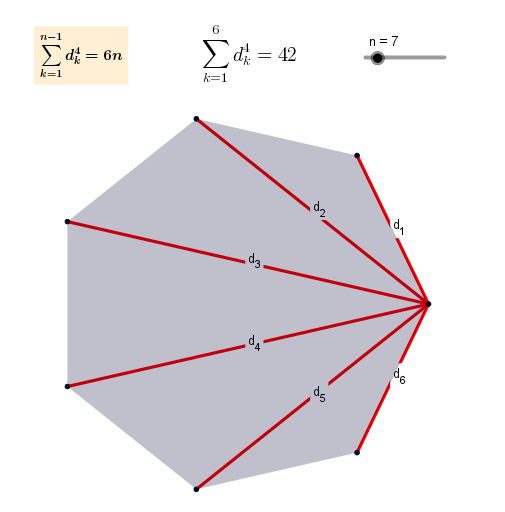
This example demonstrates how to measure selected diagonals in a planar polygonal figure and then compute the sum of the fourth powers of their lengths, providing an intuitive way to verify a diagonal-dependent numerical relationship. The core mathematical ideas are geometric distance/length between points (often represented via vectors), power operations (fourth power), and aggregation via summation over multiple diagonal quantities. Construction-wise, the provided commands indicate: Sequence is used to generate an indexed set of objects (n) and related terms; Polygon builds the polygonal configuration and its vertex structure (E, V, S); Sum performs the fourth-power summation over diagonal-length expressions (p); Text2 and Text1 are used to display the computed results or the underlying formula. Suitable for secondary school geometry enrichment, classroom exploration in analytic geometry, and early undergraduate demonstrations of translating geometric quantities into algebraic forms.
GeoGebra Commands & Parameters
Sequence((cos(((2 * k) * pi / n)), sin(((2 * k) * pi / n))), k, 0, n - 1) → EPolygon(E) → VSequence(Segment[E(1), E(k)], k, 2, n) → SSum((S(k))^(4), k, 1, n - 1) → pSequence(Text["d_{" + (k) + "}", Midpoint[S(k)]], k, 1, n - 1) → T
AI Drawing Prompt Reference
Construct a planar polygon by placing a set of points evenly distributed around a circle, indexed from 0 to n−1, and connecting them in order to form the polygon. Then draw a collection of diagonal segments between selected pairs of vertices (excluding adjacent edges), treating each diagonal segment’s length as one measured quantity. Compute the sum of the fourth powers of these diagonal lengths to represent an aggregated expression. Finally, place a small label for d_k near the midpoint of each diagonal segment so each marked length corresponds clearly to the term used in the sum.
The prompt above was compiled from the original drawing commands and is for reference only.