
GeoGebra Exploration of Divisibility by 3 and 9 with Interactive Checks
Loading the math board and drawing, please wait…
In collections
Teilbarkeitsregeln
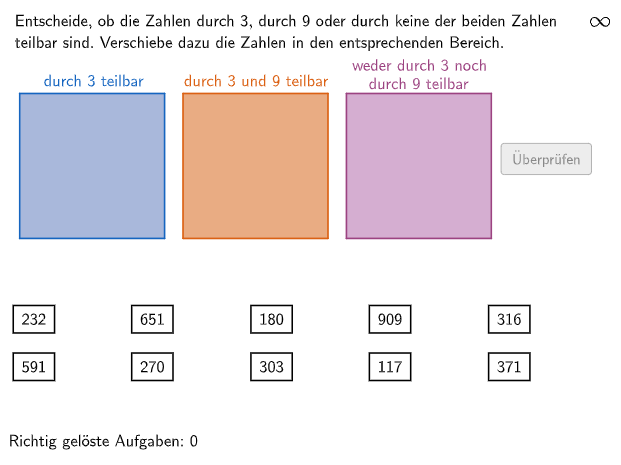
This GeoGebra example uses interactive text and generated data to illustrate how numbers behave with respect to divisibility by 3 and by 9. It supports classroom practice focused on whether a claim about divisibility is true, and encourages reasoning using verifiable conditions. The key math concepts are factors and multiples, divisibility rules, and justification (or refutation) of statements about divisibility. Construction-wise, the lesson organizes visual/text components and dynamic behavior: it uses Polygon for structured on-screen geometry/layout, RandomList3 and RandomList9 to generate test numbers, Midpoint to compute geometric reference points, Textfield to collect or display inputs, and Element/Append/Remove to manage dynamic objects. Conditional logic is implemented with If and IsInRegion to decide which statements to show, while Join helps combine text/parts of results; multiple colored text objects convey prompts and outcomes. Suitable for grades 5–6 and for teaching/learning number sense, factors, and multiples through interactive exploration.
GeoGebra Commands & Parameters
Polygon(Q1E1, Q1E2, 4) → Q1, q1_1, q1_2, q1_3, q1_4, Q1E3, Q1E4Polygon(Q2E1, Q2E2, 4) → Q2, q2_1, q2_2, q2_3, q2_4, Q2E3, Q2E4Polygon(Q3E1, Q3E2, 4) → Q3, q3_4, q3_1, q3_2, q3_3, Q3E3, Q3E4Shuffle(Sequence[Element[Shuffle[Sequence[(k * 3), k, 1, 333]], i], i, 1, 5]) → RandomList3, {117, 591, 651, 807, 303}Shuffle(Sequence[Element[Shuffle[Sequence[(k * 9), k, 1, 111]], i], i, 1, 5]) → RandomList9, {189, 423, 270, 909, 180}Shuffle(Sequence[Element[Shuffle[Sequence[k, k, 100, 1000] \ Sequence[(k * 3), k, 1, 333]], i], i, 1, 5]) → RandomListNot39, {371, 625, 583, 232, 316}Shuffle(Unique[Join[{RandomList3, RandomList9, RandomListNot39}]]) → RandomListNum, {232, 651, 180, 909, 316, 591, 270, 303, 117, 371, 625, 807, 583, 189, 423}Midpoint(Corner[NumText7, 1], Corner[NumText7, 3]) → Pos7Midpoint(Corner[NumText10, 1], Corner[NumText10, 3]) → Pos10Midpoint(Corner[T1830, 1], Corner[T1830, 3]) → Pos1830Midpoint(Corner[NumText6, 1], Corner[NumText6, 3]) → Pos6Midpoint(Corner[NumText3, 1], Corner[NumText3, 3]) → Pos3Midpoint(Corner[T1826, 1], Corner[T1826, 3]) → Pos1826Midpoint(Corner[NumText5, 1], Corner[NumText5, 3]) → Pos5Midpoint(Corner[NumText9, 1], Corner[NumText9, 3]) → Pos9Midpoint(Corner[T2628, 1], Corner[T2628, 3]) → Pos2628Midpoint(Corner[NumText8, 1], Corner[NumText8, 3]) → Pos8Midpoint(Corner[NumText4, 1], Corner[NumText4, 3]) → Pos4Midpoint(Corner[NumText2, 1], Corner[NumText2, 3]) → Pos2Midpoint(Corner[NumText1, 1], Corner[NumText1, 3]) → Pos1Textfield(aInput) → InputBox1Textfield(bInput) → InputBox2Polygon(PtopLeftCornerFeedback, PtopRightCornerFeedback, PbottomRightCornerFeedback, PbottomLeftCornerFeedback) → rectangleCorrect, ptopleftcornerfeedback, ptoprightcornerfeedback, pbottomrightcornerfeedback, pbottomleftcornerfeedbackShuffle(Sequence[Random[0, 10], i, 1, 100]) → randomNosForX, {7, 10, 3, 6, 10, 10, 6, 1, 5, 9, 3, 6, 5, 10, 4, 10, 1, 3, 9, 2, 1, 1, 0, 2, 1, 4, 2, 8, 7, 9, 9, 5, 8, 9, 1, 5, 8, 6, 1, 7, 2, 10, 1, 2, 4, 1, 3, 2, 3, 1, 7, 8, 2, 2, 7, 2, 6, 9, 4, 7, 10, 8, 6, 4, 2, 9, 10, 8, 0, 5, 10, 5, 7, 3, 5, 0, 7, 9, 8, 9, 7, 2, 3, 9, 3, 5, 2, 0, 7, 3, 2, 2, 0, 1, 8, 9, 1, 4, 5, 10}Element(randomNosForX, Mod[questionCount, 100] + 1) → numXShuffle(Sequence[Random[0, 10], i, 1, 100]) → randomNosForY, {5, 5, 1, 6, 1, 7, 1, 10, 10, 0, 8, 6, 8, 4, 1, 5, 1, 3, 5, 4, 3, 5, 8, 8, 1, 3, 2, 9, 7, 4, 2, 2, 2, 9, 10, 7, 6, 3, 1, 4, 3, 5, 7, 8, 5, 0, 2, 10, 6, 2, 6, 9, 4, 7, 9, 7, 9, 8, 10, 10, 10, 6, 4, 10, 0, 2, 9, 6, 9, 1, 0, 5, 5, 5, 7, 5, 1, 10, 10, 8, 3, 9, 3, 9, 2, 1, 7, 0, 3, 3, 8, 6, 2, 0, 5, 7, 4, 5, 4, 6}Element(randomNosForY, Mod[questionCount, 100] + 1) → numYAppend(true, Sequence[If[randomNosForX(i) ≟ randomNosForX(i - 1), false, true], i, 2, 100]) → stayXAppend(true, Sequence[If[randomNosForY(i) ≟ randomNosForY(i - 1), false, true], i, 2, 100]) → stayYRemove(Sequence[If[stayX(i), randomNosForX(i), 0], i, 1, 100], Sequence[0, i, 1, 100]) → randomNosForXwithoutRepeatRemove(Sequence[If[stayY(i), randomNosForY(i), 0], i, 1, 100], Sequence[0, i, 1, 100]) → randomNosForYwithoutRepeatElement(randomNosForXwithoutRepeat, Mod[questionCount, Length[randomNosForXwithoutRepeat]] + 1) → numXwithoutRepeatElement(randomNosForYwithoutRepeat, Mod[questionCount, Length[randomNosForYwithoutRepeat]] + 1) → numYwithoutRepeatIf(Mod[num1, 9] ≟ 0, 2, Mod[num1, 3] ≠ 0, 3, 1) → num1metaIf(Mod[num2, 9] ≟ 0, 2, Mod[num2, 3] ≠ 0, 3, 1) → num2metaIf(Mod[num3, 9] ≟ 0, 2, Mod[num3, 3] ≠ 0, 3, 1) → num3metaIf(Mod[num4, 9] ≟ 0, 2, Mod[num4, 3] ≠ 0, 3, 1) → num4metaIf(Mod[num5, 9] ≟ 0, 2, Mod[num5, 3] ≠ 0, 3, 1) → num5metaIf(Mod[num6, 9] ≟ 0, 2, Mod[num6, 3] ≠ 0, 3, 1) → num6metaIf(Mod[num7, 9] ≟ 0, 2, Mod[num7, 3] ≠ 0, 3, 1) → num7metaIf(Mod[num8, 9] ≟ 0, 2, Mod[num8, 3] ≠ 0, 3, 1) → num8metaIf(Mod[num9, 9] ≟ 0, 2, Mod[num9, 3] ≠ 0, 3, 1) → num9metaIf(Mod[num10, 9] ≟ 0, 2, Mod[num10, 3] ≠ 0, 3, 1) → num10metaIsInRegion(Pos1, If[num1meta ≟ 1, Q1, num1meta ≟ 2, Q2, Q3]) → correct1IsInRegion(Pos2, If[num2meta ≟ 1, Q1, num2meta ≟ 2, Q2, Q3]) → correct2IsInRegion(Pos3, If[num3meta ≟ 1, Q1, num3meta ≟ 2, Q2, Q3]) → correct3IsInRegion(Pos4, If[num4meta ≟ 1, Q1, num4meta ≟ 2, Q2, Q3]) → correct4IsInRegion(Pos5, If[num5meta ≟ 1, Q1, num5meta ≟ 2, Q2, Q3]) → correct5IsInRegion(Pos6, If[num6meta ≟ 1, Q1, num6meta ≟ 2, Q2, Q3]) → correct6IsInRegion(Pos7, If[num7meta ≟ 1, Q1, num7meta ≟ 2, Q2, Q3]) → correct7IsInRegion(Pos8, If[num8meta ≟ 1, Q1, num8meta ≟ 2, Q2, Q3]) → correct8IsInRegion(Pos9, If[num9meta ≟ 1, Q1, num9meta ≟ 2, Q2, Q3]) → correct9IsInRegion(Pos10, If[num10meta ≟ 1, Q1, num10meta ≟ 2, Q2, Q3]) → correct10Join(Sequence[Element[Sequence[Sequence[Q1E1 + ((i * dfx), ((-k) * dfy)), i, 0, 2], k, 0, 3], j], j, 1, 4]) → PunkteMenge1Join(Sequence[Element[Sequence[Sequence[Q2E1 + ((i * dfx), ((-k) * dfy)), i, 0, 2], k, 0, 3], j], j, 1, 4]) → PunkteMenge2Join(Sequence[Element[Sequence[Sequence[Q3E1 + ((i * dfx), ((-k) * dfy)), i, 0, 2], k, 0, 3], j], j, 1, 4]) → PunkteMenge3Text(CorrHelper, A, false, true, 0, 0) → Text11
AI Drawing Prompt Reference
This is an interactive math exploration graphic featuring multiple quadrilaterals (Q1, Q2, Q3) representing number regions, along with midpoint markers (Pos1 to Pos10) for positioning. Input boxes (InputBox1, InputBox2) and text areas (NumText1 to NumText10) are included for displaying and entering numbers. Randomly generated number lists (RandomList3, RandomList9, etc.) are mapped to quadrilaterals, with If and IsInRegion logic determining whether each number falls within its corresponding region, displaying correct or incorrect prompts. The overall layout uses Polygon and Midpoint tools to construct geometry, illustrating the visual relationship between numbers and regions, suitable for teaching divisibility concepts.
The prompt above was compiled from the original drawing commands and is for reference only.