
Geometric Construction for SSS Congruent Triangles
Loading the math board and drawing, please wait…
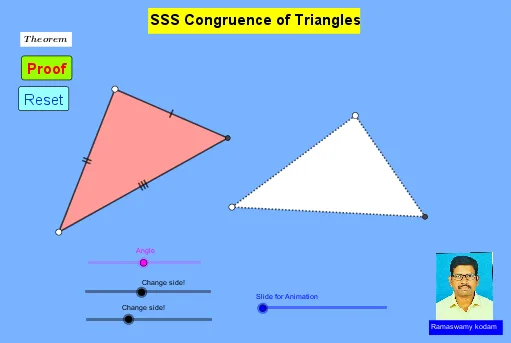
This example demonstrates how to construct two triangles in the plane from two sets of corresponding side lengths and thereby visualize the SSS (Side-Side-Side) congruence criterion. It builds the third vertex using circle intersections so that the constructed triangles share matching side lengths, and the corresponding angles/structure align as expected from the SSS theorem. Key concepts include the triangle congruence condition (SSS), circles and circle–circle intersections, and verifying angle correspondence after the construction. Construction outline in GeoGebra: create circles with Circle using known points as centers and given lengths as radii; place critical vertices with Point; obtain the third vertex via Intersect on the circles; use Segment and Polygon to draw the triangles; use Angle to measure/confirm corresponding angles; and apply geometric transformations such as Rotate and Translate (with optional Line/Vector support) to keep the constructed relationships consistent. Suitable for secondary geometry instruction, congruence unit review, and dynamic geometry demonstrations.
GeoGebra Commands & Parameters
Circle(A, a) → cCircle(B, a) → dCircle(A, b) → eCircle(B, b) → fPoint(c) → DPoint(d) → ESegment(A, D) → gSegment(B, E) → hRotate(D, α, A) → D'Angle(D, A, D') → βRotate(E, α, B) → E'Angle(E, B, E') → γSegment(A, D') → iSegment(B, E') → jIntersect(e, i) → C,Intersect(f, j) → F,Segment(A, C) → kSegment(C, D) → lSegment(B, F) → mSegment(F, E) → nSegment(A, B) → pCircle(A, ((a + b) * 0.15)) → qIntersect(q, g) → G,Intersect(i, k) → HIntersect(q, k) → I,CircleSector(A, G, I) → rDilate(D, If[0 < o ≤ 1, 1 - o, 0], E) → D'_1Vector(D, D'_1) → uTranslate(A, u) → A'Translate(D, u) → D'_2Segment(A', D'_2) → g'Line(A, h) → sAngle(s, g) → δRotate(A', If[1 < o ≤ 2, ((-(o - 1)) * δ), (-δ)], E) → A''Rotate(D'_2, If[1 < o ≤ 2, ((-(o - 1)) * δ), (-δ)], E) → JSegment(A'', J) → g''Dilate(A, If[2 < o ≤ 3, 3 - o, 0], B) → A'_1Vector(A, A'_1) → vTranslate(A, v) → A'_2Translate(C, v) → C'Segment(A'_2, C') → k'Line(A, m) → tAngle(t, k) → εRotate(A'_2, If[3 < o ≤ 4, ((-(o - 3)) * ε), (-ε)], B) → KRotate(C', If[3 < o ≤ 4, ((-(o - 3)) * ε), (-ε)], B) → C''Segment(K, C'') → k''Polygon(A, D, C) → t1, c_1, a_1, d_1Polygon(B, E, F) → t2, f_1, b_1, e_1Vector(A, A'_3) → wTranslate(A, w) → A'_4Translate(D, w) → D'_3Translate(C, w) → C'_1Polygon(A'_4, D'_3, C'_1) → t1'_2, c'_1, a'_4, d'_3Rotate(A'_4, If[5 < o ≤ 6, ((-(o - 5)) * δ), (-δ)], B) → LRotate(D'_3, If[5 < o ≤ 6, ((-(o - 5)) * δ), (-δ)], B) → MRotate(C'_1, If[5 < o ≤ 6, ((-(o - 5)) * δ), (-δ)], B) → NDilate(D, If[4 < o ≤ 5, 5 - o, 0], E) → D'_4Vector(D, D'_4) → u_1Translate(C, u_1) → C'_2Translate(D, u_1) → D'_5Segment(C'_2, D'_5) → l'Line(D, n) → g_1Angle(g_1, l) → ζRotate(C'_2, If[5 < o ≤ 6, ((-(o - 5)) * ζ), (-ζ)], E) → QRotate(D'_5, If[5 < o ≤ 6, ((-(o - 5)) * ζ), (-ζ)], E) → RSegment(Q, R) → l''Dilate(D, If[6 < o ≤ 7, 7 - o, 0], E) → D'_6Vector(D, D'_6) → v_1Translate(A, v_1) → A'_5Translate(D, v_1) → D'_7Translate(C, v_1) → C'_3Polygon(A'_5, D'_7, C'_3) → t1', c'_3, a'_5, d'_7Rotate(A'_5, If[7 < o ≤ 8, ((-(o - 7)) * ζ), (-ζ)], E) → SRotate(D'_7, If[7 < o ≤ 8, ((-(o - 7)) * ζ), (-ζ)], E) → TRotate(C'_3, If[7 < o ≤ 8, ((-(o - 7)) * ζ), (-ζ)], E) → UPolygon(S, T, U) → t1'', u_2, s_1, t_1
AI Drawing Prompt Reference
Draw two triangles to demonstrate the congruence criterion of equal corresponding sides. Determine the third vertex using the intersection of two circles centered at given points with radii equal to known lengths. Connect the vertices to form the triangles, verify the equality of corresponding angles, and use rotations and translations to maintain consistent geometric relationships.
The prompt above was compiled from the original drawing commands and is for reference only.