
Geometric Construction for Equal-Area Division of a Regular Polygon
Loading the math board and drawing, please wait…
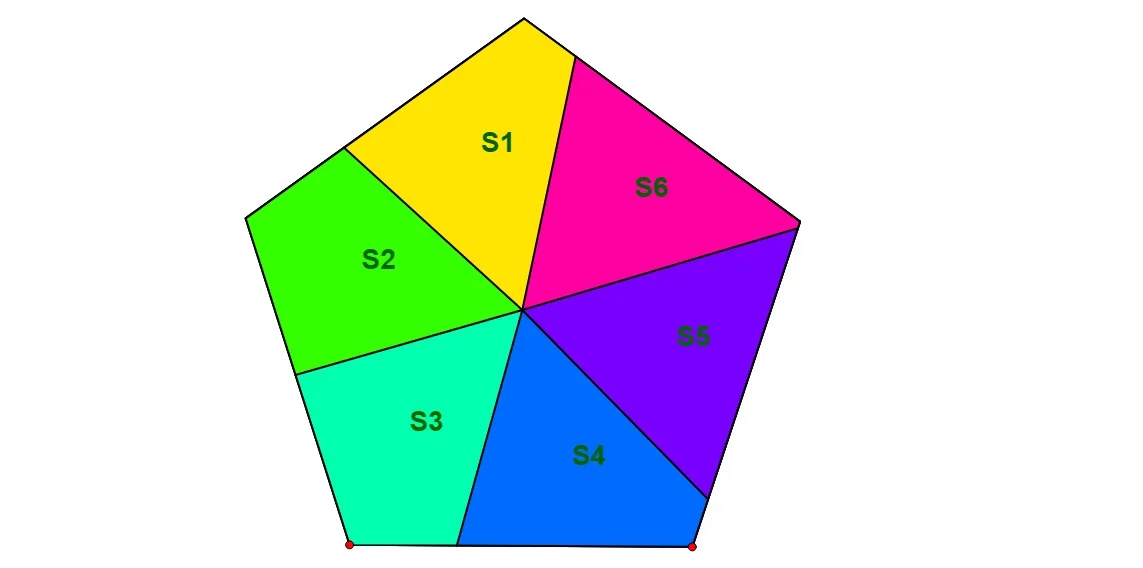
This example demonstrates how to divide a regular polygon into parts with equal areas by using a structured geometric construction, allowing learners to visually verify the balance of the resulting regions. The key mathematical ideas include the symmetry of regular polygons, identifying the polygon’s center (centroid), constructing circle-based relationships, and decomposing the polygon via lines drawn from the center to selected boundary points. Construction uses GeoGebra commands such as Polygon to create the regular n-gon (e.g., C20), Centroid to obtain the central point, Circle to build a reference circle around the center, Sequence to generate evenly spaced parameter values and thus a list of boundary/guide points (e.g., list1–list4), Join to connect the center with these points to form the subdivision boundaries, and Element/Point for managing point sets. Text is used to label key objects for interpretation. The construction summary mainly involves Polygon, Centroid, Circle, Sequence, Join, Point, Element, and Text, producing a collection of points/segments corresponding to the equal-area division. Suitable for middle/high school geometry instruction, enrichment activities, and interactive learning of equal-area partitioning using symmetry and center-based decomposition.
GeoGebra Commands & Parameters
Polygon(A, B, d) → poly1, f, p, C, D, G, H, I, J, K, L, g, h, i, j, k, l, m, nCentroid(poly1) → ECircle(E, F) → cSequence(Intersect[c, Element[Sequence[Ray[E, Element[Sequence[Point[poly1, Mod[a + m / b, 1]], m, 1, b], k]], k, 1, b], n]], n, 1, b) → list1Join({Last[list1, b - 1], First[list1, 1]}) → list2Sequence(Polygon[E, Element[list1, n], Element[list2, n]], n, 1, b) → list3Sequence(IntersectPath[poly1, Element[list3, n]], n, 1, b) → list4Circle(M, 0.5) → ePoint(e) → NElement(list4, C1) → A1Element(list4, C2) → A2Element(list4, C3) → A3Element(list4, C4) → A4Element(list4, C5) → A5Element(list4, C6) → A6Element(list4, C7) → A7Element(list4, C8) → A8Element(list4, C9) → A9Element(list4, C10) → A10Sequence(Segment[E, Element[Sequence[Point[poly1, Mod[a + m / b, 1]], m, 1, b], n]], n, 1, b) → list6Sequence(Segment[E, Element[Sequence[Point[poly1, Mod[a + m / b, 1]], m, 1, b], n]], n, 1, b) → list7Element(list4, C11) → A11Element(list4, C12) → A12Element(list4, C13) → A13Element(list4, C14) → A14Element(list4, C15) → A15Element(list4, C16) → A16Element(list4, C17) → A17Element(list4, C18) → A18Element(list4, C19) → A19Element(list4, C20) → A20Element(list7, C1) → B1Element(list7, C2) → B2Element(list7, C3) → B3Element(list7, C4) → B4Element(list7, C5) → B5Element(list7, C6) → B6Element(list7, C7) → B7Element(list7, C8) → B8Element(list7, C9) → B9Element(list7, C10) → B10Element(list7, C11) → B11Element(list7, C12) → B12Element(list7, C13) → B13Element(list7, C14) → B14Element(list7, C15) → B15Element(list7, C16) → B16Element(list7, C17) → B17Element(list7, C18) → B18Element(list7, C19) → B19Element(list7, C20) → B20Sequence(Centroid[Element[list4, i]], i, 1, Length[list4]) → l1Sequence(Text["S" + (i), Element[l1, i]], i, 1, Length[l1]) → l2Sequence(O + (i, 0), i, 0, (b * 1), 1) → l3Sequence(Text["S" + (i) + " = ", Element[l3, i]], i, 1, b) → l4Text(" ", Element[l3, Length[l3]] - If[b < 10, (0.45, 0), (0.25, 0)]) → texte1
AI Drawing Prompt Reference
Draw a regular polygon and find its center. Draw a circle centered at this point and place evenly spaced points on the circle. Connect the center to these points to divide the polygon into equal-area regions. Label the center, dividing lines, and regions with text to illustrate how symmetry and central decomposition achieve equal area division.
The prompt above was compiled from the original drawing commands and is for reference only.