
Geometric and Data Analysis Animation
Loading the math board and drawing, please wait…
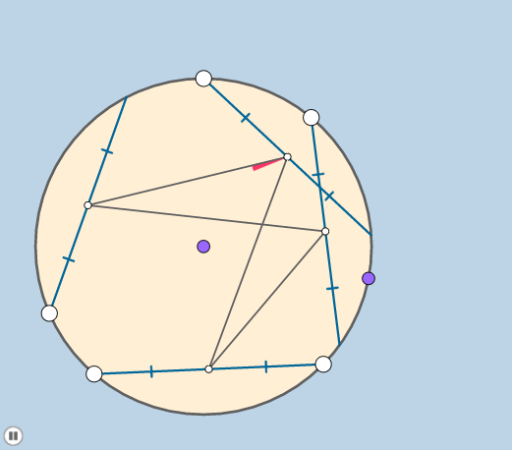
This example demonstrates dynamic changes in geometric figures like circles, angles, and polygons, alongside data analysis through animation. Core math concepts include angles, circles, congruence, incircle, pie charts, linear programming, matrices, and linear regression. Construction highlights the use of GeoGebra commands such as Circle, Point, Segment, Intersect, Midpoint, CircleArc, Min, CircleSector, Dilate, Rotate, Vector, Translate, Line, and Angle. Suitable for high school and above, ideal for teaching geometric constructions, data analysis, and algorithm visualization.
GeoGebra Commands & Parameters
Circle(A, B) → cPoint(c) → CPoint(c) → DSegment(C, D) → fPoint(c) → ICircle(I, f) → kIntersect(c, k, 2) → JSegment(I, J) → iMidpoint(f) → KMidpoint(i) → NCircleArc(A, I, C) → dPoint(d) → ECircle(E, f) → eIntersect(d, e, 2) → FSegment(E, F) → gCircleArc(A, I, E) → hPoint(h) → GCircle(G, f) → pIntersect(c, p, 2) → HSegment(G, H) → jMidpoint(g) → LMidpoint(j) → MSegment(M, L) → lSegment(M, K) → mSegment(N, L) → nSegment(N, K) → qMin({l, n, m, q}) → aCircle(M, (0.2 * a)) → rIntersect(r, l, 1) → OIntersect(r, m, 1) → PCircleSector(M, O, P) → sDilate(C, If[0 < b ≤ 1, 1 - b, 0], K) → C'Segment(C, C') → tDilate(K, If[1 < b ≤ 2, 2 - b, 0], D) → K'Segment(K, K') → f_1Rotate(C, If[2 < b ≤ 3, ((b - 2) * π), π], K) → C'_1Rotate(C', If[2 < b ≤ 3, ((b - 2) * π), π], K) → C''Segment(C'_1, C'') → t'Dilate(E, If[3 < b ≤ 4, 4 - b, 0], L) → E'Dilate(G, If[3 < b ≤ 4, 4 - b, 0], M) → G'Dilate(I, If[3 < b ≤ 4, 4 - b, 0], N) → I'Segment(E, E') → g_1Segment(G, G') → h_1Segment(I, I') → i_1Dilate(M, If[4 < b ≤ 5, 5 - b, 0], H) → M'Dilate(N, If[4 < b ≤ 5, 5 - b, 0], J) → N'Dilate(L, If[4 < b ≤ 5, 5 - b, 0], F) → L'Segment(L, L') → j_1Segment(M, M') → k_1Segment(N, N') → l_1Dilate(C, If[5 < b ≤ 6, 6 - b, 0], J) → C'_2Dilate(C, If[5 < b ≤ 6, 6 - b, 0], H) → C'_3Dilate(C, If[5 < b ≤ 6, 6 - b, 0], F) → C'_4Vector(C, C'_2) → uVector(C, C'_3) → vVector(C, C'_4) → wTranslate(C, w) → C'_5Translate(C', w) → C''_1Segment(C'_5, C''_1) → t'_1Translate(C, v) → C'_6Translate(C', v) → C''_2Segment(C'_6, C''_2) → t'_2Translate(C, u) → C'_7Translate(C', u) → C''_3Segment(C'_7, C''_3) → t'_3Line(J, t) → m_1Line(F, t) → n_1Line(H, t) → p_1Point(m_1) → QAngle(N, J, Q) → αPoint(p_1) → RPoint(n_1) → SAngle(S, F, L) → βAngle(R, H, G) → γRotate(C'_7, If[6 < b ≤ 7, ((-(b - 6)) * α), (-α)], J) → TRotate(C''_3, If[6 < b ≤ 7, ((-(b - 6)) * α), (-α)], J) → USegment(T, U) → q_1Rotate(C'_5, If[6 < b ≤ 7, ((b - 6) * β), β], F) → VRotate(C''_1, If[6 < b ≤ 7, ((b - 6) * β), β], F) → WSegment(V, W) → r_1Rotate(C'_6, If[6 < b ≤ 7, ((b - 6) * γ), γ], H) → ZRotate(C''_2, If[6 < b ≤ 7, ((b - 6) * γ), γ], H) → A_1Segment(Z, A_1) → s_1Rotate(T, If[7 < b ≤ 8, ((-(b - 7)) * π), (-π)], N) → T'Rotate(U, If[7 < b ≤ 8, ((b - 7) * π), π], N) → U'Segment(T', U') → t_1Rotate(V, If[7 < b ≤ 8, ((-(b - 7)) * π), (-π)], L) → V'Rotate(W, If[7 < b ≤ 8, ((b - 7) * π), π], L) → W'Segment(V', W') → a_1Rotate(Z, If[7 < b ≤ 8, ((-(b - 7)) * π), (-π)], M) → Z'Rotate(A_1, If[7 < b ≤ 8, ((b - 7) * π), π], M) → B_1Segment(Z', B_1) → b_1Dilate(M, If[8 < b ≤ 9, 9 - b, 0], L) → M'_1Dilate(N, If[8 < b ≤ 9, 9 - b, 0], K) → N'_2Segment(M, M'_1) → c_1Segment(N, N'_2) → f_2Dilate(M, If[8 < b ≤ 9, 9 - b, 0], K) → M'_2Segment(M, M'_2) → d_1Dilate(N, If[8 < b ≤ 9, 9 - b, 0], L) → N'_1Segment(N, N'_1) → e_1Angle(L, M, K) → δRotate(O, If[9 < b ≤ 10, ((b - 9) * δ), δ], M) → O'CircleSector(M, O, O') → c_2Dilate(M, If[10.5 < b ≤ 11.5, 11.5 - b, 0], N) → M'_3Vector(M, M'_3) → u_1Translate(s, u_1) → s'Line(N, d_1) → g_2Point(g_2) → C_1Angle(K, N, C_1) → εRotate(s', If[11.5 < b ≤ 12.5, ((b - 11.5) * ((2 * π) - ε)), (2 * π) - ε], N) → s''