
From cube to dodecahedron (Euclidean construction)
Loading the math board and drawing, please wait…
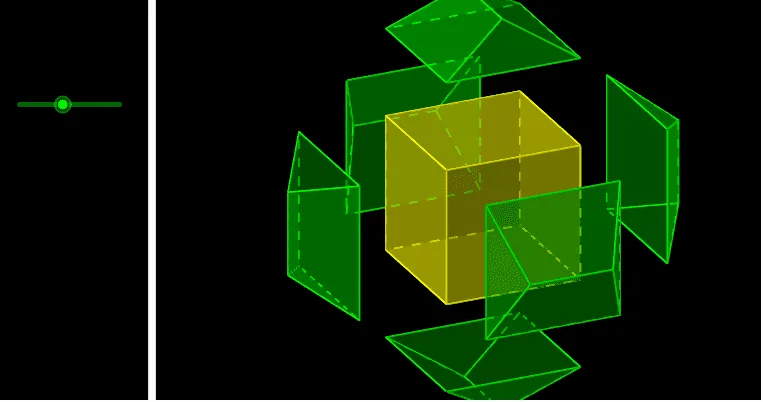
This example demonstrates the Euclidean geometric construction of transforming a cube into a dodecahedron. Key math concepts include polygons, solid geometry, and geometric transformations. Construction highlights the use of GeoGebra commands such as Vector, Cube, Polygon, Mirror, Translate, and Rotate. Suitable for high school and above students learning solid geometry and geometric constructions.
GeoGebra Commands & Parameters
Vector((0, 0, 0), (0, 1, 0)) → uCube((-1, -1, -1), (1, -1, -1), (1, 1, -1)) → a, B, face5, face6, edge1, edge2, edge3, edge4, edge5, edge6, edge7, edge8, C, edge9, edge10, edge11, edge12, D, E, F, face1, face2, face3, face4Polygon(E, F, F1, F2, E) → poly1, e, f, f1_1, f2_1, e_1Mirror(poly1, xOyPlane) → poly1'Polygon(E, F2, (1, 1, -1)) → tre, c, e_2, f2_2Mirror(tre, yAxis) → tre'Translate(list1, Vector[(b * u)]) → list1'_2Rotate(list1'_2, π / 2, xAxis) → list1'Rotate(list1', π / 2, zAxis) → list1''Rotate(list1', π / 2, yAxis) → list1''_1Mirror(list1, xAxis) → list1'_1Mirror(list1'', xAxis) → list1'''Mirror(list1''_1, zAxis) → list2Mirror(list1'_2, xAxis) → list3