
Hyperboloidal Gears
Loading the math board and drawing, please wait…
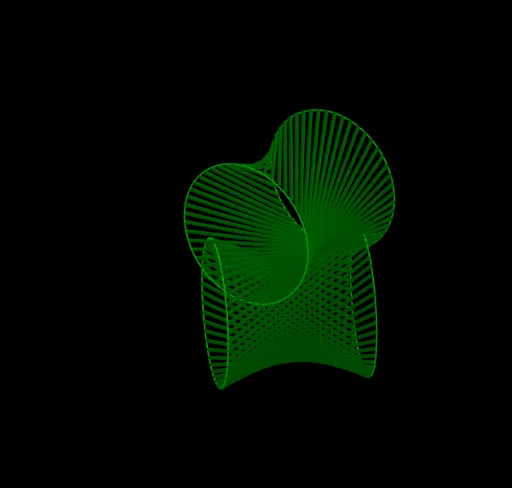
This example demonstrates the construction of hyperboloidal gears. It involves hyperbolic geometry and the basic principles of gear transmission. Using GeoGebra commands such as Circle, Rotate, Translate, and Mirror, the dynamic movement and meshing of gears can be shown. Suitable for high school students or mechanical engineering enthusiasts to learn about gear transmission principles.
GeoGebra Commands & Parameters
Circle((0, 0), 1) → cRotate(c, π / 2, yAxis) → c1Translate(c1, Vector[(0, 0, 0), (1, 0, 0)]) → c2Mirror(c2, (0, 0)) → c3Point(c2) → ASequence(Rotate[A, (n * π / 24), xAxis], n, 1, 48) → s1Translate(s1, Vector[(0, 0, 0), (-2, 0, 0)]) → s2Rotate(s2, π / 2, xAxis) → s3Sequence(Segment[Element[s1, n], Element[s3, n]], n, 1, 48) → list1Translate(list1, Vector[(0, 0, 0), (0, 0, a)]) → list2Rotate(list2, π / 4, zAxis) → list3Translate(c2, Vector[(0, 0, 0), (0, 0, a)]) → c4Rotate(c4, π / 4, zAxis) → c5Translate(c3, Vector[(0, 0, 0), (0, 0, a)]) → c6Rotate(c6, π / 4, zAxis) → c6'Line((0, 0, 0), (1, 0, 0)) → l1Translate(l1, Vector[(0, 0, 0), (0, 0, a)]) → l2Rotate(l2, π / 4, zAxis) → l3Rotate(list1, b, l1) → list1'Rotate(list3, (-b), l3) → list3'
AI Drawing Prompt Reference
Draw a pair of meshing hyperboloidal gears to demonstrate their dynamic movement and meshing principle. Start by creating a circle, then rotate, translate, and mirror it to generate multiple circles. Next, create a series of points on one circle by rotating them along the X-axis. Connect these points to form line segments, and then rotate and translate these segments along the Z-axis to create a complex gear structure. Finally, rotate and translate the gears along the Z-axis to show their meshing, illustrating the gear transmission principle.
The prompt above was compiled from the original drawing commands and is for reference only.