
Fraction Division
Loading the math board and drawing, please wait…
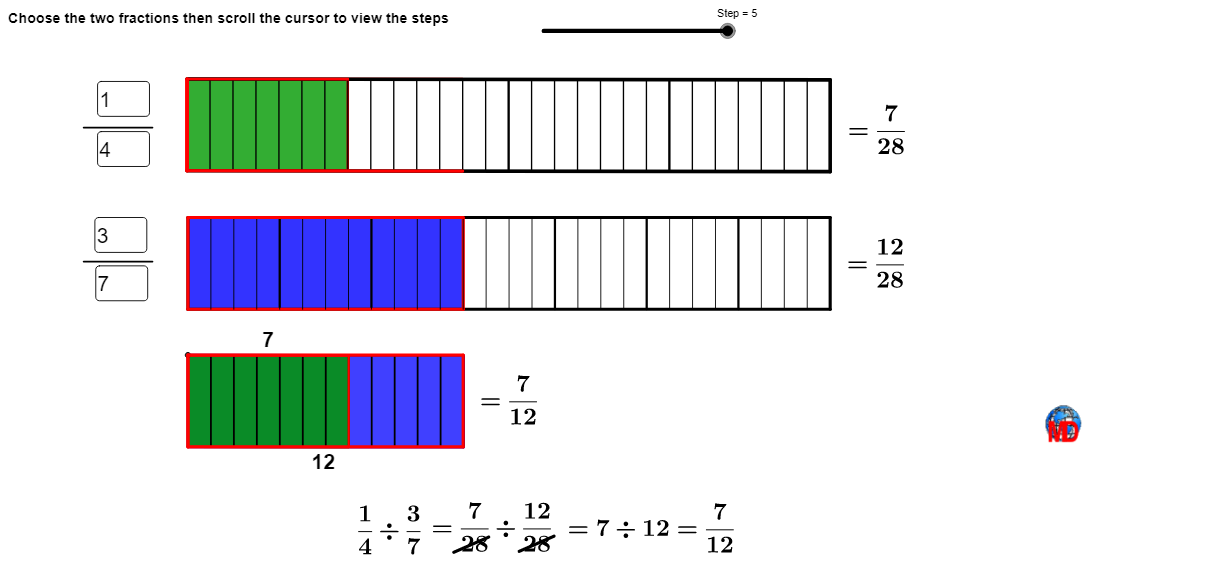
This example demonstrates the process of fraction division. It involves key mathematical concepts such as fractions and division. Using GeoGebra commands like Vector, LCM, DivPoint, etc., a geometric model of fraction division is constructed. Suitable for high-grade elementary or junior high school students to learn the concepts and operations of fraction division.
GeoGebra Commands & Parameters
Vector(A, U) → v_1LCM(b, d) → oDivPoint(A, D, o) → list7DivPoint(B, C, o) → list8Polygon(A, Element[list7, t], Element[list8, t], B) → poly5, q, r, f_1, g_1Polygon(E, F, G, H) → poly2, e, f_2, g, hSegment(I, J) → iSegment(K, L) → jTextfield(a) → InputBox1Textfield(b) → InputBox2Textfield(c) → InputBox3Textfield(d) → InputBox4Polygon(A, D, C, B) → poly1, a_1, d_1, c_1, b_1DivPoint(A, D, b) → list1DivPoint(B, C, b) → list2DivPoint(E, F, d) → list3DivPoint(H, G, d) → list4Sequence(Segment[Element[list1, i], Element[list2, i]], i, 1, b) → list5, {2, 2, 2, NaN}Sequence(Segment[Element[list3, i], Element[list4, i]], i, 1, d) → list6, {2, 2, 2, 2, 2, 2, NaN}Polygon(A, Element[list1, a], Element[list2, a], B) → poly3, a_2, k, l, b_2Polygon(E, Element[list3, c], Element[list4, c], H) → poly4, e_1, m, n, h_1DivPoint(E, F, o) → list9DivPoint(H, G, o) → list10Sequence(Segment[Element[list7, i], Element[list8, i]], i, 1, o) → list11, {2, 1.9999999999999996, 1.9999999999999996, 2.0000000000000004, 2.0000000000000004, 2, 2, 2, 1.9999999999999996, 1.9999999999999996, 2.0000000000000004, 2.0000000000000004, 2, 2, 2, 1.9999999999999996, 1.9999999999999996, 2.0000000000000004, 2.0000000000000004, 2, 2, 2, 1.9999999999999996, 1.9999999999999996, 2.0000000000000004, 2.0000000000000004, 2, NaN}Sequence(Segment[Element[list9, i], Element[list10, i]], i, 1, o) → list12, {2, 2, 2, 2, 2, 2, 2, 2, 2, 2, 2, 2, 2, 2, 2, 2, 2, 2, 2, 2, 2, 2, 2, 2, 2, 2, 2, NaN}Sequence(Polygon[Element[list7, (t * i)], Element[list7, (t * (i + 1))], Element[list8, (t * (i + 1))], Element[list8, (t * i)]], i, 1, p - 1) → list13, {}Segment(M, N) → fSegment(O, P) → i_1Point(e_1) → VVector(V, U) → u_1Translate(poly5, v_1) → poly4'Translate(poly3, v_1) → poly3'Sequence(Translate[Element[list11, i], v_1], i, 0, t) → liste1, {NaN, 2, 1.9999999999999996, 1.9999999999999996, 2.0000000000000004, 2.0000000000000004, 2, 2, 2, 1.9999999999999996, 1.9999999999999996, 2.0000000000000004, 2.0000000000000004}Translate(k, v_1) → k'Translate(a_2, v_1) → j_1Translate(B, v_1) → B'Translate(A, v_1) → A'Segment(B', A') → k_1Translate(l, v_1) → l'Translate(e_1, u_1) → l_1Translate(H, u_1) → H'Translate(m, u_1) → m'Translate(n, u_1) → n'Midpoint(j_1) → WMidpoint(n') → ZMidpoint(m') → A_1
AI Drawing Prompt Reference
Draw a geometric model demonstrating the process of fraction division, involving two triangles and a quadrilateral, constructed using vectors, least common multiples, and division points to show the geometric meaning of fraction division, suitable for junior high school students.
The prompt above was compiled from the original drawing commands and is for reference only.