
Fraction Division: a ÷ b (Partitive Meaning)
Loading the math board and drawing, please wait…
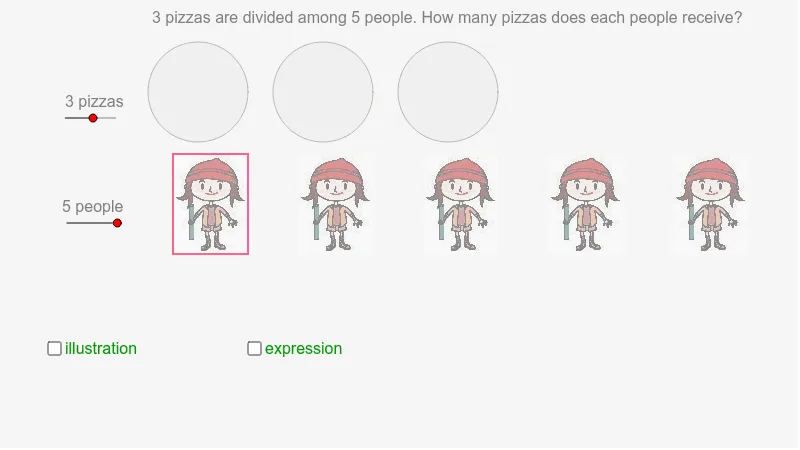
This example demonstrates the partitive interpretation of fraction division through geometric visualization, helping learners understand that a÷b equals a/b. The core mathematical concepts include the two meanings of division (partition and measurement) and the relationship between fractions and division. Construction highlights: Using GeoGebra commands such as Point, Segment, Sequence, and Polygon to build a visual partition model, dynamically showing the process of dividing a whole into b equal parts, intuitively presenting that each part equals a/b. Suitable for upper elementary and middle school mathematics teaching, useful for introducing fraction concepts, understanding the relationship between division and fractions, and developing the ability to connect numbers with shapes.
GeoGebra Commands & Parameters
Point(Segment[(x(D) + 2 / 5, y(D)), (x(D) + 1, y(D))]) → SSegment(A, (x(A) + 1, y(A))) → l1Point(Segment[(x(A) + 1 / 5, y(A)), (x(A) + 1, y(A))]) → PSegment(B, (x(B) + 1, y(B))) → l2Point(Segment[(x(B) + 2 / 6, y(B)), (x(B) + 1, y(B))]) → QPoint(Segment[(x(C) + 1 / 6 - 0.0050, y(C)), (x(Q) - 1 / 6, y(C))]) → RSegment(C, (x(C) + 1, y(C))) → l3Sequence(Circle[(2.5 * (i - 1), 0), 1], i, 1, a) → list1Sequence(Segment[(2.5 * a, 0), (2.5 * a - sin(j * θ), cos(j * θ))], j, 1, c - 1) → list2Segment(D, (x(D) + 1, y(D))) → l4Polygon((-0.5, -3.24), (1, -3.24), (1, -1.24), (-0.5, -1.24)) → poly1, e, g, h, iGCD(a, d) → kSegment(A, P) → jSegment(C, R) → lSegment(B, Q) → mSegment(D, S) → nPoint(Segment[(x(A_1) + 1 / 7, y(A_1)), (x(A_1) + 1, y(A_1))]) → P_1Segment(A_1, P_1) → j_1Point(Segment[(x(D_1) + 2 / 5, y(D_1)), (x(D_1) + 1, y(D_1))]) → S_1Point(Segment[(x(A_2) + 1 / 7, y(A_2)), (x(A_2) + 1, y(A_2))]) → P_2GCD(a_1, d_1) → k_1Segment(A_2, P_2) → j_2Segment(D_1, S_1) → n_1Point(Segment[(x(D_2) + 2 / 5, y(D_2)), (x(D_2) + 1, y(D_2))]) → S_2Point(Segment[(x(A_3) + 1 / 7, y(A_3)), (x(A_3) + 1, y(A_3))]) → P_3GCD(a_2, d_2) → k_2Segment(A_3, P_3) → j_3Segment(D_2, S_2) → n_2Sequence(Sequence[CircleSector[(-1 * f * sin((2 * k - 1) * θ / 2) + 2.5 * (m - 1), f * cos((2 * k - 1) * θ / 2)), (-1 * f * sin((2 * k - 1) * θ / 2) - sin((k - 1) * θ) + 2.5 * (m - 1), f * cos((2 * k - 1) * θ / 2) + cos((k - 1) * θ)), (-1 * f * sin((2 * k - 1) * θ / 2) - sin(k * θ) + 2.5 * (m - 1), f * cos((2 * k - 1) * θ / 2) + cos(k * θ))], k, 1, 1], m, 1, a) → list4Sequence(Sequence[CircleSector[(f * sin((2 * k - 1) * θ / 2) + 2.5 * (m - 1), f * cos((2 * k - 1) * θ / 2)), (f * sin((2 * k - 1) * θ / 2) + sin(k * θ) + 2.5 * (m - 1), f * cos((2 * k - 1) * θ / 2) + cos(k * θ)), (f * sin((2 * k - 1) * θ / 2) + sin((k - 1) * θ) + 2.5 * (m - 1), f * cos((2 * k - 1) * θ / 2) + cos((k - 1) * θ))], k, 1, b], m, 1, a) → list3
AI Drawing Prompt Reference
Create a visual model for fraction division, showing a unit segment divided into equal parts with marked points. Draw several circles, each split into equal sectors, representing the whole divided into b parts, with a total of a circles. Highlight one sector to show the fraction a/b. Include a rectangle area with proportional markings. Use distinct colors to differentiate sections, clearly illustrating the relationship between division and fractions.
The prompt above was compiled from the original drawing commands and is for reference only.