
Fraction Addition Demonstration by Auston B Cron
Loading the math board and drawing, please wait…
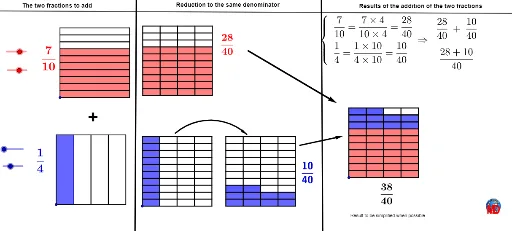
This example visually demonstrates the addition of fractions through geometric representations, showing the process and outcome of fraction addition dynamically. It involves core mathematical concepts such as fraction operations, geometric transformations, vectors, and polygon constructions. Key GeoGebra commands and objects used include Mod, Segment, Translate, Rotate, Sequence, Polygon, Vector, CircumcircleArc, Point, and Line to achieve geometric representations and dynamic changes of fractions. Suitable for middle school and above learners to understand the essence and geometric applications of fraction addition.
GeoGebra Commands & Parameters
Mod((q * m), p) → qqSegment(A, B) → aSegment(A, D) → bSegment(D, C) → cSegment(C, B) → dTranslate(E, Vector[A, B]) → FRotate(F, 90°, E) → HRotate(E, 90°, H) → GSegment(E, F) → eSegment(F, G) → fSegment(G, H) → gSegment(H, E) → hSequence(Segment[A + ((i * w / p), 0), A + ((i * w / p), w)], i, 1, p - 1) → list1Sequence(Segment[E + ((i * w / p), 0), E + ((i * w / p), w)], i, 1, p - 1) → list2Sequence(Segment[A + (0, (i * w / m)), A + (w, (i * w / m))], i, 1, m - 1) → list3Sequence(Segment[E + (0, (i * w / m)), E + (w, (i * w / m))], i, 1, m - 1) → list4Polygon(E, E + (w, 0), E + (w, (n / m * w)), E + (0, (n / m * w))) → poly1, e_1, i, j, kPolygon(A, A + ((q / p * w), 0), A + ((q / p * w), w), A + (0, w)) → poly2, a_1, l, r, s_1Polygon(I, I + (w, 0), I + (w, (n / m * w)), I + (0, (n / m * w))) → poly3, i_1, s, t, b_1Sequence(Segment[I + (0, (i * w / m)), I + (w, (i * w / m))], i, 1, m - 1) → liste1Sequence(Segment[M + ((i * w / p), 0), M + ((i * w / p), w)], i, 1, p - 1) → liste2Polygon(I, J, K, L) → poly4, i_2, j_1, k_1, l_1Polygon(M, M + ((q / p * w), 0), M + ((q / p * w), w), M + (0, w)) → poly5, m_1, c_1, d_1, f_1Polygon(M, N, O, P) → poly6, m_2, n_1, o_1, p_1Vector(E, Q) → uTranslate(G, u) → G'Translate(H, u) → H'Segment(G', H') → g'Translate(list2, u) → list2'Translate(F, u) → F'Translate(G, u) → G'_1Segment(F', G'_1) → f'Translate(H, u) → H'_1Translate(E, u) → E'Segment(H'_1, E') → h'Translate(E, u) → E'_1Translate(F, u) → F'_1Segment(E'_1, F'_1) → e'Translate(poly1, u) → poly1'Translate(list4, u) → list4'Vector(A, T) → vTranslate(C, v) → C'Translate(B, v) → B'Segment(C', B') → d'Translate(list3, v) → list3'Translate(A, v) → A'Translate(B, v) → B'_1Segment(A', B'_1) → a'Translate(list1, v) → list1'Translate(D, v) → D'Translate(C, v) → C'_1Segment(D', C'_1) → c'Translate(A, v) → A'_1Translate(D, v) → D'_1Segment(A'_1, D'_1) → b'Polygon(V, W, B', T) → poly8, v_1, w_1, b'_1, t_1Polygon(Z, B_1, A_1, V) → poly9, z, b_2, a_2, v_2Vector(T, R) → u_1Translate(V, u_1) → V'Translate(W, u_1) → W'Translate(B', u_1) → B''Translate(T, u_1) → T'Polygon(V', W', B'', T') → poly8', v', w', b'', t'Translate(Z, u_1) → Z'Translate(B_1, u_1) → STranslate(A_1, u_1) → C_1Translate(V, u_1) → V'_1Polygon(Z', S, C_1, V'_1) → poly9', z', s_2, c_2, v'_1CircumcircleArc(D_1, E_1, F_1) → g_1Point(g_1) → G_1Vector(G_1, F_1) → z_1Line(H_1, I_1) → h_1Line(J_1, K_1) → q_1Segment(W', B'') → r_1Segment(V', W') → d_2Segment(W', B'') → f_2Segment(V'_1, T') → g_2Segment(V'_1, Z') → h_2Segment(S, C_1) → j_2Vector(L_1, M_1) → u_2Vector(N_1, O_1) → w_2Sequence(Segment[V'_1 + ((i * w / p), 0), Z' + ((i * w / p), 0)], i, 1, p) → liste42Sequence(Segment[T' + ((i * w / p), 0), V' + ((i * w / p), 0)], i, 1, p) → liste41Translate(P_1, u_1) → Q_1Segment(Z', Q_1) → e_2Segment(W', G') → k_2Sequence(Segment[T' + (0, (i * w / m)), T' + (w, (i * w / m))], i, 1, pp) → liste40Line(R_1, S_1) → l_2
AI Drawing Prompt Reference
Create a dynamic geometric illustration showing fraction addition, involving multiple polygons and vectors. Use rotations and translations to demonstrate the geometric representation and process of fraction addition. Start with a base polygon, then create several geometric objects using vectors and rotations, and translate these objects to represent fraction addition, forming a complete geometric model that clearly illustrates the essence of fraction addition.
The prompt above was compiled from the original drawing commands and is for reference only.