
Four Color Theorem: Coloring Polygonal Regions
Loading the math board and drawing, please wait…
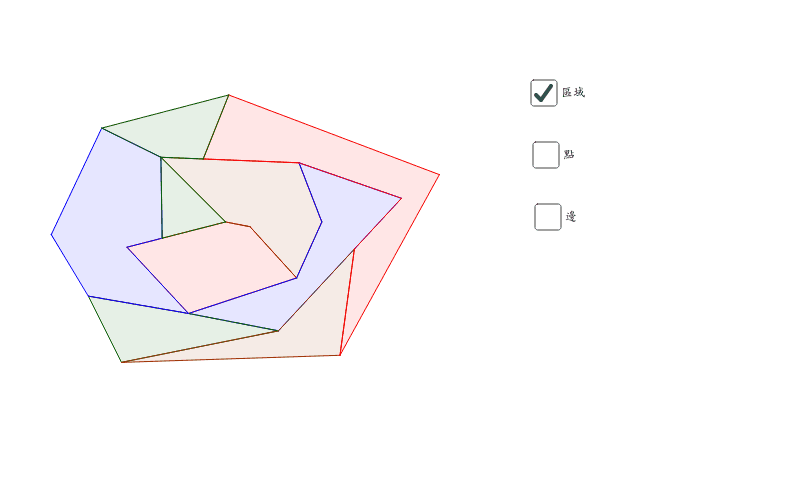
① This GeoGebra example demonstrates the Four Color Theorem by constructing a planar map composed of multiple polygonal regions and coloring them so that adjacent regions have different colors, using at most four colors. ② The core mathematical concept is the Four Color Theorem from graph theory, involving planar graph coloring, adjacency relations, and chromatic number. ③ Construction details: Based on the summary, the example uses the Polygon command to create several polygons (poly1 to poly5), Point objects for vertices (A to N), and Segment commands for edges (a to l), forming nested or adjacent regions. Each polygon is assigned a distinct color to verify the theorem's condition. ④ Suitable for high school to early university students, this example serves as an interactive tool for exploring graph theory, map coloring, and algorithmic thinking, and can be used by teachers to illustrate the theorem in mathematics or computer science classes.
GeoGebra Commands & Parameters
Polygon(A, B, C, D, E) → poly1, a, b, c, d, ePolygon(A, F, G, H, D, E) → poly2, a_1, f, g, h, d_1, e_1Polygon(C, I, J, G, H, D) → poly3, c_1, i, j, g_1, h_1, d_2Polygon(I, K, L, C) → poly4, i_1, k, l, c_2Point(i) → NPolygon(K, M, N, I) → poly5, k_1, m, n, i_2Point(f) → QPolygon(M, O, P, Q, G, J, N) → poly6, m_1, o, p, q, g_2, j_1, n_1Point(a) → TPolygon(F, R, S, L, C, B, T) → poly7, f_1, r, s, l_1, c_3, b_1, tPolygon(F, T, A) → poly8, a_2, f_2, t_1Polygon(R, P, Q, F) → poly9, r_1, p_1, q_1, f_3Segment(B_1, D_1) → s_1Segment(D_1, V) → b_2Segment(D_1, C_1) → e_2Segment(D_1, Z) → h_2Segment(D_1, W) → j_2Segment(B_1, W) → k_2Segment(V, B_1) → l_2Segment(V, E_1) → m_2Segment(V, A_1) → n_2Segment(E_1, A_1) → p_2Segment(C_1, V) → q_2Segment(C_1, U) → r_2Segment(C_1, Z) → s_2Segment(U, Z) → t_2Segment(U, W) → a_3Segment(U, A_1) → b_3Segment(B_1, E_1) → d_3
AI Drawing Prompt Reference
Draw a planar map composed of multiple polygonal regions. These regions are connected by shared edges or vertices to form adjacency relations. Each polygonal region should be assigned a different color to ensure adjacent regions have different colors. Construct by first creating polygons, then determining their vertices, connecting vertices to form edges, and arranging polygons in order. Ensure color assignment follows the Four Color Theorem to make the map look complete.
The prompt above was compiled from the original drawing commands and is for reference only.