
Complex Number and Geometry I: Subtraction of Vectors
Loading the math board and drawing, please wait…
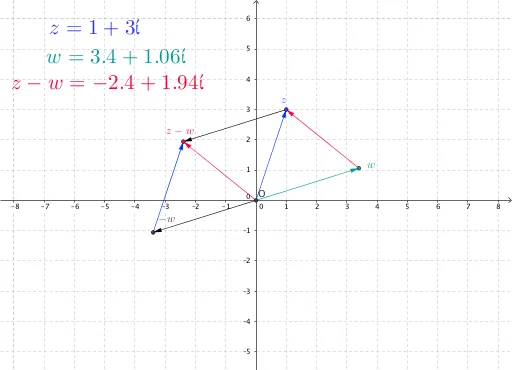
① This GeoGebra example dynamically demonstrates the subtraction of vectors corresponding to complex numbers in the complex plane, visually showing the geometric meaning of the difference of two complex numbers. ② Core mathematical concepts include the geometric representation of complex numbers, vector subtraction, the parallelogram or triangle law, and the correspondence between complex arithmetic and vector operations. ③ Construction highlights: from the construction summary, commands such as Intersect, Vector, and Translate are used to create complex numbers z and w with their points, vectors u and v, and a translated vector ww; text objects text1, text2, text3 display results, and objects like b, ans, c, d, e, a are involved, possibly for calculations or auxiliary constructions. ④ Suitable for high school or early college students learning the geometric meaning of complex numbers and vectors, and for teachers to use in classroom demonstrations to help students understand the equivalence between complex subtraction and vector subtraction.
GeoGebra Commands & Parameters
Intersect(xAxis, yAxis) → OVector(O, z) → uVector(O, w) → vTranslate(z, v) → z'Vector(O, ww) → bVector(O, ans) → cVector(z, ans) → dVector(ww, ans) → eVector(w, z) → a
AI Drawing Prompt Reference
Draw two vectors in the complex plane representing complex numbers z and w, and show their difference. Start from the origin to draw vectors u and v corresponding to z and w. Shift z by vector v to get point z', then draw vectors b and c. Next, draw vector c from the origin, and from the endpoints of z and c, draw vectors d and e. Finally, draw vector a connecting w and z, fully demonstrating the geometric meaning of complex number subtraction and the correspondence between complex arithmetic and vector operations.
The prompt above was compiled from the original drawing commands and is for reference only.