
AAA Exploration: Geometric Construction with Vectors, Matrices, and Complex Numb
Loading the math board and drawing, please wait…
In collections
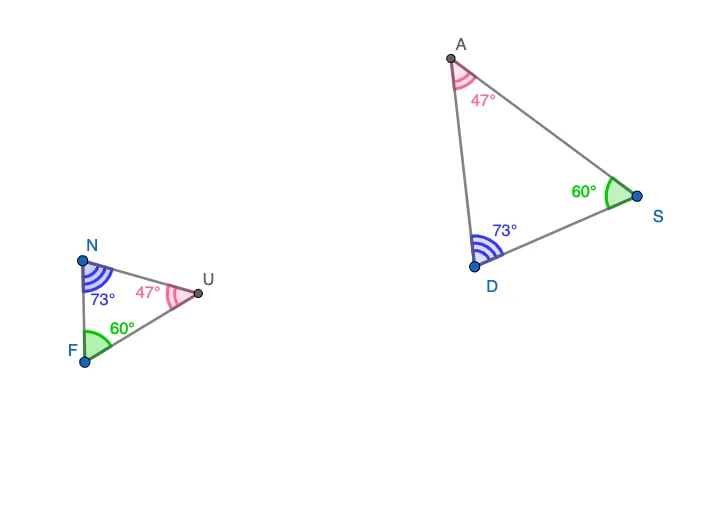
Triangle Congruency Exploration
This example demonstrates an exploratory geometric construction that integrates vectors, matrices, complex numbers, and elements of solid geometry, generating complex relationships through rotations, intersections, and segments. Core mathematical concepts include vector operations, matrix transformations, complex number representation, angle measurement, and the application of subtraction in geometry. The construction uses GeoGebra commands such as Line, Point, Rotate, Angle, Intersect, and Segment, involving objects like points A, B, C, C', A', N, U, S, G, D, F', H, as well as segments f, g, h, i, j, k, l, m, n, p, q and angles α, β, γ, δ, ε, ζ. This example is suitable for high school or university students to explore the comprehensive application of multiple geometric tools, understand the intrinsic connections between different mathematical branches, and can also serve as material for teachers designing inquiry-based classroom activities.
GeoGebra Commands & Parameters
Line(A, B) → fPoint(f) → CRotate(C, 60°, A) → C'Angle(C, A, C') → αLine(A, C') → gPoint(g) → NRotate(A, 73°, N) → A'Angle(A, N, A') → βLine(N, A') → hIntersect(f, h) → UAngle(A, U, N) → γSegment(A, U) → iSegment(U, N) → jSegment(N, A) → kLine(S, G) → lRotate(G, 60°, S) → DAngle(G, S, D) → δRotate(S, 73°, D) → F'Angle(S, D, F') → εLine(D, F') → mSegment(S, D) → nIntersect(l, m) → HSegment(D, H) → pSegment(S, H) → qAngle(S, H, D) → ζ
AI Drawing Prompt Reference
Draw a geometric construction illustrating the use of vectors, matrices, and complex numbers in solid geometry. Start with two line segments, take a point on the first, rotate it 60 degrees to get a new point, then rotate another point 73 degrees around it. Connect these points to form multiple triangles and quadrilaterals, calculating the angles between them. Draw line segments and intersection points to show the process of rotation, intersection, and segmentation, ultimately presenting complex geometric relationships and angle measurements.
The prompt above was compiled from the original drawing commands and is for reference only.