
Four-Color Pyramid Dice Model
Loading the math board and drawing, please wait…
This example demonstrates a four-color pyramid dice model composed of four congruent equilateral triangular faces. Core mathematical concepts include polygons (especially equilateral triangles), solid geometry, and color classification. Construction highlights are derived from the GeoGebra command summary, utilizing commands/objects like hr, infobox1, layer, stepper, prevNext, prev, next, a, b, c, prevHotspot, nextHotspot, btnInfobox, b1, pic2, b2, b3, b4, b5, b6, b7, e, f, g, randomHotspot, ogHotspot, stepMax, steps, step2, step2_1, step2_2, step3_1, step4, step4_2, step4_4, step4_5, step5, step5_1, step6. Suitable for high school mathematics teaching on solid geometry, polygon properties, and probability & statistics.
GeoGebra Commands & Parameters
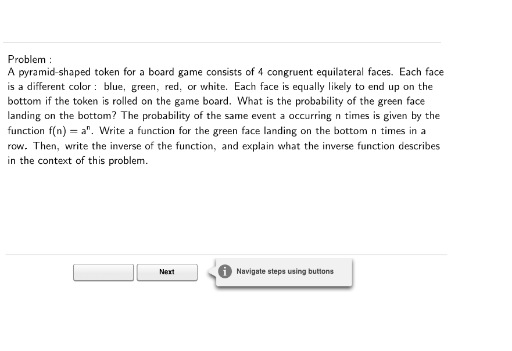
LaTeX("\text{State the probability of any of the 4 faces landing on the bottom.}") → step2LaTeX("\text{Each face has a 1 in 4, or 0.25, chance of landing on the bottom.}") → step2_1LaTeX("\text{Thus, the probability of the green face landing on the bottom is 0.25.}") → step2_2LaTeX("\text{This answer should add up to 1.}") → step3_1LaTeX("\text{Write the function for the green face landing on the bottom n times in a row.}") → step4LaTeX("f(n)=a^n") → step4_2LaTeX("f(n) = (4^{–1})^n") → step4_4LaTeX("f(n) = 4^{–n}") → step4_5LaTeX("\text{Write the inverse of the function determined in Step 4.}") → step5LaTeX(" \text{This will give the logarithm requested in the problem.}") → step5_1LaTeX("\text{Explain what the inverse function describes in the context of this problem.}") → step6LaTeX("\text{Switch the variables and change } f(n) \text{ to } f^{-1}(n):") → step5_3LaTeX("f^{-1}(n)=\log_4 \, n = \log_4 \, n^{-1}") → step5_{32}LaTeX("\text{This is the first step in defining the probability event. }\cr\text{There are 4 faces on the token.}") → step1_1LaTeX("\text{State the number of faces on the token.}") → step1LaTeX("\text{Check your answer to step 2 by calculating the chance that any}\cr\text{of the 4 faces lands on the bottom.}") → step3LaTeX("\text{The probability of a blue, green, red, or white face landing on the bottom}\cr\text{is given by }0.25 + 0.25 + 0.25 + 0.25\text{, which equals 1.}") → step3_2LaTeX("\text{Therefore, the inverse function is } f^{-1}(n) = \log_4 \, n^{-1}.") → step5_4LaTeX(" \text{Suppose n = 4. The value of the function at n = 4 is given by the ordered}\cr\text{pair }(4,\ 4^{–4})\text{, so the corresponding point for the inverse is }(4^{-4},\ 4).\cr\text{The inverse implies that when a probability of }4^{–4}\text{ occurs, the token has }\cr\text{been rolled 4 times with the same outcome }(4^{–1})\text{ each time.}") → step6_1LaTeX("\text{This generalizes the result of step 2 for any number of rolls of the token}\cr\text{Let }a = \frac{1}{4} \text{ in the function }f(n) = a^n \text{ and simplify.}") → step4_1LaTeX("f(n)=\bigg(\frac{1}{4}\bigg)^n") → step4_3LaTeX((((((("\text{The inverse of } f(n) = " * a) * "^{-n} \text { is } \log_") * a) * "\,f(n) = -n, \text{ which simplies to } \cr\ n=-\log_") * a) * " \, f(n).")) → step5_2LaTeX("\text{Problem: }\cr \text{A pyramid-shaped token for a board game consists of 4 congruent equilateral faces. Each face}\cr\text{is a different color: blue, green, red, or white. Each face is equally likely to end up on the}\cr\text{bottom if the token is rolled on the game board. What is the probability of the green face}\cr\text{landing on the bottom? The probability of the same event a occurring n times is given by the}\cr \text{function } f(n) = a^n \text{. Write a function for the green face landing on the bottom n times in a}\cr\text{row. Then, write the inverse of the function, and explain what the inverse function describes}\cr\text{in the context of this problem.}") → Problem
AI Drawing Prompt Reference
Draw a four-color pyramid dice model composed of four congruent equilateral triangular faces, each a different color: blue, green, red, and white. Illustrate the probability calculation for any face landing on the bottom with a 1/4 chance, and use the function f(n) = (1/4)^n to represent the probability of the same face appearing n times in a row. Plot its inverse function f^(-1)(n) = log_4(n^-1) and explain its meaning in the context of multiple dice rolls.
The prompt above was compiled from the original drawing commands and is for reference only.