
Flux Across a Plane Surface
Loading the math board and drawing, please wait…
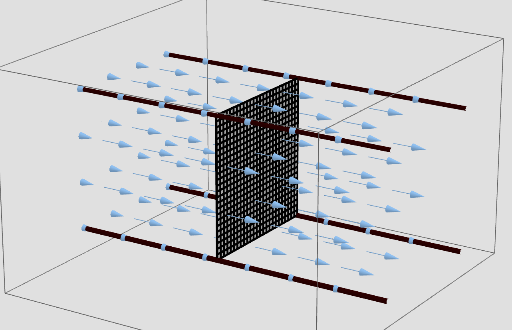
This example demonstrates how to calculate the flux across a plane surface. Key mathematical concepts include vectors and coordinate geometry. Using GeoGebra commands such as CurveCartesian, PointIn, Vector, etc., a dynamic model of the plane surface is constructed, and the flux is calculated. Suitable for high school and above students to learn about flux in calculus.
GeoGebra Commands & Parameters
CurveCartesian((2 * t) - 4, 0, 0, t, 0, 10) → PathlineSphere(FluidPt_2, 1) → a_1PointIn(a_1) → S_4PointIn(a_1) → S_5PointIn(a_1) → S_2PointIn(a_1) → S_1PointIn(a_1) → S_6PointIn(a_1) → S_7PointIn(a_1) → S_3OrthogonalLine(A, xOyPlane) → i_1Rotate(B, (-angle), A) → B'Line(A, B') → bOrthogonalLine(B', b, xOyPlane) → dPoint(d) → G_1Vector(B', G_1) → v_1Circle(A, 2, normalvectorplane) → s_1Intersect(xOyPlane, s_1) → J_1, K_1Line(K_1, J_1) → a_2OrthogonalLine(J_1, xOyPlane) → t_1OrthogonalLine(K_1, xOyPlane) → j_1Intersect(i_1, s_1) → H_1, I_1Line(I_1, a_2) → c_2Intersect(j_1, c_2) → Cuadro3Intersect(t_1, c_2) → Cuadro4Line(H_1, a_2) → b_2Intersect(b_2, t_1) → Cuadro2Intersect(b_2, j_1) → Cuadro1Polygon(Cuadro3, Cuadro4, Cuadro2, Cuadro1) → poly3, o_2, n_2, m_2, l_2OrthogonalPlane(B', d) → eOrthogonalPlane(FluidPt, yAxis) → mOrthogonalLine(FluidPt, xOyPlane) → lPoint(l) → FOrthogonalLine(F, m) → rOrthogonalLine(FluidPt, xAxis, xOyPlane) → hPoint(h) → EOrthogonalLine(E, xOyPlane) → qIntersect(r, q) → KLine(E, xAxis) → iLine(K, i) → Container3Intersect(Container3, e) → PCircle(FluidPt, E, xOyPlane) → kIntersect(h, k) → H, JOrthogonalLine(H, xOyPlane) → nIntersect(r, n) → LLine(H, xAxis) → jLine(L, j) → Container4Intersect(Container4, e) → OCircle(h, F) → pIntersect(l, p) → G, ILine(I, h) → sIntersect(s, q) → NLine(N, i) → Container2Intersect(Container2, e) → QIntersect(s, n) → MLine(M, j) → Container1Intersect(Container1, e) → RIntersect(xAxis, yAxis) → ZVector(D_1, Z) → u_1OrthogonalLine(A, xAxis, xOyPlane) → aAngle(B', A, B, xOyPlane) → αOrthogonalPlane(A, xAxis) → cSegment(A, B') → gPoint(h) → DPolygon(L, K, N, M) → poly1, l_1, k_1, n_1, m_1Segment(O, P) → d_1Segment(P, Q) → e_1Segment(R, Q) → f_1Segment(R, O) → g_1PointIn(poly1) → TPointIn(poly1) → UPointIn(poly1) → VPointIn(poly1) → WSequence(Sequence[Sequence[Vector[(j, k, l), (j + (scale * F_1(j, k, l)), k + (scale * F_2(j, k, l)), l + (scale * F_3(j, k, l)))], j, (-extent) - 2, extent + 2, step], k, (-extent), extent, step], l, (-extent), extent, step) → VField, {{{(1, 0, 0), (1, 0, 0), (1, 0, 0), (1, 0, 0), (0.9999999999999998, 0, 0), (1, 0, 0), (1, 0, 0)}, {(1, 0, 0), (1, 0, 0), (1, 0, 0), (1, 0, 0), (0.9999999999999998, 0, 0), (1, 0, 0), (1, 0, 0)}, {(1, 0, 0), (1, 0, 0), (1, 0, 0), (1, 0, 0), (0.9999999999999998, 0, 0), (1, 0, 0), (1, 0, 0)}, {(1, 0, 0), (1, 0, 0), (1, 0, 0), (1, 0, 0), (0.9999999999999998, 0, 0), (1, 0, 0), (1, 0, 0)}}, {{(1, 0, 0), (1, 0, 0), (1, 0, 0), (1, 0, 0), (0.9999999999999998, 0, 0), (1, 0, 0), (1, 0, 0)}, {(1, 0, 0), (1, 0, 0), (1, 0, 0), (1, 0, 0), (0.9999999999999998, 0, 0), (1, 0, 0), (1, 0, 0)}, {(1, 0, 0), (1, 0, 0), (1, 0, 0), (1, 0, 0), (0.9999999999999998, 0, 0), (1, 0, 0), (1, 0, 0)}, {(1, 0, 0), (1, 0, 0), (1, 0, 0), (1, 0, 0), (0.9999999999999998, 0, 0), (1, 0, 0), (1, 0, 0)}}, {{(1, 0, 0), (1, 0, 0), (1, 0, 0), (1, 0, 0), (0.9999999999999998, 0, 0), (1, 0, 0), (1, 0, 0)}, {(1, 0, 0), (1, 0, 0), (1, 0, 0), (1, 0, 0), (0.9999999999999998, 0, 0), (1, 0, 0), (1, 0, 0)}, {(1, 0, 0), (1, 0, 0), (1, 0, 0), (1, 0, 0), (0.9999999999999998, 0, 0), (1, 0, 0), (1, 0, 0)}, {(1, 0, 0), (1, 0, 0), (1, 0, 0), (1, 0, 0), (0.9999999999999998, 0, 0), (1, 0, 0), (1, 0, 0)}}, {{(1, 0, 0), (1, 0, 0), (1, 0, 0), (1, 0, 0), (0.9999999999999998, 0, 0), (1, 0, 0), (1, 0, 0)}, {(1, 0, 0), (1, 0, 0), (1, 0, 0), (1, 0, 0), (0.9999999999999998, 0, 0), (1, 0, 0), (1, 0, 0)}, {(1, 0, 0), (1, 0, 0), (1, 0, 0), (1, 0, 0), (0.9999999999999998, 0, 0), (1, 0, 0), (1, 0, 0)}, {(1, 0, 0), (1, 0, 0), (1, 0, 0), (1, 0, 0), (0.9999999999999998, 0, 0), (1, 0, 0), (1, 0, 0)}}}Point(xAxis) → A_1Vector(A_1, Z) → vIntersect(yAxis, xAxis) → C_1Vector(B_1, Z) → wVector(S, E_1) → uElement(list2, faces) → SelectedvectorLine(S, E_1) → direction1Area(poly3) → AreaNetSequence(Segment[Cuadro1 + (i * (Cuadro3 - Cuadro1) / net), Cuadro2 + (i * (Cuadro4 - Cuadro2) / net)], i, 0, net) → nethSequence(Segment[Cuadro1 + (i * (Cuadro2 - Cuadro1) / net), Cuadro3 + (i * (Cuadro4 - Cuadro3) / net)], i, 0, net) → netvIf(-4 ≤ x(FluidPt) ≤ 1, 0, Flux) → FluxconditionPoint(VField) → CPoint(Container4) → O_1Prism(poly1, O_1) → t, L_1, edge1, edge3, edge4, edge5, edge7, edge8, edge6, M_1, N_1, face1, face2, face4, face3, face5, edge2Sequence(Vector[Element[motionvectors, i], (x(Element[motionvectors, i]) + (scale * F_1(x(Element[motionvectors, i]), y(Element[motionvectors, i]), z(Element[motionvectors, i]))), y(Element[motionvectors, i]) + (scale * F_2(x(Element[motionvectors, i]), y(Element[motionvectors, i]), z(Element[motionvectors, i]))), z(Element[motionvectors, i]) + (scale * F_3(x(Element[motionvectors, i]), y(Element[motionvectors, i]), z(Element[motionvectors, i]))))], i, 1, 8) → vectorParticles