
Finding Area of Parallelogram by Dissection
Loading the math board and drawing, please wait…
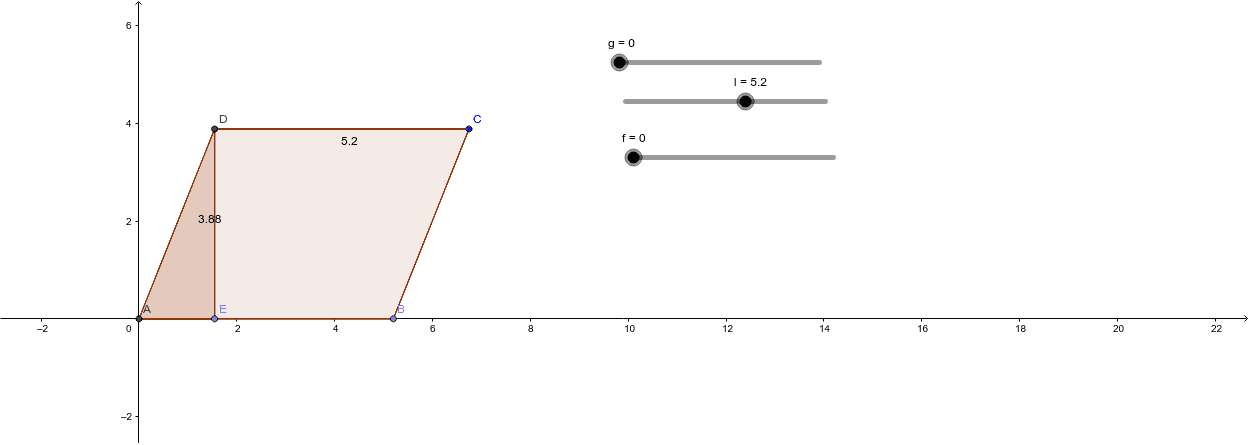
This example demonstrates how to calculate the area of a parallelogram by dissecting and reforming it into a rectangle. Key math concepts include parallelogram properties, area calculation, and geometric transformations. GeoGebra commands/objects used are Intersect, Line, Segment, OrthogonalLine, Point, Polygon, and Translate. Suitable for middle school and above students learning the parallelogram area formula and geometric transformations.
GeoGebra Commands & Parameters
Intersect(xAxis, yAxis) → ALine(C, xAxis) → aSegment(C, B) → bLine(A, b) → cIntersect(a, c) → DOrthogonalLine(D, a) → dOrthogonalLine(B, a) → eIntersect(a, e) → FPoint(d) → EPolygon(D, A, E) → poly1, e_1, d_1, a_1Translate(D, u) → D'Translate(A, u) → A'Translate(E, u) → E'Polygon(D', A', E') → poly1', e', d', a'Segment(D, C) → hSegment(A, B) → iSegment(D, E) → jSegment(E, B) → kPolygon(D, C, B, A) → poly2, d_2, c_1, b_1, a_2Polygon(D, E, E', C) → poly3, d_3, e_2, e'_1, c_2Polygon(D, A, B, C) → poly4, d_4, a_3, b_2, c_3
AI Drawing Prompt Reference
Draw a parallelogram with its base on the horizontal axis and its left vertex at the origin. From the upper right vertex, drop a perpendicular to the base, marking the foot. From the upper left vertex, drop another perpendicular to the base, marking its foot. Choose a point on the left perpendicular to form a right triangle with the origin and the left vertex. Translate this triangle horizontally so that its right angle vertex aligns with the upper right vertex, forming a new triangle. The original parallelogram is thus dissected into two triangles and a rectangle, and by translation, it is clear that its area equals base times height. Show the outlines of the parallelogram, the two triangles, and the rectangle, and indicate the correspondence before and after translation.
The prompt above was compiled from the original drawing commands and is for reference only.