
Factors of Positive Integers
Loading the math board and drawing, please wait…
In collections
Elementary School
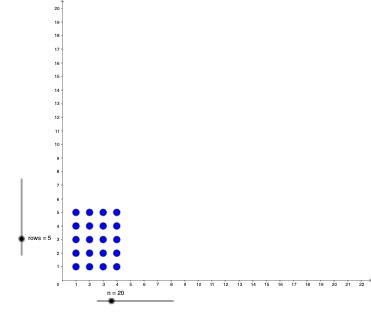
This example demonstrates the factorization of positive integers. Key mathematical concepts include factors, integers, and sequences. Using GeoGebra commands Mod and Sequence, the factor list of positive integers is constructed. Suitable for high-grade elementary and junior high school students to learn about factorization and sequences.
GeoGebra Commands & Parameters
Mod(n, rows) → remSequence(Sequence[(i, j), i, 1, c], j, 1, rows) → l1, {{(1, 1), (2, 1), (3, 1), (4, 1)}, {(1, 2), (2, 2), (3, 2), (4, 2)}, {(1, 3), (2, 3), (3, 3), (4, 3)}, {(1, 4), (2, 4), (3, 4), (4, 4)}, {(1, 5), (2, 5), (3, 5), (4, 5)}}Sequence((floor(c) + 1, i), i, 1, rem) → l2, {}Sequence(Sequence[(i, j), i, 1, c], j, 1, rows) → m1, {{(1, 1), (2, 1), (3, 1), (4, 1)}, {(1, 2), (2, 2), (3, 2), (4, 2)}, {(1, 3), (2, 3), (3, 3), (4, 3)}, {(1, 4), (2, 4), (3, 4), (4, 4)}, {(1, 5), (2, 5), (3, 5), (4, 5)}}
AI Drawing Prompt Reference
Create a visual representation of the factorization of positive integers using points to denote integers and their factors, arranged in rows. The first row shows integers from 1 to c and their factors, subsequent rows display factor pairs for each integer, illustrating clear sequence relationships.
The prompt above was compiled from the original drawing commands and is for reference only.