
Factorization using Special Algebraic Identities
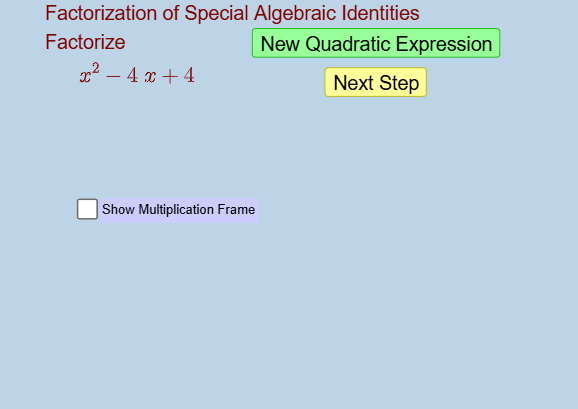
Loading the math board and drawing, please wait…
This example demonstrates how to use GeoGebra for factorizing special algebraic identities like perfect squares and difference of squares. Core math concepts include factorization, perfect square formula, difference of squares formula, and quadratic equations. GeoGebra commands used are RandomElement, Simplify, Factor, If, GCD, Segment, Midpoint, Polygon, and Coefficients. Suitable for high school mathematics education, enhancing understanding and application of algebraic identities.
GeoGebra Commands & Parameters
RandomElement(list1) → bRandomElement(lista) → aSimplify((f1(x) * f2(x))) → fSimplify((f1(x))^(2)) → gFactor(g) → hFactor(f) → pRandomElement({2, 1, 2}) → showIf(show ≟ 1, text1, text2) → textGeneratedExpressionIf(show ≟ 1, text5, text4) → text6GCD(a, b) → hcfSimplify(f1(x) / hcf) → f1gSimplify(f2(x) / hcf) → f2gSimplify((f1g(x))^(2)) → ggFactor(gg) → hgSimplify((f1g(x) * f2g(x))) → fgFactor(fg) → pgSegment(S_1, S_2) → cSegment(S_2, S_3) → dSegment(S_3, S_4) → eSegment(S_4, S_1) → iMidpoint(c) → CMidpoint(d) → DMidpoint(e) → EMidpoint(i) → FSegment(C, E) → jSegment(D, F) → kMidpoint(S_1, C) → GMidpoint(S_1, S_3) → HMidpoint(S_1, H) → IMidpoint(C, S_2) → JMidpoint(C, D) → KMidpoint(S_2, D) → LMidpoint(D, S_3) → MMidpoint(H, S_3) → NMidpoint(S_3, E) → OMidpoint(E, S_4) → PMidpoint(F, E) → QMidpoint(F, S_4) → RMidpoint(F, S_1) → SPolygon(F, H, E, S_4) → poly1, f_1, h_1, e_1, s_4Polygon(C, S_2, D, H) → poly2, c_1, s_2, d_1, h_2Polygon(H, D, S_3, E) → poly3, h_3, d_2, s_3, e_2Polygon(S_1, C, H, F) → poly4, s_1, c_2, h_4, f_2Coefficients(g) → l1GCD(l1) → m