
Factorization of Standard Quadratic Expression Using Multiplication Frame (with
Loading the math board and drawing, please wait…
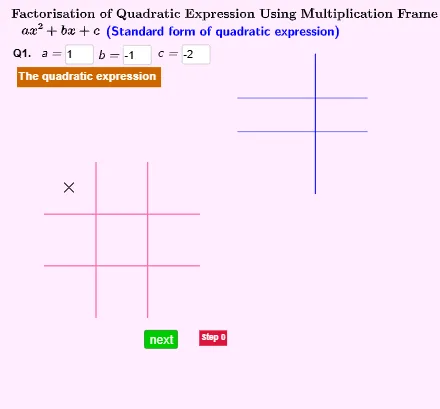
This example demonstrates the factorization of a standard quadratic expression using a multiplication frame, with a step-by-step explanation of the process. It involves core mathematical concepts such as quadratic expression factorization, multiplication, and algebraic operations. The construction utilizes GeoGebra commands like DivisorsList, Factors, Sequence, IndexOf, Element, If, Expand, Textfield, Point, Segment, Text, Vector, Polygon, Circle, CircumcircleArc, and CircleArc. It is suitable for middle school students and above, ideal for initial teacher-led instruction followed by self-directed mastery learning.
GeoGebra Commands & Parameters
DivisorsList(d_.2) → listDivisorsFactors(d_.2) →Sequence(Element[list2, p] + Element[list3, p], p, 1, d) → list4, {-1}IndexOf(b, list4) → poointElement(list3, pooint) → p_.2Factors((a * x^(2)) + (b * x) + c) → m1If(Element[Coefficients[Element[m1, 1, 1]], 1] < Element[Coefficients[Element[m1, 2, 1]], 1], Element[Coefficients[Element[m1, 1, 1]], 2], Element[Coefficients[Element[m1, 2, 1]], 2]) → g_{r1}If(Element[Coefficients[Element[m1, 1, 1]], 1] < Element[Coefficients[Element[m1, 2, 1]], 1], Element[Coefficients[Element[m1, 2, 1]], 1], Element[Coefficients[Element[m1, 1, 1]], 1]) → g_{m1}Element(list2, pooint) → p_.1If(Element[Coefficients[Element[m1, 1, 1]], 1] < Element[Coefficients[Element[m1, 2, 1]], 1], Element[Coefficients[Element[m1, 1, 1]], 1], Element[Coefficients[Element[m1, 2, 1]], 1]) → g_{o1}Expand((g_o * x) + g_r) → g_{f2}If(Element[Coefficients[Element[m1, 1, 1]], 1] < Element[Coefficients[Element[m1, 2, 1]], 1], Element[Coefficients[Element[m1, 2, 1]], 2], Element[Coefficients[Element[m1, 1, 1]], 2]) → g_{n1}Expand((g_m * x) + g_n) → g_{f1}Textfield(a) → InputBox1Textfield(b) → InputBox2Textfield(c) → InputBox3Sequence((4.5, 3 - (p * 1.3)), p, 1, d) → list5_.factors1Sequence((7, 6 - (p * 1.8)), p, 1, d + 3) → list7_.midlinePoint(list7_.midline) → ASegment(C, F) → jSegment(G, H) → kSegment(I, J) → lSegment(K, L) → mSequence(Text[Element[list2, p], Element[list5_.factors1, p]], p, 1, d) → listfactor1Sequence((4.8, 3 - (p * 1.3)), p, 1, d) → list9_.factors2Sequence((7.5, 3 - (p * 1.3)), p, 1, d) → list11_.sumSegment(Element[list7_.midline, 1], Element[list7_.midline, d + 2]) → iSequence((3.8, 3 - (p * 1.3)), p, 1, d) → list13_.brkt1Text("[", Element[list13_.brkt1, pooint]) → text22Sequence((10, 3 - (p * 1.3)), p, 1, d) → list14_.brkt2Text("]", Element[list14_.brkt2, pooint]) → text21Element(list13_.brkt1, pooint) → PKVector(PK, A_1) → wVector(PK, B_1) → nPolygon(U + (-0.2, 0.4), V + (0, 0.4), W, Z + (-0.2, 0)) → poly1, g_1, h_1, p_1, a_1Polygon(C_1 + (-0.2, 0.4), D_1 + (0.1, 0.4), E_1 + (0.1, 0), F_1 + (-0.2, 0)) → poly2, g, s, t, f_1Polygon(G_1, H_1, I_1, J_1) → poly3, g_2, h_2, i_1, j_1Polygon(O_1, P_1, Q_1, R_1) → poly5, o_1, p_2, q_1, r_1Polygon(S_1, T_1, U_1, V_1) → poly6, s_1, t_1, u_1, v_1Polygon(K_1, L_1, M_1, N_1) → poly4, k_1, l_1, m_1, n_1Sequence(Segment[(4, 3.8 - (p * 1.3)), (9, 3.8 - (p * 1.3))], p, 1, d + 1) → listSegmentIf(Defined[rootdiscrim], If[(Numerator[rootdiscrim] / Denominator[rootdiscrim])^(2) ≟ rootdiscrim^(2), true, false], false) → isrootrationalCircle(W_1, 0.8) → eCircle(Z_1, 0.9) → fSequence(Text[" × " + (Element[list3, p]), Element[list9_.factors2, p]], p, 1, d) → listFactor2Sequence(Text[Element[list2, p] + " + " + (Element[list3, p]) + " = " + (Element[list4, p]), Element[list11_.sum, p]], p, 1, d) → listSumCircumcircleArc(M + (0.3, -0.5), Midpoint[M + (0.6, 0), P + (0.6, 0)], P + (0.5, 0)) → hCircleArc(P + (8, -6), M - (0, 0.3), O + (1.5, -0.4)) → pPoint(p) → B_2CircumcircleArc(M + (0.3, -0.5), Midpoint[M + (1.2, 0), S + (1.2, 0)], S + (0.5, 0)) → qCircumcircleArc(M - (0, 0.4), O + (0.3, 0), R + (0.5, -0.05)) → r
AI Drawing Prompt Reference
Draw a factorization diagram for a standard quadratic expression, showing the step-by-step process. Include a multiplication frame to illustrate the factorization, displaying coefficients and results. Connect elements with points and lines to form a geometric representation. Start with the multiplication frame and intermediate steps, then show the final factorization and geometric shapes, emphasizing mathematical concepts and relationships.
The prompt above was compiled from the original drawing commands and is for reference only.