
Exterior Angles of Polygons Demo by Anthony OR 柯志明
Loading the math board and drawing, please wait…
In collections
GCSE Higher Ch5 Angles & Trigonometry
Angles in polygons
PDGE Year 1: Making Use of ICT Resources
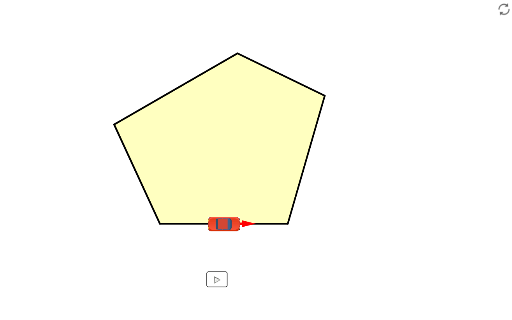
This example visually demonstrates the properties of exterior angles in polygons by simulating a car turning at each vertex. It covers core concepts like exterior angles, interior angles, and the sum of interior angles theorem. GeoGebra commands used include Rotate, Polygon, Vector, and Angle. Suitable for middle school and above students to grasp spatial geometry relationships.
GeoGebra Commands & Parameters
Rotate((x(P1) + (x(A) - x(E)) / Distance[E, A], y(P1) + (y(A) - y(E)) / Distance[E, A]), (Min[Max[t - 1, 0], 1] * (180° - Angle[B, A, E])), P1) → P1'Rotate((x(P2) + (x(B) - x(A)) / Distance[A, B], y(P2) + (y(B) - y(A)) / Distance[A, B]), (Min[Max[t - 3, 0], 1] * (180° - Angle[C, B, A])), P2) → P2'Rotate((x(P3) + (x(C) - x(B)) / Distance[B, C], y(P3) + (y(C) - y(B)) / Distance[B, C]), (Min[Max[t - 5, 0], 1] * (180° - Angle[D, C, B])), P3) → P3'Rotate((x(P4) + (x(D) - x(C)) / Distance[C, D], y(P4) + (y(D) - y(C)) / Distance[C, D]), (Min[Max[t - 7, 0], 1] * (180° - Angle[E, D, C])), P4) → P4'Rotate((x(P5) + (x(E) - x(D)) / Distance[E, D], y(P5) + (y(E) - y(D)) / Distance[E, D]), (Min[Max[t - 9, 0], 1] * (180° - Angle[A, E, D])), P5) → P5'Polygon(E, A, B, C, D) → poly1, a_1, b_1, c_1, d_1, e_1If(t ≤ 2, P1, If[t ≤ 4, P2, If[t ≤ 6, P3, If[t ≤ 8, P4, If[t ≤ 10, P5, P6]]]]) → PIf(t ≤ 2, P1', If[t ≤ 4, P2', If[t ≤ 6, P3', If[t ≤ 8, P4', If[t ≤ 10, P5', P6']]]]) → P'Vector(P, P') → uAngle(P1', P1, (x(P1) + (x(A) - x(E)) / Distance[E, A], y(P1) + (y(A) - y(E)) / Distance[E, A])) → αAngle(P2', P2, (x(P2) + (x(B) - x(A)) / Distance[A, B], y(P2) + (y(B) - y(A)) / Distance[A, B])) → βAngle(P3', P3, (x(P3) + (x(C) - x(B)) / Distance[B, C], y(P3) + (y(C) - y(B)) / Distance[B, C])) → γAngle(P4', P4, (x(P4) + (x(D) - x(C)) / Distance[C, D], y(P4) + (y(D) - y(C)) / Distance[C, D])) → δAngle(P5', P5, (x(P5) + (x(E) - x(D)) / Distance[E, D], y(P5) + (y(E) - y(D)) / Distance[E, D])) → εOrthogonalLine(P, u) → fPoint(f) → FMidpoint(F, P') → GVector(G, P) → vTranslate(P, v) → P'_1Translate(P', v) → P''Midpoint(a_1) → OSegment(A, A + ((1.5 * r) * UnitVector[Segment[E, A]])) → gSegment(B, B + ((1.5 * r) * UnitVector[Segment[A, B]])) → hSegment(C, C + ((1.5 * r) * UnitVector[Segment[B, C]])) → iSegment(D, D + ((1.5 * r) * UnitVector[Segment[C, D]])) → jSegment(E, E + ((1.5 * r) * UnitVector[Segment[D, E]])) → kAngle((x(A) + (x(A) - x(E)) / Distance[E, A], y(A) + (y(A) - y(E)) / Distance[E, A]), A, B) → aAngle((x(B) + (x(B) - x(A)) / Distance[A, B], y(B) + (y(B) - y(A)) / Distance[A, B]), B, C) → bAngle((x(C) + (x(C) - x(B)) / Distance[B, C], y(C) + (y(C) - y(B)) / Distance[B, C]), C, D) → cAngle((x(D) + (x(D) - x(C)) / Distance[C, D], y(D) + (y(D) - y(C)) / Distance[C, D]), D, E) → dAngle((x(E) + (x(E) - x(D)) / Distance[D, E], y(E) + (y(E) - y(D)) / Distance[D, E]), E, A) → eCircleSector(C, If[c ≤ 180°, C + (r * UnitVector[Segment[B, C]]), C + (r * UnitVector[Segment[C, D]])], If[c ≤ 180°, D, C + (r * UnitVector[Segment[B, C]])]) → c'CircleSector(A, If[a ≤ 180°, A + (r * UnitVector[Segment[E, A]]), A + (r * UnitVector[Segment[A, B]])], If[a ≤ 180°, B, A + (r * UnitVector[Segment[E, A]])]) → a'CircleSector(B, If[b ≤ 180°, B + (r * UnitVector[Segment[A, B]]), B + (r * UnitVector[Segment[B, C]])], If[b ≤ 180°, C, B + (r * UnitVector[Segment[A, B]])]) → b'CircleSector(D, If[d ≤ 180°, D + (r * UnitVector[Segment[C, D]]), D + (r * UnitVector[Segment[D, E]])], If[d ≤ 180°, E, D + (r * UnitVector[Segment[C, D]])]) → d'CircleSector(E, If[e ≤ 180°, E + (r * UnitVector[Segment[D, E]]), E + (r * UnitVector[Segment[E, A]])], If[e ≤ 180°, A, E + (r * UnitVector[Segment[D, E]])]) → e'Corner(1) → ICorner(3) → JCorner(5) → pixelnosIf(s ≤ 0.5, (-8 * (1 - (2 * s))) - (80 * s), (-40 * (1 - (2 * (s - 0.5)))) - (1120 * (s - 0.5))) → xminIf(s ≤ 0.5, (-5 * (1 - (2 * s))) - (50 * s), (-25 * (1 - (2 * (s - 0.5)))) - (700 * (s - 0.5))) → yminIf(a + b + c + d + e ≟ 360°, true, false) → convex