
Exploring the Tangent of a Sum
Loading the math board and drawing, please wait…
In collections
Trigonometric Identities
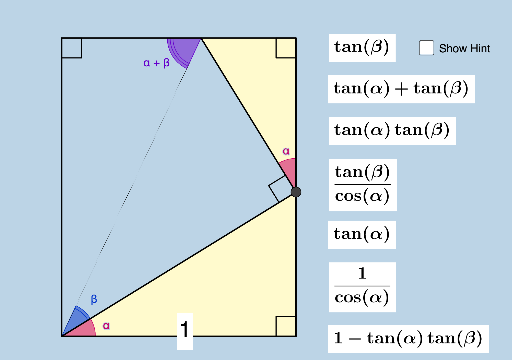
This example uses an interactive puzzle and proof to explore the tangent of a sum of two angles. Key mathematical concepts include trigonometry and sum of angles formulas. GeoGebra commands such as Point, OrthogonalLine, and Ray are used for geometric construction. Suitable for high school mathematics education and learning.
GeoGebra Commands & Parameters
Point(a) → APoint(b) → BOrthogonalLine(B, a) → fPoint(a) → DRay(A, D) → gPoint(g) → ESegment(B, E) → hOrthogonalLine(E, b) → iIntersect(a, f) → FSegment(A, F) → jSegment(B, F) → kOrthogonalLine(E, b) → lIntersect(b, l) → HSegment(B, H) → nAngle(E, F, B) → βSegment(A, E) → sSegment(E, F) → tPoint(t) → CSegment(B, C) → cOrthogonalLine(C, c) → dOrthogonalLine(E, t) → eIntersect(d, e) → GSegment(B, G) → mSegment(G, C) → pAngle(G, C, B) → αAngle(B, H, G) → γSegment(H, E) → qAngle(F, B, C) → δAngle(C, B, G) → εAngle(H, G, B) → ζAngle(E, C, G) → ηAngle(H, E, F) → θSegment(H, G) → rSegment(G, E) → a_1Segment(E, C) → b_1Segment(C, F) → c_1Distance(B, C) → distanceBCDistance(B, G) → distanceBGAngle(C, G, E) → ιPolygon(B, F, C) → poly1, c_2, b_2, f_1Polygon(C, E, G) → poly2, g_1, c_3, e_1Segment(H, B) → d_1Segment(H, G) → h_1Segment(G, E) → i_1Segment(E, C) → j_1Segment(C, F) → k_1Segment(F, B) → l_1Segment(B, C) → m_1Segment(C, G) → n_1Segment(G, B) → p_1Distance(B, F) → distanceBF