
Exploring Perpendicular Lines and Their Gradients
Loading the math board and drawing, please wait…
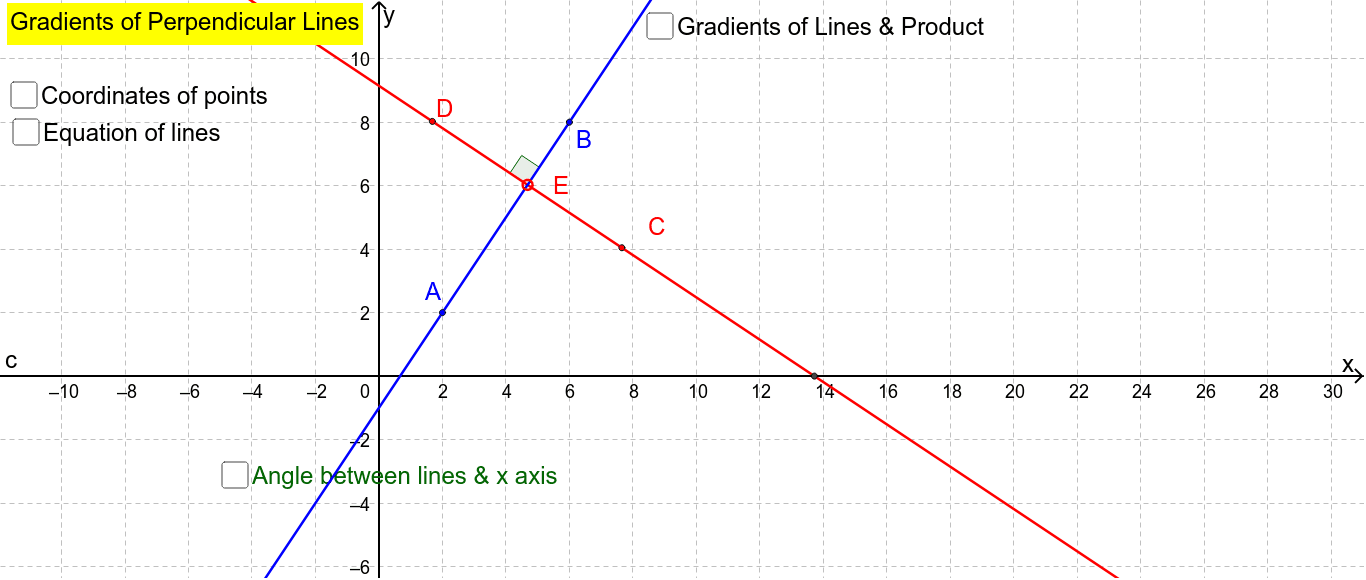
This example demonstrates the relationship between two perpendicular lines and their gradients. Key math concepts include angles, straight lines, slopes, and the properties of perpendicular lines. It utilizes GeoGebra commands/objects like Line, Point, Intersect, Angle, Slope, and OrthogonalLine. Suitable for high school mathematics students to understand the properties of perpendicular lines in analytical geometry and for related teaching demonstrations.
GeoGebra Commands & Parameters
Line(A, B) → aPoint(a) → EIntersect(f, g) →Intersect(a, c) → F_1Point(f) → HAngle(c, a) → αPoint(f) → ISlope(a) → m_1Intersect(a, yAxis) → FOrthogonalLine(E, a) → dAngle(d, a) → γPoint(d) → CPoint(d) → DLine(C, D) → eSlope(e) → m_2Intersect(e, c) → LAngle(c, e) → βIntersect(e, yAxis) → D_1Line(A, B) → a_1
AI Drawing Prompt Reference
Draw two perpendicular lines and mark their intersection point and points where they meet the coordinate axes. Take a point on the first line, draw a perpendicular line through this point, marking the foot of the perpendicular and the intersection point with the second line. Measure and display the angle between the two lines, calculate and label their slopes, and observe whether their product is -1.
The prompt above was compiled from the original drawing commands and is for reference only.